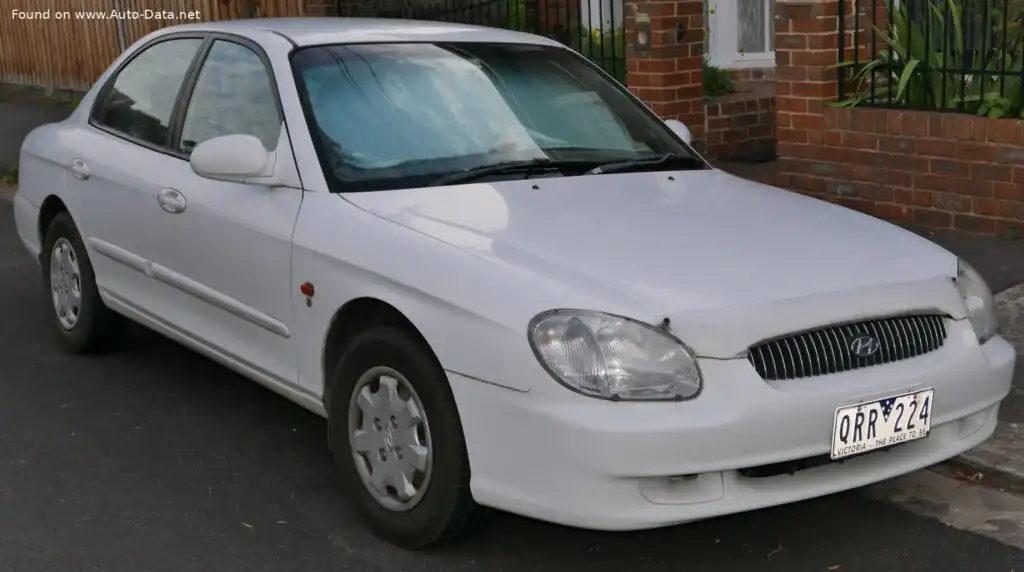
The Hyundai Sonata IV (EF) 1.8, produced between 1998 and 2001, represented a significant step forward for the South Korean automaker in the mid-size sedan segment. Positioned as an entry-level offering within the EF Sonata range, it provided a more affordable alternative to the higher-trim 2.0L and 2.4L models. The EF generation, internally designated as the 1HX0, was crucial in establishing Hyundai’s reputation for value and reliability in the North American market, and the 1.8L variant played a key role in attracting budget-conscious buyers. This model aimed to deliver a comfortable and practical driving experience, prioritizing fuel efficiency and ease of maintenance over outright performance.
Technical Specifications
| Brand | Hyundai |
| Model | Sonata |
| Generation | Sonata IV (EF) |
| Type (Engine) | 1.8 (133 Hp) |
| Start of production | 1998 |
| End of production | 2001 |
| Powertrain Architecture | Internal Combustion engine |
| Body type | Sedan |
| Seats | 5 |
| Doors | 4 |
| Fuel Type | Petrol (Gasoline) |
| Weight-to-power ratio | 9.8 kg/Hp, 101.5 Hp/tonne |
| Weight-to-torque ratio | 7.8 kg/Nm, 129 Nm/tonne |
| Power | 133 Hp @ 6000 rpm |
| Power per litre | 72.4 Hp/l |
| Torque | 169 Nm @ 4500 rpm (124.65 lb.-ft. @ 4500 rpm) |
| Engine layout | Front, Transverse |
| Engine displacement | 1836 cm3 (112.04 cu. in.) |
| Number of cylinders | 4 |
| Engine configuration | Inline |
| Cylinder Bore | 81.5 mm (3.21 in.) |
| Piston Stroke | 88 mm (3.46 in.) |
| Number of valves per cylinder | 4 |
| Fuel injection system | Multi-port manifold injection |
| Engine aspiration | Naturally aspirated engine |
| Valvetrain | DOHC |
| Kerb Weight | 1310 kg (2888.06 lbs.) |
| Trunk (boot) space – minimum | 396 l (13.98 cu. ft.) |
| Fuel tank capacity | 65 l (17.17 US gal | 14.3 UK gal) |
| Length | 4710 mm (185.43 in.) |
| Width | 1818 mm (71.57 in.) |
| Height | 1410 mm (55.51 in.) |
| Wheelbase | 2700 mm (106.3 in.) |
| Front track | 1540 mm (60.63 in.) |
| Rear (Back) track | 1520 mm (59.84 in.) |
| Drag coefficient (Cd) | 0.32 |
| Minimum turning circle (turning diameter) | 10.5 m (34.45 ft.) |
| Drivetrain Architecture | The Internal combustion engine (ICE) drives the front wheels of the vehicle. |
| Drive wheel | Front wheel drive |
| Number of gears and type of gearbox | 5 gears, manual transmission |
| Front suspension | Independent, type McPherson with coil spring and anti-roll bar |
| Rear suspension | Independent multi-link suspension |
| Front brakes | Ventilated discs |
| Rear brakes | Disc |
| Assisting systems | ABS (Anti-lock braking system) |
| Steering type | Steering rack and pinion |
| Power steering | Hydraulic Steering |
| Tires size | 195/70 R14 |
| Wheel rims size | 14 |
Powertrain & Engine Architecture
The heart of the Sonata IV 1.8 was the Hyundai G4EH engine, a 1.8-liter inline-four cylinder powerplant. This engine utilized a multi-port fuel injection (MPI) system, delivering fuel directly into the intake ports for improved combustion efficiency. The engine featured a double overhead camshaft (DOHC) valvetrain, operating 16 valves (four per cylinder) to optimize airflow and enhance performance. The G4EH engine was known for its relatively simple design, contributing to its reliability and ease of maintenance. The 5-speed manual transmission was the standard offering, providing drivers with direct control over the engine’s power. The engine’s 133 horsepower at 6000 rpm and 169 Nm (124.65 lb-ft) of torque at 4500 rpm were respectable for its class, but noticeably less than the 2.0L and 2.4L variants.
Driving Characteristics
The 1.8L Sonata offered a comfortable, albeit not particularly sporty, driving experience. The 5-speed manual transmission allowed for reasonable acceleration, but the engine’s limited torque meant that frequent downshifting was often necessary, especially when tackling hills or overtaking. Compared to the more powerful Sonata trims, the 1.8 felt less responsive and required more effort to maintain speed. The gear ratios were tuned for fuel economy rather than outright performance. The suspension, while providing a comfortable ride, wasn’t particularly engaging, leaning towards a softer setup designed to absorb bumps and imperfections in the road. The front-wheel-drive configuration provided predictable handling, but lacked the dynamic capabilities of rear-wheel-drive alternatives.
Equipment & Trim Levels
The 1.8L Sonata typically came with a fairly basic level of standard equipment. Interior features generally included cloth upholstery, manual air conditioning, and a basic audio system. Power windows and door locks were often included, but features like cruise control and alloy wheels were typically reserved for higher trim levels. Optional extras included a sunroof, upgraded audio systems, and power seats. The interior design was functional and straightforward, prioritizing practicality over luxury. The dashboard layout was clean and easy to navigate, with clearly labeled controls.
Chassis & Braking
The Sonata IV utilized an independent McPherson strut suspension in the front, providing a comfortable ride and decent handling characteristics. The rear suspension employed an independent multi-link setup, further enhancing ride quality and stability. Braking duties were handled by ventilated discs in the front and solid discs in the rear. Anti-lock Braking System (ABS) was standard, enhancing safety by preventing wheel lockup during hard braking. The steering system was a rack-and-pinion setup with hydraulic power assistance, providing responsive and precise steering feel. The standard tire size was 195/70 R14, mounted on 14-inch steel wheels.
Market Reception & Comparison
The Hyundai Sonata IV 1.8 was generally well-received by critics as a value-oriented option in the mid-size sedan segment. It was praised for its affordability, spacious interior, and comfortable ride. However, it was often criticized for its lack of performance compared to its competitors and higher-trim Sonata models. Compared to the 2.0L and 2.4L Sonatas, the 1.8 offered significantly lower fuel economy, but also a lower purchase price. Reliability was generally considered good, although some owners reported minor issues with the fuel injection system and cooling system. The 1.8L variant appealed to buyers who prioritized practicality and affordability over performance and luxury.
Legacy
The Hyundai Sonata IV 1.8, while not the most powerful or technologically advanced version of the EF Sonata, played a crucial role in establishing Hyundai as a viable competitor in the North American market. Its affordability and reliability made it a popular choice among budget-conscious buyers. Today, these vehicles are relatively common in the used car market, often prized for their low running costs and simple mechanical design. While finding well-maintained examples can be challenging due to their age, the G4EH engine is known for its durability and longevity, making it a relatively reliable choice for those seeking an affordable and practical used car. Parts availability remains reasonably good, further contributing to its appeal as a budget-friendly transportation option.