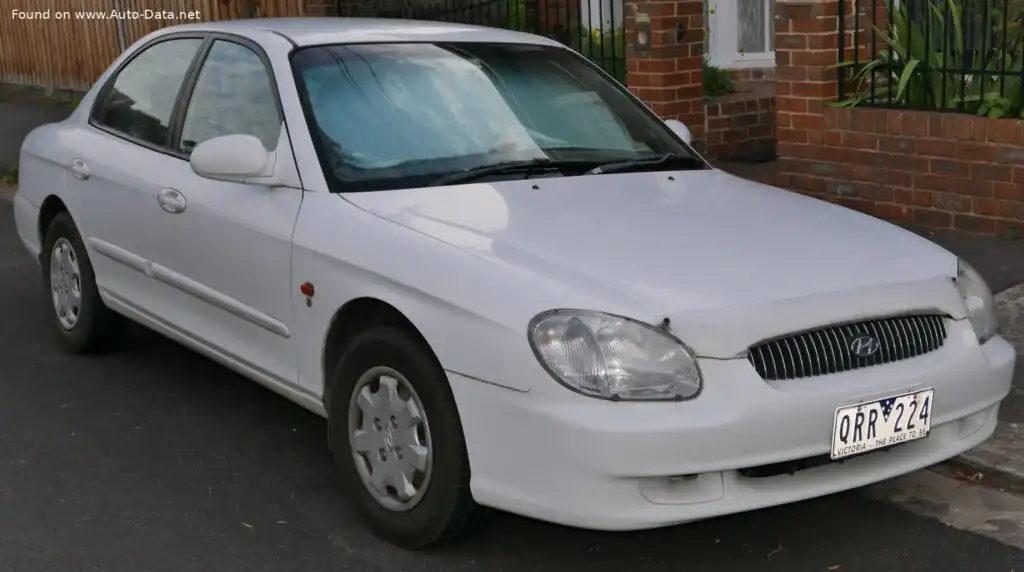
The Hyundai Sonata IV (EF) 2.5 V6 Automatic, produced between 1998 and 2001, represented a significant step forward for the South Korean automaker in the mid-size sedan segment. Positioned as a near-premium offering within the EF Sonata range, this variant aimed to attract buyers seeking a blend of comfort, performance, and value. It was a key model in Hyundai’s efforts to establish a stronger foothold in the North American market, offering a compelling alternative to established Japanese and American competitors. The EF Sonata, as a whole, was built on the Hyundai’s then-new platform, offering increased interior space and improved refinement over its predecessor.
Technical Specifications
| Brand | Hyundai |
| Model | Sonata |
| Generation | Sonata IV (EF) |
| Type (Engine) | 2.5 V6 (175 Hp) Automatic |
| Start of production | 1998 year |
| End of production | 2001 year |
| Powertrain Architecture | Internal Combustion engine |
| Body type | Sedan |
| Seats | 5 |
| Doors | 4 |
| Fuel Type | Petrol (Gasoline) |
| Weight-to-power ratio | 7.8 kg/Hp, 127.7 Hp/tonne |
| Weight-to-torque ratio | 6 kg/Nm, 167.9 Nm/tonne |
| Power | 175 Hp @ 6000 rpm |
| Power per litre | 70.2 Hp/l |
| Torque | 230 Nm @ 4000 rpm, 169.64 lb.-ft. @ 4000 rpm |
| Engine layout | Front, Transverse |
| Engine Model/Code | Delta / G6BV |
| Engine displacement | 2494 cm3, 152.19 cu. in. |
| Number of cylinders | 6 |
| Engine configuration | V-engine |
| Cylinder Bore | 84 mm, 3.31 in. |
| Piston Stroke | 75 mm, 2.95 in. |
| Compression ratio | 10:1 |
| Number of valves per cylinder | 4 |
| Fuel injection system | Multi-port manifold injection |
| Engine aspiration | Naturally aspirated engine |
| Valvetrain | DOHC |
| Engine oil capacity | 4.5 l, 4.76 US qt | 3.96 UK qt |
| Kerb Weight | 1370 kg, 3020.33 lbs |
| Trunk (boot) space – minimum | 396 l, 13.98 cu. ft |
| Fuel tank capacity | 65 l, 17.17 US gal | 14.3 UK gal |
| Length | 4710 mm, 185.43 in |
| Width | 1818 mm, 71.57 in |
| Height | 1410 mm, 55.51 in |
| Wheelbase | 2700 mm, 106.3 in |
| Front track | 1540 mm, 60.63 in |
| Rear (Back) track | 1520 mm, 59.84 in |
| Drag coefficient (Cd) | 0.32 |
| Minimum turning circle (turning diameter) | 10.5 m, 34.45 ft |
| Drivetrain Architecture | The Internal combustion engine (ICE) drives the front wheels of the vehicle. |
| Drive wheel | Front wheel drive |
| Number of gears and type of gearbox | 4 gears, automatic transmission |
| Front suspension | Independent, type McPherson with coil spring and anti-roll bar |
| Rear suspension | Independent multi-link suspension |
| Front brakes | Ventilated discs |
| Rear brakes | Disc |
| Assisting systems | ABS (Anti-lock braking system) |
| Steering type | Steering rack and pinion |
| Power steering | Hydraulic Steering |
| Tires size | 205/60 R15 |
| Wheel rims size | 15 |
Powertrain & Engine Architecture
The heart of the Sonata 2.5 V6 was the Hyundai Delta engine, specifically the G6BV code. This 2.5-liter, 60-degree V6 engine featured a double overhead camshaft (DOHC) valvetrain with four valves per cylinder. The engine utilized a multi-port fuel injection (MPI) system, delivering fuel directly to each intake port for improved combustion efficiency. The 10:1 compression ratio was a standard figure for the time, balancing performance and fuel economy. Paired with this engine was a four-speed automatic transmission, designed for smooth and comfortable shifts. This transmission, while not offering the sportiness of a manual, was well-suited to the car’s intended role as a comfortable family sedan. The engine’s design prioritized smooth operation and reasonable power output over outright performance.
Driving Characteristics
The 175 horsepower and 230 Nm (169.64 lb-ft) of torque provided by the 2.5 V6 and automatic transmission combination delivered adequate, though not exhilarating, performance. Acceleration from 0 to 60 mph was typically in the 9-10 second range. The automatic transmission’s gear ratios were tuned for fuel efficiency and smooth cruising, rather than aggressive acceleration. Compared to the base 2.0-liter four-cylinder Sonata, the V6 offered a noticeable improvement in power and responsiveness, particularly when merging onto highways or climbing hills. However, it didn’t match the performance of the later, more powerful V6 options available in subsequent Sonata generations. The automatic transmission, while reliable, could feel somewhat sluggish during quick downshifts.
Equipment & Trim Levels
The 2.5 V6 Automatic trim generally represented a step up in features compared to the base Sonata models. Standard equipment typically included air conditioning, power windows and locks, a CD player, and cloth upholstery. Higher trim levels, often denoted by “GLS” or similar designations, added features such as a sunroof, upgraded audio systems, alloy wheels, and leather upholstery. Optional extras could include a power driver’s seat, cruise control, and upgraded interior trim. The interior design was functional and relatively spacious, prioritizing comfort and practicality over luxury.
Chassis & Braking
The EF Sonata utilized an independent suspension setup, with McPherson struts at the front and a multi-link suspension at the rear. This configuration provided a comfortable ride quality, absorbing bumps and irregularities in the road surface effectively. The front brakes were ventilated discs, offering good stopping power, while the rear brakes were solid discs. Anti-lock braking system (ABS) was standard, enhancing safety by preventing wheel lockup during hard braking. The steering was rack-and-pinion with hydraulic power assistance, providing a reasonably responsive and easy-to-use steering feel. The standard tire size was 205/60 R15, mounted on 15-inch steel or alloy wheels.
Market Reception & Comparison
The Sonata 2.5 V6 Automatic was generally well-received by automotive critics as a solid and reliable mid-size sedan. It was praised for its spacious interior, comfortable ride, and competitive price point. However, some reviewers noted that the engine lacked the refinement and power of some of its Japanese competitors. Fuel economy was considered average for the class. Compared to the four-cylinder Sonata, the V6 offered a significant improvement in performance, but at a higher price. Compared to other V6-powered sedans, such as the Honda Accord or Toyota Camry, the Sonata offered a more affordable option, but with slightly less refinement and performance.
Legacy
The Hyundai Sonata IV (EF) 2.5 V6 Automatic proved to be a reliable and durable vehicle. The Delta engine, while not known for being particularly high-performance, was generally robust and capable of lasting for many years with proper maintenance. The automatic transmission also proved to be relatively trouble-free. Today, these Sonatas are relatively affordable on the used car market, making them a practical choice for budget-conscious buyers. While not a collector’s item, the EF Sonata represents an important milestone in Hyundai’s history, demonstrating the company’s growing ability to compete with established automakers in the global market. Parts availability remains reasonably good, and the car’s simple mechanical design makes it relatively easy to maintain and repair.