Technical Specifications
| Brand | Hyundai |
| Model | Sonata |
| Generation | Sonata IV (EF, facelift 2001) |
| Type (Engine) | 2.0 16V GLS (131 Hp) Automatic |
| Start of production | 2001 |
| End of production | 2004 |
| Powertrain Architecture | Internal Combustion engine |
| Body type | Sedan |
| Seats | 5 |
| Doors | 4 |
| Fuel consumption (urban) | 13.4 l/100 km (17.6 US mpg, 21.1 UK mpg, 7.5 km/l) |
| Fuel consumption (extra urban) | 7.3 l/100 km (32.2 US mpg, 38.7 UK mpg, 13.7 km/l) |
| Fuel consumption (combined) | 9.5 l/100 km (24.8 US mpg, 29.7 UK mpg, 10.5 km/l) |
| Fuel Type | Petrol (Gasoline) |
| Acceleration 0 – 100 km/h | 13.2 sec |
| Acceleration 0 – 62 mph | 13.2 sec |
| Acceleration 0 – 60 mph | 12.5 sec |
| Maximum speed | 184 km/h (114.33 mph) |
| Emission standard | Euro 3 |
| Weight-to-power ratio | 11 kg/Hp, 90.7 Hp/tonne |
| Weight-to-torque ratio | 8.1 kg/Nm, 123.2 Nm/tonne |
| Power | 131 Hp @ 6000 rpm |
| Power per litre | 65.6 Hp/l |
| Torque | 178 Nm @ 4500 rpm (131.29 lb.-ft. @ 4500 rpm) |
| Engine layout | Front, Transverse |
| Engine Model/Code | Sirius II / G4JP |
| Engine displacement | 1997 cm3 (121.86 cu. in.) |
| Number of cylinders | 4 |
| Engine configuration | Inline |
| Cylinder Bore | 85 mm (3.35 in.) |
| Piston Stroke | 88 mm (3.46 in.) |
| Compression ratio | 10:1 |
| Number of valves per cylinder | 4 |
| Fuel injection system | Multi-port manifold injection |
| Engine aspiration | Naturally aspirated engine |
| Valvetrain | DOHC |
| Engine oil capacity | 4.3 l (4.54 US qt | 3.78 UK qt) |
| Coolant capacity | 6 l (6.34 US qt | 5.28 UK qt) |
| Kerb Weight | 1445 kg (3185.68 lbs.) |
| Max. weight | 2020 kg (4453.34 lbs.) |
| Max load | 575 kg (1267.66 lbs.) |
| Trunk (boot) space – minimum | 430 l (15.19 cu. ft.) |
| Fuel tank capacity | 65 l (17.17 US gal | 14.3 UK gal) |
| Length | 4747 mm (186.89 in.) |
| Width | 1820 mm (71.65 in.) |
| Height | 1422 mm (55.98 in.) |
| Wheelbase | 2700 mm (106.3 in.) |
| Front track | 1540 mm (60.63 in.) |
| Rear (Back) track | 1530 mm (60.24 in.) |
| Drag coefficient (Cd) | 0.32 |
| Minimum turning circle | 11.2 m (36.75 ft.) |
| Drivetrain Architecture | ICE, Front wheel drive |
| Drive wheel | Front wheel drive |
| Number of gears | 4 |
| Gearbox type | automatic transmission |
| Front suspension | Independent, McPherson with coil spring and anti-roll bar |
| Rear suspension | Independent multi-link suspension |
| Front brakes | Ventilated discs |
| Rear brakes | Disc |
| Assisting systems | ABS (Anti-lock braking system) |
| Steering type | Steering rack and pinion |
| Power steering | Hydraulic |
| Tires size | 205/65 R15 |
| Wheel rims size | 15 |
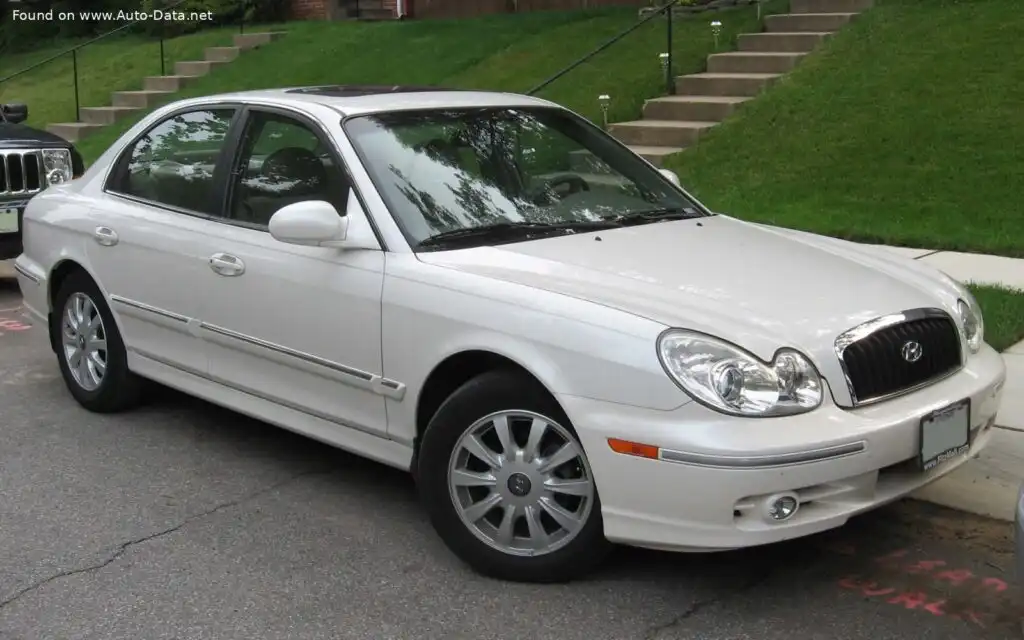
The Hyundai Sonata IV (EF series), particularly the facelifted version introduced in 2001, marked a significant advancement for Hyundai in the mid-size sedan segment. Produced from 2001 to 2004, the 2.0 16V GLS model with the automatic transmission became a popular choice for buyers seeking a comfortable, well-equipped, and affordable family car. This variant occupied a mid-range position within the EF Sonata lineup, balancing performance and economy, positioned below the more powerful 2.5L V6 models and above the base 2.0L manual transmission options. The EF Sonata was instrumental in establishing Hyundai’s reputation for value and reliability in the North American market, and this 2.0L automatic configuration was a key volume seller.
Powertrain & Engine Architecture
The 2.0 GLS automatic Sonata was powered by the Hyundai Sirius II engine, designated G4JP. This 1.997-liter inline-four cylinder engine featured a double overhead camshaft (DOHC) valvetrain with four valves per cylinder, contributing to its respectable power output for its displacement. The engine utilized a multi-port fuel injection (MPI) system, delivering fuel directly into the intake ports for efficient combustion. The Sirius II engine was known for its relatively smooth operation and decent reliability. The automatic transmission paired with this engine was a conventional four-speed unit. While not the most technologically advanced transmission, it provided smooth shifts and contributed to the Sonata’s comfortable driving experience. The transmission was tuned for fuel efficiency and ease of use, rather than outright performance.
Driving Characteristics
The 2.0L automatic Sonata offered a comfortable and predictable driving experience. With 131 horsepower and 178 Nm (131 lb-ft) of torque, acceleration was adequate for everyday driving, but not particularly brisk. The 0-60 mph time of around 12.5 seconds reflects this. The four-speed automatic transmission, while smooth, lacked the responsiveness of more modern transmissions or manual gearboxes. Gear ratios were optimized for fuel economy, meaning the engine often felt strained during quick acceleration or when climbing hills. Compared to the 2.5L V6 Sonata, the 2.0L automatic was noticeably slower, but it offered significantly better fuel economy. The suspension provided a comfortable ride, absorbing bumps and imperfections in the road well. Steering was light and easy, making it well-suited for city driving.
Equipment & Trim Levels
The GLS trim level of the 2001-2004 Sonata offered a good level of standard equipment. Typically, this included air conditioning, power windows and locks, a CD player, and cloth upholstery. Higher trim levels added features like a sunroof, leather seats, and upgraded audio systems. The 2.0L GLS automatic often came standard with alloy wheels, though this could vary depending on regional specifications. Optional extras included a power driver’s seat, cruise control, and an upgraded sound system. The interior design was functional and straightforward, prioritizing usability over luxury.
Chassis & Braking
The Sonata IV utilized an independent suspension setup, with McPherson struts at the front and a multi-link system at the rear. This configuration provided a good balance of ride comfort and handling. The front brakes were ventilated discs, offering good stopping power, while the rear brakes were solid discs. Anti-lock Braking System (ABS) was standard, enhancing safety. The chassis was relatively lightweight for its class, contributing to its decent fuel economy. The steering system was a rack-and-pinion setup with hydraulic power assistance, providing light and easy steering feel.
Market Reception & Comparison
The 2.0L automatic Sonata was well-received by consumers and critics alike, particularly for its value proposition. It offered a spacious interior, a comfortable ride, and a good level of standard equipment at a competitive price point. Fuel economy was a strong point, making it an attractive option for budget-conscious buyers. Compared to rivals like the Toyota Camry and Honda Accord, the Sonata offered similar features and performance at a lower price. However, it wasn’t as refined or sporty as those Japanese competitors. Reliability was generally good, though some owners reported minor issues with the automatic transmission over time.
Legacy
The Hyundai Sonata IV, and specifically the 2.0L GLS automatic variant, played a pivotal role in transforming Hyundai’s image in the automotive market. It demonstrated that Hyundai could build a reliable, well-equipped, and affordable mid-size sedan that could compete with established Japanese and American brands. Today, these Sonatas are often found on the used car market, offering a budget-friendly transportation option. The Sirius II engine and four-speed automatic transmission have proven to be reasonably durable, though regular maintenance is essential. While not a performance icon, the 2.0L automatic Sonata remains a practical and dependable choice for those seeking a comfortable and economical used car.