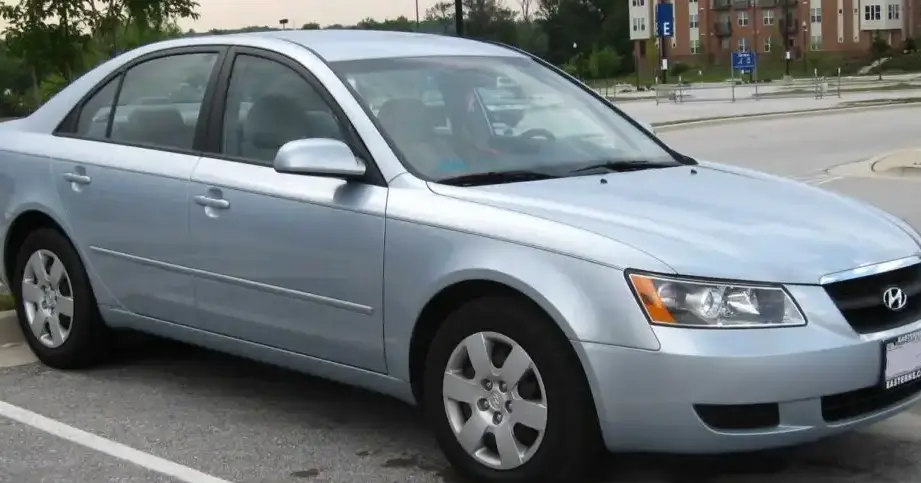
The Hyundai Sonata V (NF) 2.0 CRDi 16V, produced between 2006 and 2008, represented a significant step forward for Hyundai in the mid-size sedan segment. Part of the fifth generation Sonata (NF), this variant was primarily aimed at the European market, offering a diesel-powered option that prioritized fuel efficiency and torque. It occupied a middle ground within the NF lineup, positioned between the base gasoline models and the more powerful, often higher-trim, gasoline variants. The NF generation itself was a departure for Hyundai, showcasing a more refined design and improved build quality compared to its predecessors, and the 2.0 CRDi aimed to deliver a compelling package for diesel buyers.
Technical Specifications
| Brand | Hyundai |
| Model | Sonata |
| Generation | Sonata V (NF) |
| Type (Engine) | 2.0 CRDi 16V (140 Hp) |
| Start of production | 2006 |
| End of production | 2008 |
| Powertrain Architecture | Internal Combustion engine |
| Body type | Sedan |
| Seats | 5 |
| Doors | 4 |
| Fuel consumption (urban) | 8.2 l/100 km (28.7 US mpg, 34.4 UK mpg, 12.2 km/l) |
| Fuel consumption (extra urban) | 5 l/100 km (47 US mpg, 56.5 UK mpg, 20 km/l) |
| Fuel consumption (combined) | 6.1 l/100 km (38.6 US mpg, 46.3 UK mpg, 16.4 km/l) |
| Fuel Type | Diesel |
| Acceleration 0 – 100 km/h | 10.7 sec |
| Acceleration 0 – 62 mph | 10.7 sec |
| Acceleration 0 – 60 mph | 10.2 sec |
| Maximum speed | 203 km/h (126.14 mph) |
| Emission standard | Euro 4 |
| Weight-to-power ratio | 11.4 kg/Hp, 88.1 Hp/tonne |
| Weight-to-torque ratio | 5.2 kg/Nm, 191.8 Nm/tonne |
| Power | 140 Hp @ 4000 rpm |
| Power per litre | 70.3 Hp/l |
| Torque | 305 Nm @ 1800-2500 rpm (224.96 lb.-ft. @ 1800-2500 rpm) |
| Engine layout | Front, Transverse |
| Engine Model/Code | D4EA |
| Engine displacement | 1991 cm3 (121.5 cu. in.) |
| Number of cylinders | 4 |
| Engine configuration | Inline |
| Cylinder Bore | 83 mm (3.27 in.) |
| Piston Stroke | 92 mm (3.62 in.) |
| Compression ratio | 17.3:1 |
| Number of valves per cylinder | 4 |
| Fuel injection system | Diesel Commonrail |
| Engine aspiration | Turbocharger, Intercooler |
| Valvetrain | SOHC |
| Engine oil capacity | 5.9 l (6.23 US qt | 5.19 UK qt) |
| Coolant | 8.1 l (8.56 US qt | 7.13 UK qt) |
| Kerb Weight | 1590 kg (3505.35 lbs.) |
| Max. weight | 2150 kg (4739.94 lbs.) |
| Max load | 560 kg (1234.59 lbs.) |
| Trunk (boot) space – minimum | 523 l (18.47 cu. ft.) |
| Fuel tank capacity | 70 l (18.49 US gal | 15.4 UK gal) |
| Max. roof load | 100 kg (220.46 lbs.) |
| Permitted trailer load with brakes (12%) | 1700 kg (3747.86 lbs.) |
| Permitted trailer load without brakes | 750 kg (1653.47 lbs.) |
| Permitted towbar download | 80 kg (176.37 lbs.) |
| Length | 4800 mm (188.98 in.) |
| Width | 1832 mm (72.13 in.) |
| Height | 1475 mm (58.07 in.) |
| Wheelbase | 2730 mm (107.48 in.) |
| Front track | 1565 mm (61.61 in.) |
| Rear (Back) track | 1550 mm (61.02 in.) |
| Ride height (ground clearance) | 160 mm (6.3 in.) |
| Drag coefficient (Cd) | 0.32 |
| Minimum turning circle (turning diameter) | 12.0 m (39.37 ft.) |
| Drivetrain Architecture | The Internal combustion engine (ICE) drives the front wheels of the vehicle. |
| Drive wheel | Front wheel drive |
| Number of gears and type of gearbox | 6 gears, manual transmission |
| Front suspension | Independent, type McPherson with coil spring and anti-roll bar |
| Rear suspension | Independent multi-link spring suspension with stabilizer |
| Front brakes | Ventilated discs |
| Rear brakes | Disc |
| Assisting systems | ABS (Anti-lock braking system) |
| Steering type | Steering rack and pinion |
| Tires size | 215/60 R16 |
| Wheel rims size | 6.5J x 16 |
Powertrain & Engine Architecture
The heart of the Sonata V 2.0 CRDi is the Hyundai D4EA engine, a 1.991-liter inline-four cylinder diesel. This engine utilizes a second-generation common rail direct injection system, delivering fuel at extremely high pressures for optimized combustion. The D4EA features a single overhead camshaft (SOHC) valvetrain operating 16 valves (four per cylinder). A turbocharger with an intercooler is employed to boost power and torque, mitigating turbo lag and improving overall engine responsiveness. The engine’s 17.3:1 compression ratio is typical for a diesel engine, contributing to its thermal efficiency. The 6-speed manual transmission was standard, providing a good balance between fuel economy and performance. The engine was designed to meet Euro 4 emission standards, incorporating technologies like exhaust gas recirculation (EGR) and a diesel particulate filter (DPF).
Driving Characteristics
The 2.0 CRDi engine delivered a respectable 140 horsepower and 305 Nm (224.96 lb-ft) of torque. While not a performance-oriented variant, the engine’s torque output provided ample power for everyday driving and overtaking maneuvers. Acceleration from 0 to 100 km/h (0-62 mph) took approximately 10.7 seconds. The 6-speed manual transmission allowed drivers to keep the engine in its optimal power band. Compared to higher-output gasoline versions of the Sonata NF, the 2.0 CRDi prioritized fuel economy and low-end torque over outright speed. The manual gearbox, while efficient, didn’t offer the seamlessness of some contemporary automatic transmissions. The suspension tuning aimed for comfort, resulting in a relatively soft ride, but it could feel somewhat less controlled during spirited driving compared to sportier trims.
Equipment & Trim Levels
The 2.0 CRDi trim level typically included standard features such as air conditioning, power windows, central locking, and an audio system. Safety features included ABS brakes and front airbags. Higher trim levels added features like alloy wheels, a sunroof, and upgraded interior upholstery. Interior materials were generally of good quality for the price point, though not as luxurious as some competitors. The dashboard layout was functional and user-friendly, with logically placed controls. Optional extras included a CD changer, leather seats, and a trip computer.
Chassis & Braking
The Sonata V NF utilized a front-wheel-drive layout. The front suspension consisted of independent McPherson struts with coil springs and an anti-roll bar, while the rear suspension employed an independent multi-link setup with a stabilizer bar. This configuration aimed to provide a comfortable ride and decent handling. The braking system featured ventilated discs on the front wheels and solid discs on the rear. ABS (Anti-lock Braking System) was standard, enhancing braking performance and stability. The steering was rack and pinion, providing reasonably precise control.
Market Reception & Comparison
The Hyundai Sonata V 2.0 CRDi was generally well-received in the European market as a practical and fuel-efficient family sedan. Critics praised its spacious interior, comfortable ride, and competitive price. However, some reviewers noted that the engine could be somewhat noisy compared to gasoline alternatives. Compared to other diesel-powered sedans in its class, such as the Ford Mondeo TDCi and Volkswagen Passat TDI, the Sonata offered a compelling value proposition. Its fuel economy was competitive, and its reliability proved to be generally good.
Legacy
The Hyundai Sonata V 2.0 CRDi 16V has proven to be a relatively reliable vehicle in the used car market. The D4EA engine, while not without its potential issues (such as DPF clogging and turbocharger wear), is generally durable when properly maintained. Parts availability is good, and repair costs are typically reasonable. Today, these Sonatas represent an affordable and practical option for buyers seeking a fuel-efficient and spacious family sedan. While not a collector’s item, the NF generation Sonata, and particularly the 2.0 CRDi variant, played a crucial role in establishing Hyundai as a credible competitor in the European automotive market.