Technical Specifications
| Brand | Hyundai |
| Model | Sonata |
| Generation | Sonata V (NF) |
| Type (Engine) | 2.0 CRDi 16V (140 Hp) Automatic |
| Start of production | 2006 |
| End of production | 2008 |
| Powertrain Architecture | Internal Combustion engine |
| Body type | Sedan |
| Seats | 5 |
| Doors | 4 |
| Fuel consumption (urban) | 10.6 l/100 km (22.2 US mpg, 26.6 UK mpg, 9.4 km/l) |
| Fuel consumption (extra urban) | 5.5 l/100 km (42.8 US mpg, 51.4 UK mpg, 18.2 km/l) |
| Fuel consumption (combined) | 7.3 l/100 km (32.2 US mpg, 38.7 UK mpg, 13.7 km/l) |
| Fuel Type | Diesel |
| Acceleration 0 – 100 km/h | 11.6 sec |
| Acceleration 0 – 62 mph | 11.6 sec |
| Acceleration 0 – 60 mph | 11 sec |
| Maximum speed | 200 km/h (124.27 mph) |
| Emission standard | Euro 4 |
| Weight-to-power ratio | 11.5 kg/Hp, 86.8 Hp/tonne |
| Weight-to-torque ratio | 5.3 kg/Nm, 189.1 Nm/tonne |
| Power | 140 Hp @ 4000 rpm |
| Power per litre | 70.3 Hp/l |
| Torque | 305 Nm @ 1800-2500 rpm (224.96 lb.-ft. @ 1800-2500 rpm) |
| Engine layout | Front, Transverse |
| Engine Model/Code | D4EA |
| Engine displacement | 1991 cm3 (121.5 cu. in.) |
| Number of cylinders | 4 |
| Engine configuration | Inline |
| Cylinder Bore | 83 mm (3.27 in.) |
| Piston Stroke | 92 mm (3.62 in.) |
| Compression ratio | 17.3:1 |
| Number of valves per cylinder | 4 |
| Fuel injection system | Diesel Commonrail |
| Engine aspiration | Turbocharger, Intercooler |
| Valvetrain | SOHC |
| Engine oil capacity | 5.9 l (6.23 US qt | 5.19 UK qt) |
| Coolant | 8.1 l (8.56 US qt | 7.13 UK qt) |
| Kerb Weight | 1613 kg (3556.06 lbs.) |
| Max. weight | 2150 kg (4739.94 lbs.) |
| Max load | 537 kg (1183.88 lbs.) |
| Trunk (boot) space – minimum | 523 l (18.47 cu. ft.) |
| Fuel tank capacity | 70 l (18.49 US gal | 15.4 UK gal) |
| Max. roof load | 100 kg (220.46 lbs.) |
| Permitted trailer load with brakes (12%) | 1700 kg (3747.86 lbs.) |
| Permitted trailer load without brakes | 750 kg (1653.47 lbs.) |
| Permitted towbar download | 80 kg (176.37 lbs.) |
| Length | 4800 mm (188.98 in.) |
| Width | 1832 mm (72.13 in.) |
| Height | 1475 mm (58.07 in.) |
| Wheelbase | 2730 mm (107.48 in.) |
| Front track | 1565 mm (61.61 in.) |
| Rear (Back) track | 1550 mm (61.02 in.) |
| Ride height (ground clearance) | 160 mm (6.3 in.) |
| Drag coefficient (Cd) | 0.32 |
| Minimum turning circle (turning diameter) | 12.0 m (39.37 ft.) |
| Drivetrain Architecture | The Internal combustion engine (ICE) drives the front wheels of the vehicle. |
| Drive wheel | Front wheel drive |
| Number of gears and type of gearbox | 4 gears, automatic transmission |
| Front suspension | Independent, type McPherson with coil spring and anti-roll bar |
| Rear suspension | Independent multi-link spring suspension with stabilizer |
| Front brakes | Ventilated discs |
| Rear brakes | Disc |
| Assisting systems | ABS (Anti-lock braking system) |
| Steering type | Steering rack and pinion |
| Tires size | 215/60 R16 |
| Wheel rims size | 6.5J x 16 |
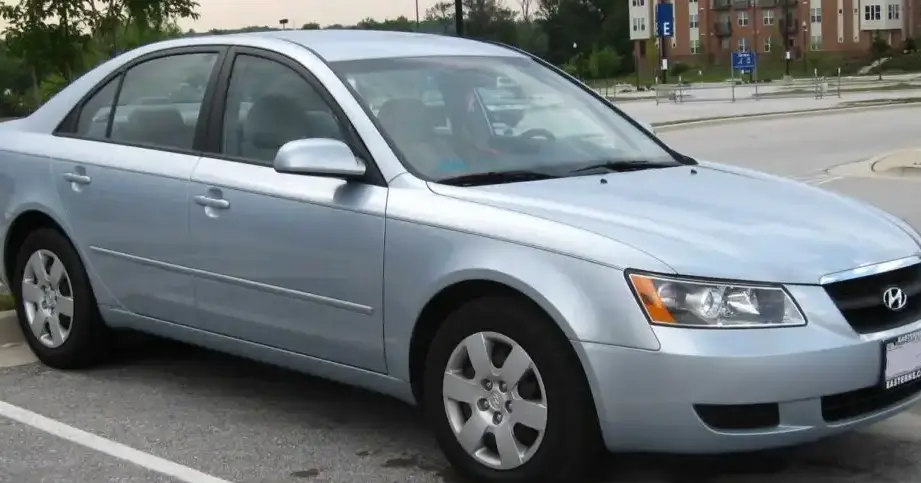
The Hyundai Sonata V (NF) 2.0 CRDi 16V Automatic, produced between 2006 and 2008, represented a significant advancement for Hyundai in the mid-size sedan market. As part of the fifth-generation Sonata (NF platform, also shared with the Kia Optima), this variant offered a diesel-powered option primarily aimed at European and other markets where fuel efficiency and torque were highly valued. It occupied a middle ground within the Sonata V lineup, positioned between the base gasoline models and the more powerful gasoline V6 options. The 2.0 CRDi Automatic was designed to provide a balance of performance, economy, and comfort for both family and business users.
Powertrain & Engine Architecture
The core of this Sonata variant is the Hyundai D4EA 2.0-liter inline-four cylinder diesel engine. This engine was a cornerstone of Hyundai’s diesel offerings during that era, featuring a second-generation common rail direct injection system. Supplied by Bosch, this system enabled precise fuel delivery, enhancing combustion efficiency, reducing engine noise, and increasing power output. The D4EA utilizes a single overhead camshaft (SOHC) valvetrain operating 16 valves – four valves per cylinder. A turbocharger, coupled with an intercooler, is employed to boost power and torque, mitigating the inherent limitations of a naturally aspirated diesel. The engine’s 17.3:1 compression ratio is typical for diesel engines, maximizing combustion efficiency. The automatic transmission is a conventional four-speed unit, selected for its user-friendliness and comfort, although it doesn’t match the efficiency or responsiveness of more modern transmissions.
Driving Characteristics
The 140 horsepower and 305 Nm (224.96 lb-ft) of torque generated by the 2.0 CRDi engine delivered adequate, though not particularly sporty, performance. Acceleration from 0 to 100 km/h (0-62 mph) took approximately 11.6 seconds. The automatic transmission, while smooth in operation, did somewhat diminish the engine’s potential, resulting in a slightly less responsive feel compared to the manual transmission versions. The engine’s strength resided in its mid-range torque, making it well-suited for highway cruising and overtaking maneuvers. Fuel economy was a major selling point, with combined figures around 7.3 l/100 km (32.2 US mpg), positioning it as a competitive option in its class. In comparison to the gasoline engines, the diesel offered significantly improved fuel economy and greater torque, but lacked the higher peak power figures.
Equipment & Trim Levels
The 2.0 CRDi Automatic typically came equipped with a reasonable array of standard features. These included air conditioning, power windows and mirrors, central locking, and an audio system. Higher trim levels added features such as alloy wheels, a sunroof, leather upholstery, and upgraded audio systems. Safety features included ABS brakes and dual front airbags. The interior design was functional and relatively spacious, although the materials used weren’t as luxurious as those found in some competing vehicles.
Chassis & Braking
The Sonata V employed a front-wheel-drive layout with independent suspension on all four wheels. The front suspension utilized a McPherson strut design, while the rear featured a multi-link setup. This configuration provided a comfortable ride, though handling wasn’t particularly sporty. The braking system consisted of ventilated discs at the front and solid discs at the rear, providing sufficient stopping power for the vehicle’s weight and performance. ABS was standard, enhancing safety during emergency braking situations.
Market Reception & Comparison
The 2.0 CRDi Automatic Sonata was generally well-received in markets where diesel engines were popular. Critics praised its fuel efficiency, comfortable ride, and spacious interior. However, some noted the engine’s relative lack of refinement compared to some European competitors and the somewhat dated feel of the automatic transmission. Compared to the gasoline-powered Sonatas, the diesel offered superior fuel economy and torque, making it a more practical choice for drivers covering high mileage. However, the diesel engine typically carried a higher price tag.
Legacy
The Hyundai Sonata V 2.0 CRDi Automatic, while not a revolutionary vehicle, played a crucial role in establishing Hyundai as a serious contender in the mid-size sedan segment. The D4EA engine proved to be relatively reliable, and well-maintained examples can still be found in the used car market today. While modern diesels offer significantly more advanced technology, the NF Sonata’s diesel variant remains a practical and economical option for those seeking a comfortable and fuel-efficient family car. Common issues with these vehicles often relate to wear and tear on suspension components and the potential for turbocharger problems as the vehicle ages and accumulates mileage.