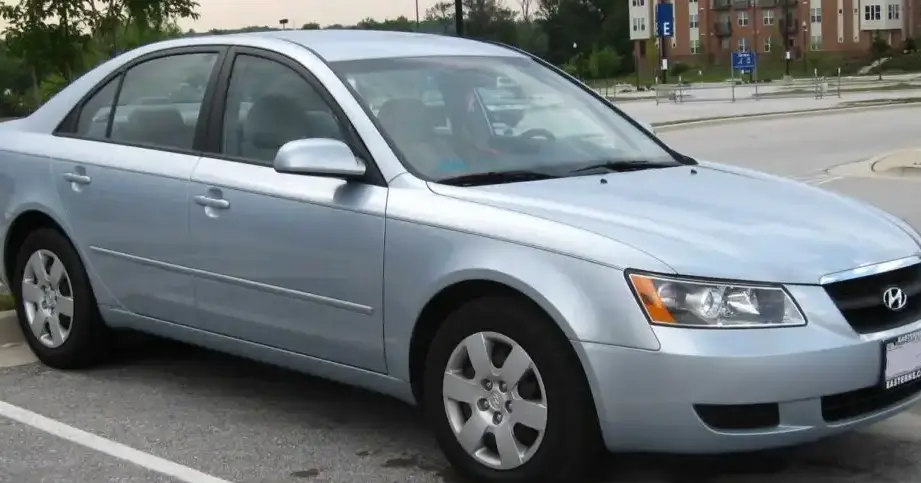
The Hyundai Sonata V (NF) 2.0i 16V Automatic, produced between 2006 and 2008, represented a significant step forward for Hyundai in the mid-size sedan segment. Part of the fifth generation Sonata (NF), this variant was positioned as a mainstream offering, balancing affordability with a reasonable level of equipment and comfort. It served as a key model in Hyundai’s efforts to gain market share in North America and other global markets, competing with established rivals like the Toyota Camry and Honda Accord. The NF generation, and this trim specifically, aimed to offer a more refined and modern alternative to previous Sonata models.
Technical Specifications
| Brand | Hyundai |
| Model | Sonata |
| Generation | Sonata V (NF) |
| Type (Engine) | 2.0 i 16V (137 Hp) Automatic |
| Start of production | 2006 |
| End of production | 2008 |
| Powertrain Architecture | Internal Combustion engine |
| Body type | Sedan |
| Seats | 5 |
| Doors | 4 |
| Fuel consumption (urban) | 10.3 l/100 km (22.8 US mpg) |
| Fuel consumption (extra urban) | 8.2 l/100 km (28.7 US mpg) |
| Fuel consumption (combined) | 9.2 l/100 km (25.6 US mpg) |
| Fuel Type | Petrol (Gasoline) |
| Acceleration 0 – 100 km/h | 9.6 sec |
| Acceleration 0 – 62 mph | 9.6 sec |
| Acceleration 0 – 60 mph | 9.1 sec |
| Maximum speed | 200 km/h (124.27 mph) |
| Weight-to-power ratio | 10.9 kg/Hp |
| Weight-to-torque ratio | 8.4 kg/Nm |
| Power | 137 Hp @ 6000 rpm |
| Torque | 179 Nm @ 4600 rpm (132.02 lb.-ft. @ 4600 rpm) |
| Engine layout | Front, Transverse |
| Engine displacement | 1997 cm3 (121.86 cu. in.) |
| Number of cylinders | 4 |
| Engine configuration | Inline |
| Number of valves per cylinder | 4 |
| Fuel injection system | Multi-port manifold injection |
| Engine aspiration | Naturally aspirated |
| Engine oil capacity | 4.3 l (4.54 US qt | 3.78 UK qt) |
| Kerb Weight | 1498 kg (3302.52 lbs) |
| Max. weight | 2020 kg (4453.34 lbs) |
| Max load | 522 kg (1150.81 lbs) |
| Trunk (boot) space | 430 l (15.19 cu. ft.) |
| Fuel tank capacity | 65 l (17.17 US gal | 14.3 UK gal) |
| Length | 4747 mm (186.89 in) |
| Width | 1820 mm (71.65 in) |
| Height | 1422 mm (55.98 in) |
| Wheelbase | 2700 mm (106.3 in) |
| Front track | 1540 mm (60.63 in) |
| Rear track | 1530 mm (60.24 in) |
| Drivetrain Architecture | Front wheel drive |
| Number of gears | 4 |
| Gearbox type | Automatic transmission |
| Front suspension | Spring Strut |
| Rear suspension | Transverse stabilizer |
| Front brakes | Ventilated discs |
| Rear brakes | Disc |
| Assisting systems | ABS (Anti-lock braking system) |
| Steering type | Steering rack and pinion |
| Tires size | 215/60 R16 |
| Wheel rims size | 16 |
Powertrain & Engine Architecture
The heart of the Sonata V 2.0i Automatic was the Hyundai G4GF engine, a 1.997-liter (121.86 cubic inches) inline-four cylinder gasoline engine. This engine featured a double overhead camshaft (DOHC) design with four valves per cylinder, contributing to its relatively efficient operation. Fuel delivery was handled by a multi-point fuel injection system. The engine produced 137 horsepower at 6000 rpm and 179 Nm (132 lb-ft) of torque at 4600 rpm. The engine was known for its generally reliable operation, though it wasn’t particularly groundbreaking in terms of performance. The four-speed automatic transmission was a conventional torque converter type, prioritizing smooth shifts over outright speed. This transmission was chosen to appeal to a broader audience seeking ease of use rather than sporty driving dynamics.
Driving Characteristics
The 2.0i Automatic Sonata offered a comfortable, but not particularly exhilarating, driving experience. Acceleration from 0 to 60 mph took around 9.1 seconds, which was adequate for everyday driving but lagged behind competitors offering more powerful engines. The four-speed automatic transmission, while smooth, lacked the responsiveness of more modern transmissions with more gears. The gear ratios were tuned for fuel efficiency and relaxed cruising, rather than aggressive acceleration. Compared to the available V6 engine options in the Sonata lineup, the 2.0i Automatic felt noticeably less powerful, especially when fully loaded or tackling steep inclines. However, it provided a more economical option for buyers prioritizing fuel costs.
Equipment & Trim Levels
The 2.0i Automatic trim typically included standard features such as air conditioning, power windows and locks, a basic audio system, and anti-lock brakes (ABS). Higher trim levels, often denoted with names like “Limited” or “LX,” added features like alloy wheels, a sunroof, upgraded audio systems, and cruise control. Interior upholstery was typically cloth, with leather options available on higher trims. The dashboard layout was functional and straightforward, prioritizing usability over stylistic flair. Optional extras included a CD changer, upgraded sound systems, and various accessory packages.
Chassis & Braking
The Sonata V utilized a front-wheel-drive layout with a MacPherson strut front suspension and a multi-link rear suspension. The suspension was tuned for comfort, providing a relatively smooth ride over most road surfaces. Front brakes were ventilated discs, while rear brakes were solid discs. The ABS system provided enhanced braking control, particularly in emergency situations. Stabilizer bars were included both front and rear to reduce body roll during cornering, though the car’s handling was generally geared towards comfort rather than sporty performance.
Market Reception & Comparison
The 2.0i Automatic Sonata was generally well-received as a practical and affordable mid-size sedan. Critics praised its comfortable ride, spacious interior, and competitive price point. However, it was often criticized for its lack of power and somewhat uninspired driving dynamics compared to rivals like the Honda Accord and Toyota Camry. Fuel economy was considered average for its class. Compared to the Sonata’s V6 engine options, the 2.0i Automatic offered significantly better fuel economy but at the cost of performance. The 2.0i Automatic appealed to buyers seeking a reliable and economical family sedan, while those prioritizing performance often opted for the more powerful V6 models.
Legacy
The Hyundai Sonata V (NF) 2.0i Automatic, while not a performance icon, played a crucial role in establishing Hyundai as a credible competitor in the mid-size sedan market. The G4GF engine proved to be reasonably reliable, and many examples remain on the road today. However, like any vehicle of this age, maintenance is key to longevity. Common issues include wear and tear on suspension components, potential oil leaks, and the eventual need for timing belt replacement. In the used car market, these Sonatas are often valued for their affordability and practicality, making them a popular choice for budget-conscious buyers. The NF generation Sonata marked a turning point for Hyundai, demonstrating the brand’s commitment to improving quality and offering competitive vehicles.