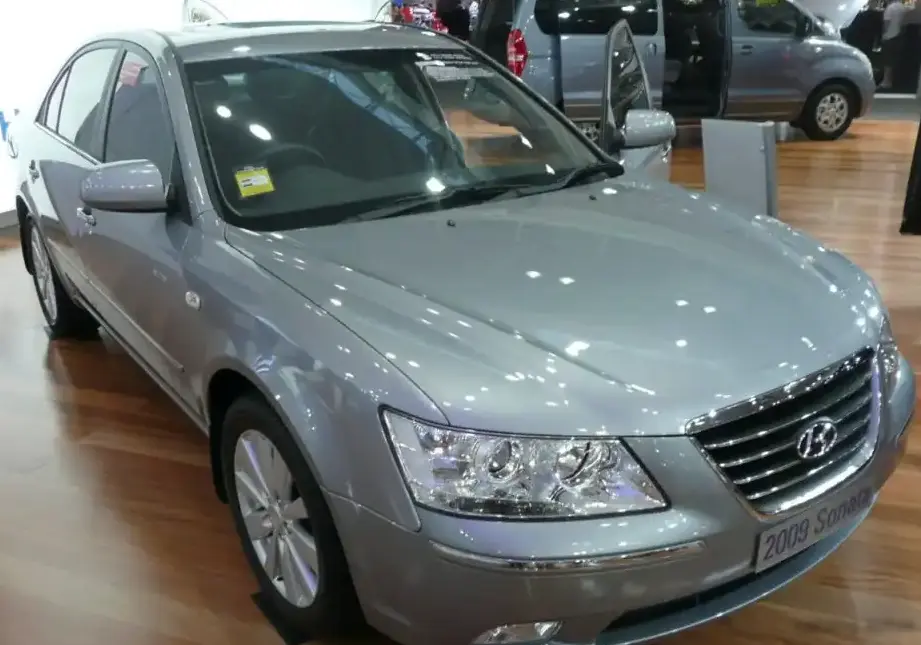
The Hyundai Sonata V (NF series, facelifted in 2008) 2.0-liter variant represents a significant step forward for Hyundai in the mid-size sedan segment. Produced from 2008 to 2009, this version of the NF Sonata aimed to balance fuel efficiency with acceptable performance for the North American market, where the Sonata was gaining traction as a value-oriented alternative to established Japanese and American brands. This particular trim level, equipped with the 2.0-liter Theta II engine producing 163 horsepower, occupied a middle ground in the Sonata V lineup, positioned above the base models and below the more powerful 2.4-liter options.
Technical Specifications
| Brand | Hyundai |
| Model | Sonata |
| Generation | Sonata V (NF, facelift 2008) |
| Type (Engine) | 2.0 (163 Hp) |
| Start of production | 2008 |
| End of production | 2009 |
| Powertrain Architecture | Internal Combustion engine |
| Body type | Sedan |
| Seats | 5 |
| Doors | 4 |
| Fuel Type | Petrol (Gasoline) |
| Weight-to-power ratio | 9 kg/Hp, 110.9 Hp/tonne |
| Weight-to-torque ratio | 7.5 kg/Nm, 134 Nm/tonne |
| Power | 163 Hp @ 6200 rpm |
| Power per litre | 81.6 Hp/l |
| Torque | 197 Nm @ 4500 rpm (145.3 lb.-ft. @ 4500 rpm) |
| Engine layout | Front, Transverse |
| Engine Model/Code | Theta II / G4KD |
| Engine displacement | 1998 cm3 (121.93 cu. in.) |
| Number of cylinders | 4 |
| Engine configuration | Inline |
| Cylinder Bore | 86 mm (3.39 in.) |
| Piston Stroke | 86 mm (3.39 in.) |
| Compression ratio | 10.5:1 |
| Number of valves per cylinder | 4 |
| Fuel injection system | Multi-port manifold injection |
| Engine aspiration | Naturally aspirated engine |
| Valvetrain | DOHC, CVVT |
| Engine oil capacity | 3.9 l (4.12 US qt | 3.43 UK qt) |
| Coolant | 6.2 l (6.55 US qt | 5.46 UK qt) |
| Kerb Weight | 1470 kg (3240.8 lbs) |
| Trunk (boot) space – minimum | 523 l (18.47 cu. ft.) |
| Fuel tank capacity | 70 l (18.49 US gal | 15.4 UK gal) |
| Length | 4800 mm (188.98 in.) |
| Width | 1832 mm (72.13 in.) |
| Height | 1475 mm (58.07 in.) |
| Wheelbase | 2730 mm (107.48 in.) |
| Front track | 1565 mm (61.61 in.) |
| Rear (Back) track | 1550 mm (61.02 in.) |
| Drag coefficient (Cd) | 0.32 |
| Minimum turning circle (turning diameter) | 12 m (39.37 ft.) |
| Drivetrain Architecture | The Internal combustion engine (ICE) drives the front wheels of the vehicle. |
| Drive wheel | Front wheel drive |
| Number of gears and type of gearbox | 5 gears, manual transmission |
| Front suspension | Independent, type McPherson with coil spring and anti-roll bar |
| Rear suspension | Independent multi-link suspension |
| Front brakes | Ventilated discs |
| Rear brakes | Disc |
| Assisting systems | ABS (Anti-lock braking system) |
| Steering type | Steering rack and pinion |
| Tires size | 205/60 R16 |
| Wheel rims size | 16 |
Powertrain & Engine Architecture
The heart of the 2008-2009 Hyundai Sonata V 2.0 is the Theta II inline-four cylinder engine, specifically the G4KD variant. This engine represents a significant upgrade over previous Hyundai four-cylinder offerings, incorporating dual overhead camshafts (DOHC) and continuously variable valve timing (CVVT) on both intake and exhaust valves. The multi-port fuel injection system delivers fuel directly to the intake ports, optimizing combustion efficiency. The engine’s 1998cc displacement, combined with a 10.5:1 compression ratio, allows it to produce 163 horsepower at 6200 rpm and 197 Nm (145.3 lb-ft) of torque at 4500 rpm. The five-speed manual transmission was standard, offering a relatively direct connection between the engine and the front wheels.
Driving Characteristics
The 2.0-liter Sonata offered a comfortable, if not particularly sporty, driving experience. The 163 hp engine provided adequate power for everyday driving situations, such as commuting and highway merging. However, it lacked the punch of the optional 2.4-liter engine, especially when fully loaded with passengers or cargo. The five-speed manual transmission allowed for reasonable control, but the gear ratios were tuned more for fuel economy than outright acceleration. Compared to the automatic transmission options available on other Sonata trims, the manual offered a more engaging driving experience and slightly better fuel efficiency. The suspension, tuned for comfort, absorbed bumps well but didn’t provide particularly sharp handling.
Equipment & Trim Levels
The 2.0-liter Sonata typically came with a respectable level of standard equipment. This included air conditioning, power windows and locks, a basic audio system, and standard safety features like ABS. Higher trim levels added features such as alloy wheels, a sunroof, upgraded audio systems, and cruise control. Interior upholstery was typically cloth, with optional leather available on higher trims. The dashboard layout was functional and straightforward, prioritizing ease of use over stylistic flair.
Chassis & Braking
The Sonata V utilized a front-wheel-drive layout with an independent McPherson strut suspension in the front and an independent multi-link suspension in the rear. This setup provided a good balance of ride comfort and handling. Front brakes were ventilated discs, offering good stopping power, while rear brakes were solid discs. The ABS system helped to maintain steering control during hard braking. The chassis was designed to provide a stable and predictable driving experience, prioritizing comfort and safety over sporty handling.
Market Reception & Comparison
The 2008-2009 Hyundai Sonata V 2.0 received generally positive reviews, particularly for its value proposition. Critics praised its spacious interior, comfortable ride, and generous warranty. However, some noted that the 2.0-liter engine felt underpowered compared to competitors, and the interior materials weren’t as refined as those found in some Japanese rivals. Compared to the 2.4-liter Sonata, the 2.0 offered better fuel economy but significantly less performance. Against competitors like the Toyota Camry and Honda Accord, the Sonata offered a lower price point but lacked the established reputation for reliability and resale value.
Legacy
The Theta II engine family, including the G4KD variant found in the 2008-2009 Sonata V 2.0, proved to be relatively reliable. While some early Theta II engines experienced issues with oil consumption, these were generally addressed in later revisions. Today, used examples of the Sonata V 2.0 are readily available and represent an affordable option for budget-conscious buyers. The 2.0-liter engine, while not a powerhouse, is known for its durability and relatively low maintenance costs. The Sonata V, as a whole, played a crucial role in establishing Hyundai as a credible competitor in the mid-size sedan market, paving the way for the brand’s continued success in North America.