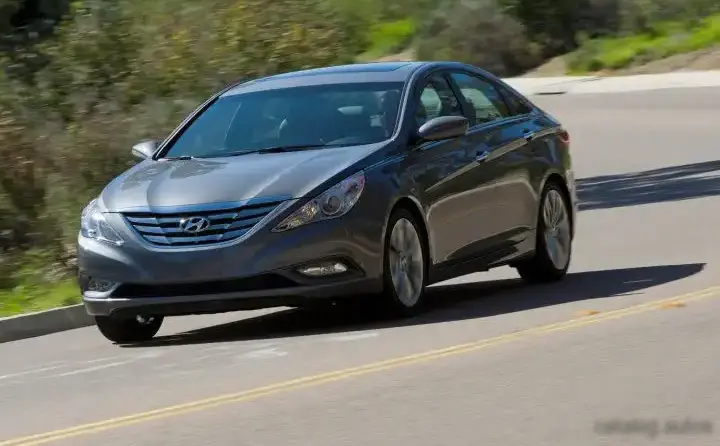
The Hyundai Sonata VI (YF) 2.0 Turbo GDI, produced from 2011 to 2012, represented a significant step forward for Hyundai in the mid-size sedan segment. Positioned as the performance-oriented trim within the YF generation, this variant offered a substantial power upgrade over the base models, appealing to drivers seeking a more engaging driving experience. Built on the YF platform, the Sonata VI aimed to challenge established competitors like the Honda Accord and Toyota Camry with a combination of style, features, and a competitive price point. The 2.0 Turbo GDI was a key component in Hyundai’s strategy to elevate its brand image and attract a wider customer base in the North American market.
Technical Specifications
| Brand | Hyundai |
| Model | Sonata |
| Generation | Sonata VI (YF) |
| Type (Engine) | 2.0 Turbo GDI (271 Hp) Automatic |
| Start of production | 2011 |
| End of production | 2012 |
| Powertrain Architecture | Internal Combustion engine |
| Body type | Sedan |
| Seats | 5 |
| Doors | 4 |
| Fuel Type | Petrol (Gasoline) |
| Acceleration 0 – 100 km/h | 8.5 sec |
| Acceleration 0 – 62 mph | 8.5 sec |
| Acceleration 0 – 60 mph | 8.1 sec |
| Maximum speed | 210 km/h (130.49 mph) |
| Weight-to-power ratio | 5.6 kg/Hp, 178.3 Hp/tonne |
| Weight-to-torque ratio | 4.2 kg/Nm, 240.1 Nm/tonne |
| Power | 271 Hp @ 6000 rpm |
| Power per litre | 135.6 Hp/l |
| Torque | 365 Nm @ 1750-4500 rpm (269.21 lb.-ft. @ 1750-4500 rpm) |
| Engine layout | Front, Transverse |
| Engine Model/Code | Theta II / G4KH |
| Engine displacement | 1998 cm3 (121.93 cu. in.) |
| Number of cylinders | 4 |
| Engine configuration | Inline |
| Cylinder Bore | 86 mm (3.39 in.) |
| Piston Stroke | 86 mm (3.39 in.) |
| Compression ratio | 9.5:1 |
| Number of valves per cylinder | 4 |
| Fuel injection system | Direct injection |
| Engine aspiration | Turbocharger, Intercooler |
| Valvetrain | DOHC, CVVT |
| Engine oil capacity | 4.6 l (4.86 US qt | 4.05 UK qt) |
| Coolant | 6.6 l (6.97 US qt | 5.81 UK qt) |
| Kerb Weight | 1520 kg (3351.03 lbs.) |
| Trunk (boot) space – minimum | 523 l (18.47 cu. ft.) |
| Fuel tank capacity | 70 l (18.49 US gal | 15.4 UK gal) |
| Length | 4820 mm (189.76 in.) |
| Width | 1835 mm (72.24 in.) |
| Height | 1470 mm (57.87 in.) |
| Wheelbase | 2795 mm (110.04 in.) |
| Front track | 1587 mm (62.48 in.) |
| Rear (Back) track | 1587 mm (62.48 in.) |
| Drag coefficient (Cd) | 0.28 |
| Minimum turning circle | 10.9 m (35.76 ft.) |
| Drivetrain Architecture | The Internal combustion engine (ICE) drives the front wheels of the vehicle. |
| Drive wheel | Front wheel drive |
| Number of gears and type of gearbox | 6 gears, automatic transmission |
| Front suspension | Independent, type McPherson with coil spring and anti-roll bar |
| Rear suspension | Independent multi-link suspension |
| Front brakes | Ventilated discs |
| Rear brakes | Ventilated discs |
| Assisting systems | ABS (Anti-lock braking system) |
| Steering type | Steering rack and pinion |
| Tires size | 225/45 R18 |
| Wheel rims size | 7.5J x 18 |
Introduction
The Hyundai Sonata VI (YF) 2.0 Turbo GDI, launched in 2011 and continuing through 2012, was a pivotal model for Hyundai. It represented a significant upgrade in performance and refinement compared to the naturally aspirated engines offered in the base Sonata YF models. This variant aimed to attract buyers who desired a more spirited driving experience without sacrificing the practicality and value proposition of the Sonata. The “GDI” designation signifies Gasoline Direct Injection, a technology that enhances both power and fuel efficiency. This trim level sat at the top of the YF Sonata lineup, offering a premium experience relative to the 2.4L and hybrid options.
Powertrain & Engine Architecture
At the heart of the 2.0 Turbo GDI Sonata lies the Hyundai Theta II engine, specifically the G4KH code. This 1998cc (121.93 cubic inches) inline-four cylinder engine utilizes direct fuel injection, a turbocharger, and an intercooler to produce 271 horsepower at 6000 rpm and 269.21 lb-ft of torque between 1750 and 4500 rpm. The direct injection system precisely meters fuel directly into the combustion chamber, improving combustion efficiency and reducing knocking. The turbocharger, coupled with the intercooler, forces more air into the engine, boosting power output. The engine also features a Double Overhead Camshaft (DOHC) valvetrain with Continuously Variable Valve Timing (CVVT) on both intake and exhaust valves, optimizing engine performance across the rev range. The engine is transversely mounted in the front of the vehicle. Paired with the engine is a six-speed automatic transmission, designed to handle the increased power and torque. This transmission offered smooth shifts and contributed to the overall refined driving experience.
Driving Characteristics
The 2.0 Turbo GDI Sonata delivered a noticeably more responsive and engaging driving experience compared to the standard 2.4L engine. The turbocharger provides a surge of power during acceleration, resulting in a 0-60 mph time of approximately 8.1 seconds. While not a sports sedan, the 271 hp output allowed for confident passing maneuvers and highway cruising. The six-speed automatic transmission was well-tuned, providing smooth and timely gear changes. However, some reviewers noted that the transmission could occasionally feel hesitant during downshifts. The steering was light and precise, making the car easy to maneuver in urban environments. Compared to the manual transmission options available on other Sonata trims, the automatic prioritized comfort and convenience over outright performance.
Equipment & Trim Levels
The 2.0 Turbo GDI trim typically came well-equipped with standard features such as leather upholstery, heated front seats, a premium audio system, automatic climate control, and a rearview camera. Optional extras included a panoramic sunroof, navigation system, and upgraded alloy wheels. Interior appointments were generally upscale for the price point, with a focus on comfort and convenience. The dashboard layout was modern and intuitive, with easy-to-use controls. The trim level was positioned as a near-luxury offering within the Sonata range, bridging the gap between mainstream family sedans and more expensive premium brands.
Chassis & Braking
The Sonata YF featured an independent suspension system, with a McPherson strut setup at the front and a multi-link suspension at the rear. This configuration provided a comfortable ride while maintaining reasonable handling characteristics. The 2.0 Turbo GDI models typically came equipped with ventilated disc brakes on all four wheels, providing ample stopping power. Anti-lock Braking System (ABS) was standard. Stabilizer bars were fitted to both the front and rear suspension to reduce body roll during cornering. The suspension tuning was geared towards comfort, but the chassis was capable of handling the increased power output of the turbocharged engine.
Market Reception & Comparison
The 2.0 Turbo GDI Sonata received generally positive reviews from automotive critics. It was praised for its strong performance, comfortable ride, and generous feature set. However, some reviewers noted that the styling was somewhat polarizing. Compared to the base 2.4L Sonata, the Turbo GDI offered a significant performance advantage, but at a higher price point. Fuel economy was comparable to other turbocharged four-cylinder engines in the segment. Reliability reports were generally favorable, although some owners reported minor issues with the turbocharger and fuel injection system. Against competitors like the Honda Accord and Toyota Camry, the Sonata offered a more aggressive driving experience and a more modern design, but lacked the established reputation for long-term reliability of its Japanese rivals.
Legacy
The Hyundai Sonata VI (YF) 2.0 Turbo GDI played a crucial role in establishing Hyundai as a serious contender in the mid-size sedan market. The powertrain proved to be relatively reliable, with many examples still on the road today. On the used car market, these models hold their value reasonably well, particularly those that have been well-maintained. The Theta II engine, while not without its issues (some later iterations experienced oil consumption problems), proved to be a durable and capable powerplant. The YF Sonata, and particularly the 2.0 Turbo GDI variant, helped to change perceptions of the Hyundai brand, demonstrating that the company was capable of producing vehicles that could compete with the best in the industry.