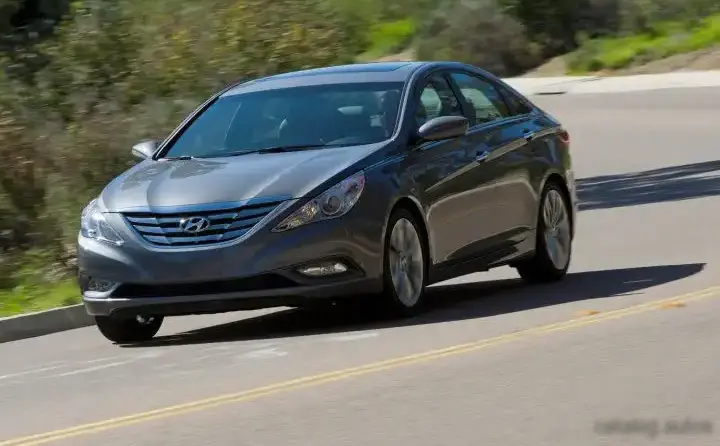
The Hyundai Sonata VI (YF), produced from 2009 to 2012, marked a significant evolution for Hyundai in the competitive mid-size sedan segment. Replacing the NF Sonata, the YF aimed to deliver a more refined and stylish alternative to established rivals like the Toyota Camry and Honda Accord. Within the YF range, the 2.4-liter engine paired with a 6-speed automatic transmission was the mainstream offering, striking a balance between affordability, performance, and features, appealing to a broad customer base seeking a comfortable and dependable family vehicle.
Technical Specifications
| Brand | Hyundai |
| Model | Sonata |
| Generation | Sonata VI (YF) |
| Type (Engine) | 2.4 (178 Hp) Automatic |
| Start of production | 2009 |
| End of production | 2012 |
| Powertrain Architecture | Internal Combustion engine |
| Body type | Sedan |
| Seats | 5 |
| Doors | 4 |
| Fuel consumption (urban) | 11.2 l/100 km (21 US mpg) |
| Fuel consumption (extra urban) | 6.1 l/100 km (38.6 US mpg) |
| Fuel consumption (combined) | 8 l/100 km (29.4 US mpg) |
| CO2 emissions | 190 g/km |
| Fuel Type | Petrol (Gasoline) |
| Acceleration 0 – 100 km/h | 9.5 sec |
| Acceleration 0 – 62 mph | 9.5 sec |
| Acceleration 0 – 60 mph | 9 sec |
| Maximum speed | 210 km/h (130.49 mph) |
| Weight-to-power ratio | 8 kg/Hp |
| Weight-to-torque ratio | 6.3 kg/Nm |
| Power | 178 Hp @ 6000 rpm |
| Torque | 228 Nm @ 4000 rpm (168.16 lb.-ft. @ 4000 rpm) |
| Engine layout | Front, Transverse |
| Engine Model/Code | Theta II / G4KE |
| Engine displacement | 2359 cm3 (143.96 cu. in.) |
| Number of cylinders | 4 |
| Engine configuration | Inline |
| Cylinder Bore | 88 mm (3.46 in.) |
| Piston Stroke | 97 mm (3.82 in.) |
| Number of valves per cylinder | 4 |
| Fuel injection system | Multi-port manifold injection |
| Engine aspiration | Naturally aspirated engine |
| Valvetrain | DOHC, CVVT |
| Engine oil capacity | 4.5 l (4.76 US qt | 3.96 UK qt) |
| Coolant capacity | 6.4 l (6.76 US qt | 5.63 UK qt) |
| Kerb Weight | 1425 kg (3141.59 lbs.) |
| Max. weight | 1980 kg (4365.15 lbs.) |
| Max load | 555 kg (1223.57 lbs.) |
| Trunk (boot) space – minimum | 523 l (18.47 cu. ft.) |
| Fuel tank capacity | 70 l (18.49 US gal | 15.4 UK gal) |
| Length | 4820 mm (189.76 in.) |
| Width | 1835 mm (72.24 in.) |
| Height | 1470 mm (57.87 in.) |
| Wheelbase | 2795 mm (110.04 in.) |
| Front track | 1597 mm (62.87 in.) |
| Rear (Back) track | 1597 mm (62.87 in.) |
| Drag coefficient (Cd) | 0.28 |
| Minimum turning circle | 10.9 m (35.76 ft.) |
| Drivetrain Architecture | Front wheel drive |
| Number of gears | 6 |
| Gearbox type | Automatic transmission |
| Front suspension | Independent, McPherson with coil spring and anti-roll bar |
| Rear suspension | Independent multi-link suspension |
| Front brakes | Ventilated discs |
| Rear brakes | Disc |
| Assisting systems | ABS (Anti-lock braking system) |
| Steering type | Steering rack and pinion |
| Tires size | 205/65 R16 |
| Wheel rims size | 6.5J x 16 |
Powertrain & Engine Architecture
The core of this Sonata variant is the Hyundai Theta II 2.4-liter inline-four cylinder engine, internally designated G4KE. This engine represented a substantial improvement over Hyundai’s previous four-cylinder designs, incorporating dual continuously variable valve timing (CVVT) on both the intake and exhaust camshafts. This technology enhanced both power delivery and fuel efficiency. The engine employs a multi-port fuel injection system, delivering fuel directly into the intake ports. The 6-speed automatic transmission, a key component of this trim level, was engineered to provide smooth and efficient gear changes. It features a torque converter for seamless launches and a broad range of gear ratios optimized for both city and highway driving. The transmission’s programming prioritized comfort and fuel economy over aggressive shifting characteristics.
Driving Characteristics
The 2.4-liter engine, producing 178 horsepower, delivered adequate, though not particularly sporty, performance. Acceleration from 0 to 60 mph took around 9 seconds, placing it in line with other mainstream mid-size sedans of the period. The automatic transmission, while smooth, could sometimes feel hesitant during rapid acceleration or when attempting to overtake on the highway. Compared to the optional 2.0-liter turbocharged engine available in higher trims, the 2.4L automatic lacked the immediate responsiveness and overall power. However, it offered a more refined and predictable driving experience, especially for drivers prioritizing comfort and ease of use. The gear ratios were tuned for fuel efficiency, resulting in a relaxed cruising experience at highway speeds.
Equipment & Trim Levels
The 2.4-liter automatic Sonata typically came standard with features such as air conditioning, power windows and locks, a basic audio system with a CD player and auxiliary input, and standard safety equipment including ABS and multiple airbags. Higher trim levels, often designated as GLS or Limited packages, added features like alloy wheels, a sunroof, upgraded audio systems, leather upholstery, and heated seats. Optional extras included a navigation system, a rearview camera, and automatic climate control. The interior design was generally straightforward and functional, utilizing durable materials and emphasizing practicality.
Chassis & Braking
The YF Sonata utilized an independent McPherson strut front suspension and an independent multi-link rear suspension. This configuration provided a comfortable ride quality, effectively absorbing bumps and road imperfections. The front brakes were ventilated discs, offering good stopping power, while the rear brakes were solid discs. ABS (Anti-lock Braking System) was standard, enhancing safety during emergency braking maneuvers. The suspension tuning was geared towards comfort rather than sporty handling, resulting in a noticeable degree of body roll during cornering. Stabilizer bars were incorporated both front and rear to help minimize body roll.
Market Reception & Comparison
The 2.4-liter automatic Sonata was generally well-received by automotive critics as a solid and reliable family sedan. It was praised for its spacious interior, comfortable ride, and competitive fuel economy. However, some reviewers noted that the engine lacked the power of some competitors and that the automatic transmission could be slow to respond. Compared to the more powerful turbocharged Sonata, the 2.4L automatic offered a lower purchase price and potentially lower maintenance costs. Fuel economy was comparable to other 2.4-liter sedans in its class, averaging around 29 mpg in combined driving. Reliability was generally good, although some owners reported minor issues with the automatic transmission over the long term.
Legacy
The Hyundai Sonata YF 2.4L automatic has proven to be a relatively durable and dependable vehicle in the used car market. The Theta II engine, while not entirely without potential issues (such as oil consumption in some instances), is generally considered a robust and long-lasting powerplant when properly maintained. The 6-speed automatic transmission, while not the most technologically advanced, has also demonstrated reasonable reliability. Today, these Sonatas represent an affordable and practical option for buyers seeking a used mid-size sedan. Their relatively low cost of ownership and readily available parts make them an attractive choice for budget-conscious consumers.