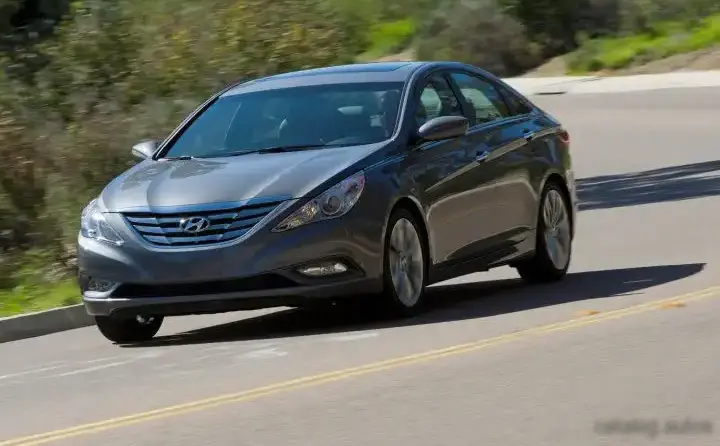
The Hyundai Sonata VI (YF) 2.4 Hybrid Automatic, produced from 2010 to 2012, represented a significant step forward for Hyundai in the mid-size sedan segment, particularly in the burgeoning hybrid market. Positioned as a technologically advanced and fuel-efficient option, this variant occupied a mid-to-upper trim level within the YF Sonata lineup. It combined a 2.4-liter gasoline engine with an electric motor, offering a blend of performance and economy. The YF generation Sonata, built on the YF platform, was a critical model for Hyundai, showcasing a more sophisticated design and improved quality compared to its predecessors, and aimed to challenge established Japanese and American competitors.
Technical Specifications
| Brand | Hyundai |
| Model | Sonata |
| Generation | Sonata VI (YF) |
| Type (Engine) | 2.4 (209 Hp) Hybrid Automatic |
| Start of production | 2010 |
| End of production | 2012 |
| Powertrain Architecture | FHEV (Full Hybrid Electric Vehicle) |
| Body type | Sedan |
| Seats | 5 |
| Doors | 4 |
| Fuel consumption (combined) | 6.5 l/100 km (36.2 US mpg, 43.5 UK mpg, 15.4 km/l) |
| Fuel Type | Petrol (Gasoline) |
| Weight-to-power ratio | 7.6 kg/Hp, 132.3 Hp/tonne |
| Weight-to-torque ratio | 7.6 kg/Nm, 132.3 Nm/tonne |
| Gross battery capacity | 1.43 kWh |
| Battery voltage | 270 V |
| Battery weight | 42 kg (92.59 lbs) |
| Electric motor power | 41 Hp @ 1400-6000 rpm |
| Electric motor Torque | 205 Nm @ 1400 rpm (151.2 lb.-ft. @ 1400 rpm) |
| System power | 209 Hp |
| Internal combustion engine power | 168 Hp @ 6000 rpm |
| Power per litre | 71.2 Hp/l |
| Torque | 209 Nm @ 4500 rpm (154.15 lb.-ft. @ 4500 rpm) |
| Engine layout | Front, Transverse |
| Engine displacement | 2359 cm3 (143.96 cu. in) |
| Number of cylinders | 4 |
| Engine configuration | Inline |
| Cylinder Bore | 88 mm (3.46 in) |
| Piston Stroke | 97 mm (3.82 in) |
| Compression ratio | 13:1 |
| Number of valves per cylinder | 4 |
| Fuel injection system | Multi-port manifold injection |
| Engine aspiration | Naturally aspirated engine |
| Valvetrain | DOHC, CVVT |
| Engine oil capacity | 4.5 l (4.76 US qt | 3.96 UK qt) |
| Coolant | 6.6 l (6.97 US qt | 5.81 UK qt) |
| Kerb Weight | 1580 kg (3483.3 lbs) |
| Trunk (boot) space – minimum | 303 l (10.7 cu. ft) |
| Fuel tank capacity | 65 l (17.17 US gal | 14.3 UK gal) |
| Length | 4820 mm (189.76 in) |
| Width | 1835 mm (72.24 in) |
| Height | 1470 mm (57.87 in) |
| Wheelbase | 2795 mm (110.04 in) |
| Front track | 1597 mm (62.87 in) |
| Rear (Back) track | 1597 mm (62.87 in) |
| Drag coefficient (Cd) | 0.25 |
| Minimum turning circle (turning diameter) | 10.9 m (35.76 ft) |
| Drivetrain Architecture | The Internal combustion engine (ICE) and electric motor drive the front wheels of the car with the ability to work in full electric or mixed mode. |
| Drive wheel | Front wheel drive |
| Number of gears and type of gearbox | 6 gears, automatic transmission |
| Front suspension | Independent, type McPherson with coil spring and anti-roll bar |
| Rear suspension | Independent multi-link suspension |
| Front brakes | Ventilated discs |
| Rear brakes | Ventilated discs |
| Assisting systems | ABS (Anti-lock braking system) |
| Steering type | Steering rack and pinion |
| Tires size | 205/65 R16; 215/55R17 |
| Wheel rims size | 6.5J x 16; 6.5J x 17 |
Powertrain & Engine Architecture
At the heart of the YF Sonata 2.4 Hybrid lies a 2.4-liter inline-four cylinder gasoline engine, designated as the Theta II engine family. This engine produced 168 horsepower and 154 lb-ft of torque. It featured a multi-port fuel injection system and a double overhead camshaft (DOHC) valvetrain with continuously variable valve timing (CVVT) on both intake and exhaust valves. The electric motor, delivering 41 horsepower and 151 lb-ft of torque, was integrated into the powertrain and drew power from a 1.43 kWh lithium-polymer battery pack. The battery was positioned under the rear seats. The hybrid system allowed for electric-only driving at lower speeds and assisted the gasoline engine during acceleration, resulting in improved fuel economy. The transmission was a six-speed automatic, specifically tuned to work seamlessly with both the gasoline engine and the electric motor. The system prioritized fuel efficiency, often favoring higher gears and smoother shifts.
Driving Characteristics
The 2.4 Hybrid Automatic offered a noticeably different driving experience compared to the standard 2.4-liter Sonata. While not a performance-oriented model, the electric motor provided instant torque, improving responsiveness from a standstill. The combined system output of 209 horsepower was adequate for everyday driving, but acceleration was more deliberate than the non-hybrid versions. The six-speed automatic transmission was programmed for efficiency, sometimes resulting in a slight hesitation during quick overtaking maneuvers. The hybrid system’s regenerative braking feature, while contributing to fuel savings, could feel somewhat unnatural to drivers accustomed to conventional braking systems. Overall, the driving experience was comfortable and refined, prioritizing fuel economy and a smooth ride over sporty handling.
Equipment & Trim Levels
The 2.4 Hybrid Automatic typically came well-equipped, often including features such as air conditioning, power windows and locks, a touchscreen audio system with Bluetooth connectivity, and keyless entry. Higher trim levels added features like leather upholstery, a sunroof, heated front seats, and a premium audio system. Safety features included ABS, electronic stability control, and multiple airbags. The interior design was modern and spacious, with a focus on user-friendliness. The dashboard layout was clean and intuitive, with easy-to-read gauges and controls. Optional extras included a navigation system and a rearview camera.
Chassis & Braking
The YF Sonata 2.4 Hybrid utilized a McPherson strut front suspension and a multi-link rear suspension, providing a comfortable and controlled ride. The suspension was tuned to balance ride comfort with handling stability. Brakes consisted of ventilated discs on all four wheels, providing adequate stopping power. The ABS system helped to prevent wheel lockup during hard braking. The steering was a rack-and-pinion system, offering precise and responsive steering feel. Tire sizes typically ranged from 205/65R16 to 215/55R17, depending on the trim level.
Market Reception & Comparison
The Hyundai Sonata VI (YF) 2.4 Hybrid Automatic was generally well-received by critics and consumers alike. It was praised for its fuel efficiency, comfortable ride, and spacious interior. However, some reviewers noted that the acceleration was not as brisk as some competitors, and the regenerative braking system took some getting used to. Compared to the standard 2.4-liter Sonata, the hybrid version offered significantly better fuel economy, but came at a higher price point. Compared to other hybrids on the market, such as the Toyota Prius, the Sonata Hybrid offered a more conventional sedan experience, with a larger interior and a more traditional driving feel. Reliability reports were generally positive, although some owners reported minor issues with the hybrid system components.
Legacy
The YF Sonata 2.4 Hybrid Automatic played a crucial role in establishing Hyundai as a serious contender in the hybrid market. It demonstrated Hyundai’s commitment to fuel efficiency and advanced technology. While the hybrid system components can require specialized maintenance, the powertrain has proven to be reasonably reliable over the long term. Today, used YF Sonata Hybrids represent a good value for buyers seeking a fuel-efficient and comfortable mid-size sedan. The model helped pave the way for Hyundai’s continued development of hybrid and electric vehicles, solidifying its position as a leader in the automotive industry.