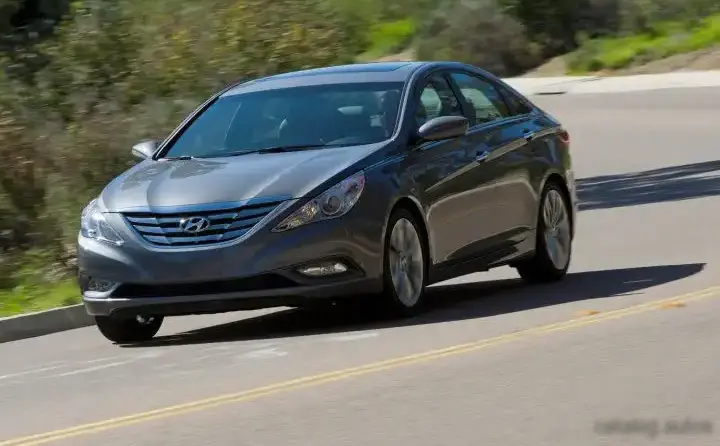
The Hyundai Sonata VI (YF), produced from 2009 to 2012, represented a significant step forward for the South Korean automaker in the mid-size sedan segment. The YF generation, replacing the NF Sonata, aimed to offer a more sophisticated and stylish alternative to established competitors like the Toyota Camry and Honda Accord. Within the YF lineup, the 2.4 GDI (Gasoline Direct Injection) variant, paired with a 6-speed automatic transmission, occupied a crucial mid-range position, balancing performance, fuel efficiency, and affordability. This model was primarily targeted at the North American and Korean markets, where a comfortable and well-equipped family sedan was highly valued.
Technical Specifications
| Brand | Hyundai |
| Model | Sonata |
| Generation | Sonata VI (YF) |
| Type (Engine) | 2.4 GDI (201 Hp) Automatic |
| Start of production | 2009 |
| End of production | 2012 |
| Powertrain Architecture | Internal Combustion engine |
| Body type | Sedan |
| Seats | 5 |
| Doors | 4 |
| Fuel consumption (urban) | 11.2 l/100 km (21 US mpg) |
| Fuel consumption (extra urban) | 5.9 l/100 km (39.9 US mpg) |
| Fuel consumption (combined) | 7.8 l/100 km (30.2 US mpg) |
| CO2 emissions | 188 g/km |
| Fuel Type | Petrol (Gasoline) |
| Acceleration 0 – 100 km/h | 9 sec |
| Acceleration 0 – 62 mph | 9 sec |
| Acceleration 0 – 60 mph | 8.6 sec |
| Maximum speed | 210 km/h (130.49 mph) |
| Weight-to-power ratio | 7.3 kg/Hp |
| Weight-to-torque ratio | 5.9 kg/Nm |
| Power | 201 Hp @ 6300 rpm |
| Torque | 250 Nm @ 4250 rpm (184.39 lb.-ft. @ 4250 rpm) |
| Engine layout | Front, Transverse |
| Engine Model/Code | Theta II / G4KJ |
| Engine displacement | 2359 cm3 (143.96 cu. in.) |
| Number of cylinders | 4 |
| Engine configuration | Inline |
| Cylinder Bore | 88 mm (3.46 in.) |
| Piston Stroke | 97 mm (3.82 in.) |
| Compression ratio | 11.3:1 |
| Number of valves per cylinder | 4 |
| Fuel injection system | Direct injection |
| Engine aspiration | Naturally aspirated engine |
| Valvetrain | DOHC, CVVT |
| Engine oil capacity | 4.8 l (5.07 US qt | 4.22 UK qt) |
| Coolant capacity | 6.6 l (6.97 US qt | 5.81 UK qt) |
| Kerb Weight | 1477 kg (3256.23 lbs.) |
| Max. weight | 2030 kg (4475.38 lbs.) |
| Max load | 553 kg (1219.16 lbs.) |
| Trunk (boot) space – minimum | 523 l (18.47 cu. ft.) |
| Fuel tank capacity | 70 l (18.49 US gal | 15.4 UK gal) |
| Length | 4820 mm (189.76 in.) |
| Width | 1835 mm (72.24 in.) |
| Height | 1470 mm (57.87 in.) |
| Wheelbase | 2795 mm (110.04 in.) |
| Front track | 1597 mm (62.87 in.) |
| Rear track | 1597 mm (62.87 in.) |
| Drag coefficient (Cd) | 0.28 |
| Minimum turning circle | 10.9 m (35.76 ft.) |
| Drivetrain Architecture | Front wheel drive |
| Number of gears | 6 |
| Gearbox type | Automatic transmission |
| Front suspension | Independent, McPherson with coil spring and anti-roll bar |
| Rear suspension | Independent multi-link suspension |
| Front brakes | Ventilated discs |
| Rear brakes | Disc |
| Assisting systems | ABS (Anti-lock braking system) |
| Steering type | Steering rack and pinion |
| Tires size | 215/55 R17 |
| Wheel rims size | 6.5J x 17 |
Powertrain & Engine Architecture
The heart of the Sonata 2.4 GDI Automatic is the Hyundai Theta II engine, specifically the G4KJ code. This 2.4-liter inline-four engine utilizes Gasoline Direct Injection (GDI) technology, a key feature that differentiates it from earlier Sonata engines. GDI allows for more precise fuel delivery, resulting in improved fuel efficiency and increased power output. The engine boasts a dual overhead camshaft (DOHC) configuration with continuously variable valve timing (CVVT) on both intake and exhaust valves, further optimizing performance and efficiency. The 6-speed automatic transmission, sourced from Hyundai’s own development, was designed to provide smooth and responsive shifting. It features a torque converter for smooth launches and a wide range of gear ratios to keep the engine operating in its optimal power band. The transmission’s programming prioritized comfort and fuel economy over outright sportiness.
Driving Characteristics
The 201 horsepower and 184 lb-ft of torque delivered by the 2.4 GDI engine provided adequate, though not exhilarating, performance. Acceleration from 0-60 mph took approximately 8.6 seconds, making it competitive with other mid-size sedans in its class. The automatic transmission, while smooth, could sometimes feel hesitant during quick acceleration maneuvers. Compared to the available 2.0T turbocharged engine, the 2.4 GDI offered less raw power, but it provided a more linear and predictable power delivery. The 2.4 GDI also differed significantly from the diesel options available in some markets, offering a quieter and smoother driving experience, albeit with lower fuel economy in certain conditions. The gear ratios were tuned for everyday driving, prioritizing fuel efficiency at highway speeds and providing sufficient torque for merging and passing.
Equipment & Trim Levels
The 2.4 GDI Automatic trim typically included standard features such as air conditioning, power windows and locks, a CD/MP3 stereo system, and basic safety equipment like airbags and ABS. Higher trim levels, such as the Limited, added features like leather upholstery, a sunroof, a navigation system, and upgraded audio systems. Interior upholstery was typically cloth on the base models, with leather options available on higher trims. The dashboard layout was generally straightforward and functional, with a focus on ease of use. Optional extras included a rearview camera, Bluetooth connectivity, and heated seats.
Chassis & Braking
The Sonata YF utilized a front-wheel-drive layout with an independent McPherson strut suspension in the front and an independent multi-link suspension in the rear. This suspension setup provided a comfortable ride quality, absorbing bumps and irregularities in the road effectively. The front brakes were ventilated discs, while the rear brakes were solid discs, providing adequate stopping power for the vehicle’s weight. ABS (Anti-lock Braking System) was standard, enhancing safety during emergency braking situations. Stabilizer bars were included both front and rear to reduce body roll during cornering.
Market Reception & Comparison
The Hyundai Sonata YF 2.4 GDI Automatic was generally well-received by automotive critics. It was praised for its stylish design, spacious interior, and comfortable ride. However, some reviewers noted that the engine lacked the punch of its turbocharged counterpart and that the automatic transmission could be slow to respond at times. Fuel economy was considered competitive for its class, averaging around 30 mpg combined. Compared to the 2.0T model, the 2.4 GDI offered a lower price point and potentially lower maintenance costs, making it an attractive option for budget-conscious buyers. Reliability was generally good, although some owners reported minor issues with the GDI fuel injectors over time.
Legacy
The Hyundai Sonata YF 2.4 GDI Automatic played a significant role in establishing Hyundai as a major player in the mid-size sedan market. The Theta II engine, while not without its quirks, proved to be a durable and reliable powerplant when properly maintained. Today, used examples of the YF Sonata 2.4 GDI are readily available and offer a compelling value proposition for buyers seeking an affordable and comfortable family sedan. The GDI system, while offering efficiency gains, requires regular intake valve cleaning to prevent carbon buildup, a common maintenance item for owners of these vehicles. Overall, the YF Sonata 2.4 GDI Automatic remains a respectable and practical choice in the used car market.