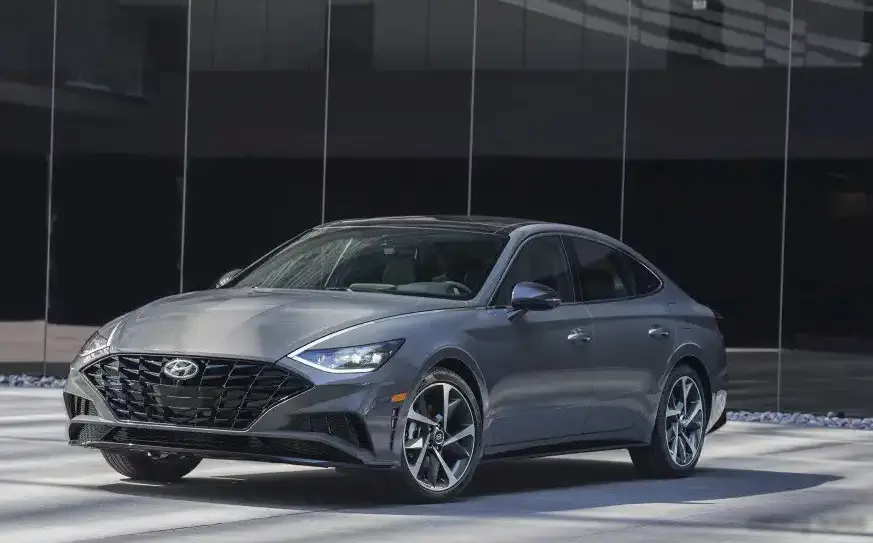
The Hyundai Sonata VIII (DN8), produced from 2020 to 2023, represented a significant leap forward for Hyundai’s mid-size sedan. Within the DN8 generation, the 2.5 Turbo GDI variant, boasting 290 horsepower, occupied the premium position in the lineup, offering a blend of performance and sophisticated features. This model aimed to compete directly with established players like the Honda Accord and Toyota Camry, offering a more dynamic driving experience and a bolder design aesthetic. The 2.5 Turbo GDI was positioned above the base 2.5L naturally aspirated engine and served as the flagship powertrain option before the introduction of hybrid models.
Technical Specifications
| Brand | Hyundai |
| Model | Sonata |
| Generation | Sonata VIII (DN8) |
| Type (Engine) | 2.5 Turbo GDI (290 Hp) Automatic |
| Start of production | 2020 |
| End of production | 2023 |
| Powertrain Architecture | Internal Combustion engine |
| Body type | Sedan |
| Seats | 5 |
| Doors | 4 |
| Fuel consumption (urban) | 10.2 l/100 km (23.1 US mpg) |
| Fuel consumption (extra urban) | 7.1 l/100 km (33.1 US mpg) |
| Fuel consumption (combined) | 8.7 l/100 km (27 US mpg) |
| Fuel Type | Petrol (Gasoline) |
| Emission standard | ULEV 70 |
| Weight-to-power ratio | 5.6 kg/Hp |
| Weight-to-torque ratio | 3.8 kg/Nm |
| Power | 290 Hp @ 5800 rpm |
| Torque | 422 Nm @ 1650-4000 rpm (311.25 lb.-ft. @ 1650-4000 rpm) |
| Engine layout | Front, Transverse |
| Engine Model/Code | Smartstream / G4KP |
| Engine displacement | 2497 cm3 (152.38 cu. in.) |
| Number of cylinders | 4 |
| Engine configuration | Inline |
| Cylinder Bore | 88.5 mm (3.48 in.) |
| Piston Stroke | 101.5 mm (4 in.) |
| Number of valves per cylinder | 4 |
| Fuel injection system | Direct injection and Multi-port manifold injection |
| Engine aspiration | Turbocharger, Intercooler |
| Valvetrain | DOHC, CVVT |
| Engine oil capacity | 5.8 l (6.13 US qt | 5.1 UK qt) |
| Coolant capacity | 8.13 l (8.59 US qt | 7.15 UK qt) |
| Kerb Weight | 1611 kg (3551.65 lbs.) |
| Max. weight | 2070 kg (4563.57 lbs.) |
| Max load | 459 kg (1011.92 lbs.) |
| Trunk (boot) space – minimum | 453 l (16 cu. ft.) |
| Length | 4900 mm (192.91 in.) |
| Width | 1859 mm (73.19 in.) |
| Height | 1445 mm (56.89 in.) |
| Wheelbase | 2840 mm (111.81 in.) |
| Ride height (ground clearance) | 135 mm (5.31 in.) |
| Drag coefficient (Cd) | 0.27 |
| Minimum turning circle | 10.9 m (35.76 ft.) |
| Drivetrain Architecture | Front wheel drive |
| Number of gears and type of gearbox | 8 gears, automatic transmission |
| Front suspension | Independent, type McPherson with coil spring and anti-roll bar |
| Rear suspension | Independent multi-link spring suspension with stabilizer |
| Front brakes | Ventilated discs, 345.44 mm |
| Rear brakes | Disc, 325.12 mm |
| Assisting systems | ABS (Anti-lock braking system) |
| Steering type | Steering rack and pinion |
| Power steering | Electric Steering |
| Tires size | 245/40 R19 |
| Wheel rims size | 8.0J x 19 |
INTRODUCTION
The 2020-2023 Hyundai Sonata 2.5 Turbo GDI represented a significant step up in performance and refinement for the Sonata nameplate. Built on the DN8 platform, which prioritized a more dynamic driving experience and a sleek, coupe-like silhouette, this variant was designed to appeal to buyers seeking a more engaging mid-size sedan. The “GDI” designation stands for Gasoline Direct Injection, a technology that enhances both power and fuel efficiency. The 8-speed automatic transmission was standard, chosen for its smooth operation and responsiveness.
Powertrain & Engine Architecture
At the heart of the Sonata 2.5 Turbo GDI lies the Smartstream G4KP engine, a 2.5-liter turbocharged inline-four cylinder. This engine utilizes a combination of direct injection and multi-port fuel injection, optimizing combustion for both power and efficiency. The direct injection system delivers fuel directly into the combustion chamber, while the multi-port injection supplements it during lower loads. The engine features a dual continuously variable valve timing (CVVT) system, allowing for precise control of valve timing to maximize performance across the rev range. The turbocharger, coupled with an intercooler, provides a significant boost in power output. The 8-speed automatic transmission, developed in-house by Hyundai, is designed for smooth and quick shifts. It features shift-by-wire technology, eliminating the traditional mechanical linkage between the gear selector and the transmission.
Driving Characteristics
The 290 horsepower and 311 lb-ft of torque delivered by the 2.5 Turbo GDI engine provide brisk acceleration and confident passing power. The 8-speed automatic transmission is well-tuned, offering smooth and responsive shifts. While not a sports sedan, the Sonata 2.5 Turbo GDI offers a noticeably more engaging driving experience than the base 2.5L model. The steering is light but precise, and the suspension provides a comfortable ride without feeling overly soft. Compared to the naturally aspirated engine, the turbo variant delivers significantly more low-end torque, making it more effortless to drive in everyday situations. The gear ratios are optimized for both acceleration and highway cruising, providing a balance between performance and fuel economy.
Equipment & Trim Levels
The 2.5 Turbo GDI trim typically came standard with a generous array of features, including leather upholstery, a panoramic sunroof, a premium audio system, and a suite of advanced driver-assistance systems (ADAS). These ADAS features often included adaptive cruise control, lane-keeping assist, forward collision avoidance assist, and blind-spot monitoring. Optional extras included a head-up display, ventilated front seats, and a larger touchscreen infotainment system. Interior appointments were generally upscale, with soft-touch materials and a modern, minimalist design. The dashboard layout was clean and intuitive, with a focus on user-friendliness.
Chassis & Braking
The Sonata 2.5 Turbo GDI utilizes an independent McPherson strut suspension in the front and an independent multi-link suspension in the rear. This suspension setup provides a comfortable ride and good handling characteristics. The front brakes are ventilated discs measuring 345.44 mm, while the rear brakes are solid discs measuring 325.12 mm. Anti-lock braking system (ABS) is standard, along with electronic stability control and traction control. The steering system is an electric power-assisted rack and pinion system, providing precise and responsive steering feel.
Market Reception & Comparison
The Hyundai Sonata 2.5 Turbo GDI was generally well-received by automotive critics, who praised its stylish design, spacious interior, and strong performance. It was often compared favorably to the Honda Accord and Toyota Camry, with many reviewers noting that the Sonata offered a more modern and feature-rich package for the price. Fuel economy was competitive for its class, although not class-leading. Reliability ratings were generally good, although some owners reported minor issues with the infotainment system. Compared to the base 2.5L Sonata, the Turbo GDI offered a significant performance upgrade, but at a higher price point.
Legacy
The Hyundai Sonata 2.5 Turbo GDI has established itself as a reliable and enjoyable mid-size sedan in the used car market. The Smartstream engine has proven to be relatively durable, with proper maintenance. The 8-speed automatic transmission is also known for its smooth operation and longevity. While not a collector’s item, the DN8 Sonata 2.5 Turbo GDI represents a high point in Hyundai’s design and engineering, offering a compelling blend of performance, features, and value. Its continued presence on the used car market demonstrates its enduring appeal to buyers seeking a well-rounded and modern mid-size sedan.