
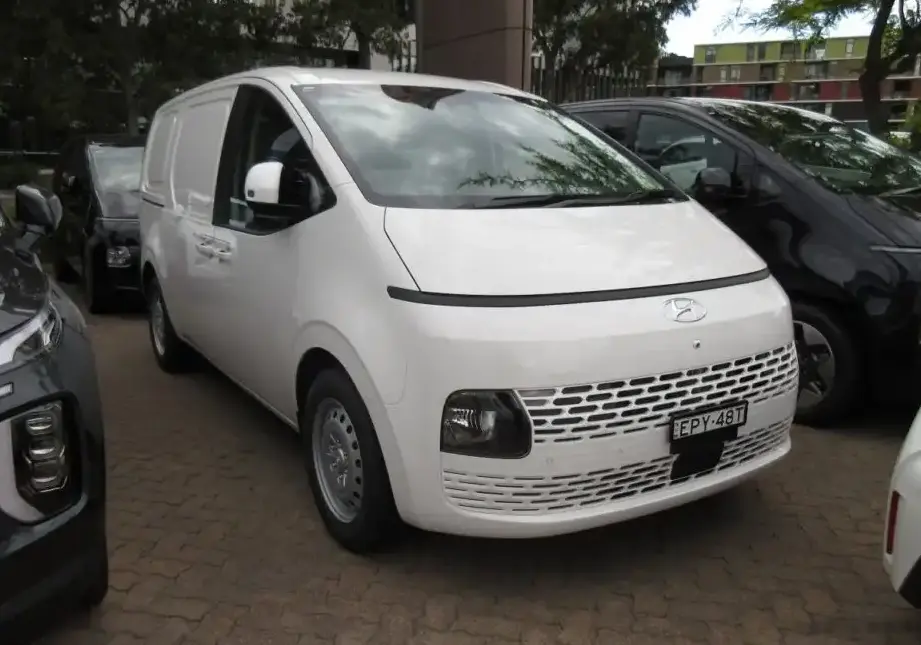
Technical Specifications
| Brand | Hyundai |
| Model | Staria |
| Generation | Staria-Load |
| Type | Crew Van 2.2 CRDi VGT (177 Hp) Automatic 5 Seat |
| Start of production | September, 2021 |
| End of production | October, 2024 |
| Powertrain Architecture | Internal Combustion engine |
| Body type | Minivan |
| Seats | 5 |
| Doors | 5 |
| Fuel consumption (urban) | 8.9 l/100 km (26.4 US mpg, 31.7 UK mpg, 11.2 km/l) |
| Fuel consumption (extra urban) | 5.9 l/100 km (39.9 US mpg, 47.9 UK mpg, 16.9 km/l) |
| Fuel consumption (combined) | 7 l/100 km (33.6 US mpg, 40.4 UK mpg, 14.3 km/l) |
| CO2 emissions | 183 g/km |
| Fuel Type | Diesel |
| Emission standard | Euro 5 |
| Weight-to-power ratio | 11.4 kg/Hp, 87.6 Hp/tonne |
| Weight-to-torque ratio | 4.7 kg/Nm, 212.9 Nm/tonne |
| Power | 177 Hp @ 3800 rpm |
| Power per litre | 80.5 Hp/l |
| Torque | 430 Nm @ 1500-2500 rpm (317.15 lb.-ft. @ 1500-2500 rpm) |
| Engine layout | Front, Transverse |
| Engine Model/Code | D4HB |
| Engine displacement | 2199 cm3 (134.19 cu. in.) |
| Number of cylinders | 4 |
| Engine configuration | Inline |
| Cylinder Bore | 85.4 mm (3.36 in.) |
| Piston Stroke | 96 mm (3.78 in.) |
| Compression ratio | 16:1 |
| Number of valves per cylinder | 4 |
| Fuel injection system | Diesel Commonrail |
| Engine aspiration | Turbocharger, Intercooler |
| Valvetrain | HLA |
| Engine oil capacity | 5.6 l (5.92 US qt | 4.93 UK qt) |
| Coolant | 9.96 l (10.52 US qt | 8.76 UK qt) |
| Kerb Weight | 2020-2076 kg (4453.34 – 4576.8 lbs.) |
| Max. weight | 3110 kg (6856.38 lbs.) |
| Max load | 1034-1090 kg (2279.58 – 2403.04 lbs.) |
| Trunk (boot) space – minimum | 2340 l (82.64 cu. ft.) |
| Fuel tank capacity | 75 l (19.81 US gal | 16.5 UK gal) |
| Max. roof load | 100 kg (220.46 lbs.) |
| Permitted trailer load with brakes (12%) | 2500 kg (5511.56 lbs.) |
| Permitted trailer load without brakes | 750 kg (1653.47 lbs.) |
| Permitted towbar download | 100 kg (220.46 lbs.) |
| Length | 5253 mm (206.81 in.) |
| Width | 1997 mm (78.62 in.) |
| Height | 2000 mm (78.74 in.) |
| Wheelbase | 3273 mm (128.86 in.) |
| Front track | 1732 mm (68.19 in.) |
| Rear (Back) track | 1716 mm (67.56 in.) |
| Ride height (ground clearance) | 186 mm (7.32 in.) |
| Minimum turning circle (turning diameter) | 11.94 m (39.17 ft.) |
| Drivetrain Architecture | Front wheel drive |
| Drive wheel | Front wheel drive |
| Number of gears and type of gearbox | 8 gears, automatic transmission |
| Front suspension | Independent type McPherson |
| Rear suspension | Rigid axle suspension, Leaf spring |
| Front brakes | Ventilated discs, 325×20 mm |
| Rear brakes | Ventilated discs, 325×20 mm |
| Assisting systems | ABS (Anti-lock braking system) |
| Steering type | Steering rack and pinion |
| Power steering | Electric Steering |
| Tires size | 215/65 R17 108H |
| Wheel rims size | 6.5J x 17 |
The Hyundai Staria-Load Crew Van 2.2 CRDi VGT Automatic, produced from September 2021 to October 2024, is a practical and versatile commercial vehicle within Hyundai’s lineup. It’s a five-seat crew van variant of the broader Staria-Load generation, designed for businesses and individuals needing both passenger and cargo space. This specific configuration, with the 2.2-liter diesel engine and an eight-speed automatic transmission, aimed to balance fuel efficiency, usability, and driving comfort compared to manual transmission options. The Staria-Load was primarily marketed in Asia, Australia, and select European markets, offering a modern alternative to established competitors in the van and people-mover segments.
Powertrain & Engine Architecture
The Staria-Load Crew Van 2.2 CRDi VGT Automatic is powered by the Hyundai D4HB engine, a 2.2-liter inline-four cylinder diesel. This engine employs a common rail direct injection system, delivering fuel at high pressure for efficient combustion and reduced emissions. The “VGT” designation signifies the use of a Variable Geometry Turbocharger, which adjusts turbine vanes to optimize boost across the engine’s speed range, improving both low-end torque and high-end power. An intercooler further enhances performance by cooling the intake air. The D4HB produces 177 horsepower at 3800 rpm and 430 Nm (317.15 lb.-ft.) of torque between 1500 and 2500 rpm. This torque is particularly valuable for a commercial vehicle, providing strong pulling power and effortless acceleration even when loaded. The engine is paired with an eight-speed automatic transmission, designed for smooth gear changes and efficient power delivery, offering a more relaxed driving experience than manual options.
Driving Characteristics
The combination of 177 hp and 430 Nm of torque in the Staria-Load Crew Van delivers adequate, but not sporty, performance. Acceleration is sufficient for daily driving and highway merging, but it’s not designed for aggressive driving. The eight-speed automatic transmission is well-tuned, providing smooth shifts and keeping the engine within its optimal torque band. The gear ratios prioritize fuel efficiency and hauling capability. Compared to higher-output Staria-Load versions, this variant emphasizes fuel economy and ease of use over outright performance. The automatic transmission enhances driving comfort, especially in city traffic, but may feel slightly less responsive than a manual in certain situations.
Equipment & Trim Levels
The Crew Van configuration of the Staria-Load typically includes five seats, offering flexibility for passengers and cargo. Standard equipment generally includes air conditioning, power windows, a basic audio system, and ABS brakes. Higher trim levels, if offered, might add features like a touchscreen infotainment system, rear parking sensors, and upgraded interior materials. The interior is designed for practicality, featuring durable materials and a functional layout. The dashboard is relatively simple and straightforward, with easy-to-use controls.
Chassis & Braking
The Staria-Load Crew Van utilizes a front-wheel-drive layout, contributing to its relatively low weight and improved fuel efficiency. The front suspension consists of independent McPherson struts, providing a comfortable ride and good handling. The rear suspension employs a rigid axle with leaf springs, a cost-effective and durable solution for carrying heavy loads. The braking system features ventilated discs on all four wheels, providing adequate stopping power. ABS (Anti-lock Braking System) is standard, enhancing safety during emergency braking.
Market Reception & Comparison
The Hyundai Staria-Load Crew Van 2.2 CRDi VGT Automatic was generally well-received in its target markets. Critics praised its spacious interior, practical design, and relatively fuel-efficient engine. The automatic transmission was seen as a welcome addition, making the van easier to drive in urban environments. Compared to other vans in its class, the Staria-Load offered a competitive combination of features, performance, and price. Its fuel economy was comparable to other diesel-powered vans, and its reliability was generally considered good. However, some critics noted that its interior materials weren’t as refined as those found in some European competitors.
Legacy
The Hyundai Staria-Load, and specifically the 2.2 CRDi VGT Automatic variant, has become a reliable and practical workhorse in the used car market. The D4HB engine, while requiring proper servicing like any diesel, has proven relatively durable. The eight-speed automatic transmission has also demonstrated good longevity. As a used vehicle, the Staria-Load Crew Van offers excellent value, providing a spacious and versatile platform for businesses and individuals. Its continued presence on the road is a testament to its build quality and practicality.
