
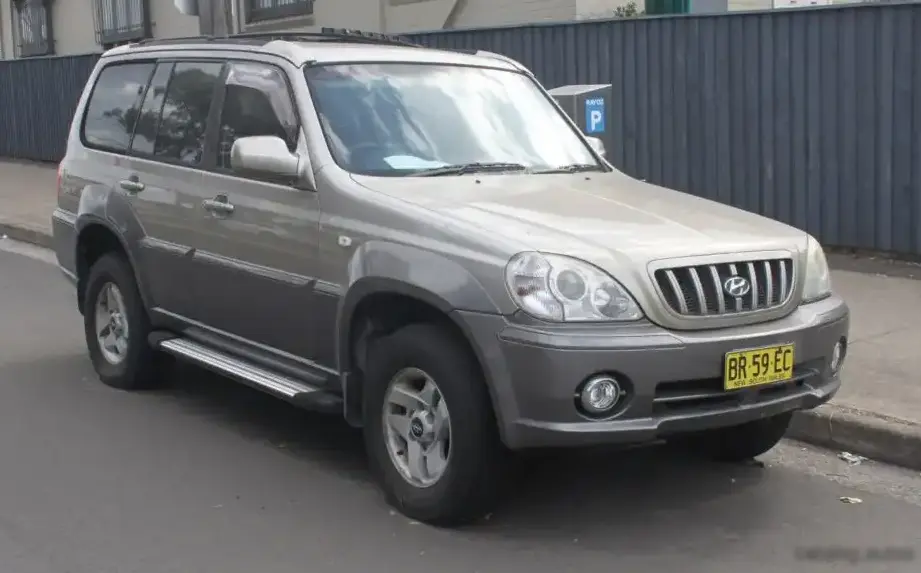
The Hyundai Terracan 2.9 16V DSL, producing 150 horsepower, was a mid-size SUV manufactured by the South Korean automaker Hyundai from 2001 to 2004. Positioned as a body-on-frame SUV, the Terracan aimed to compete with established Japanese and European models in the growing SUV segment. It was primarily marketed outside of North America, finding its strongest sales in Europe, Australia, and parts of Asia. This particular 2.9-liter diesel variant represented a balance between fuel efficiency and capability, slotting in as a mid-range offering within the Terracan lineup, below the more powerful gasoline engines and above any potential base-level trims.
Technical Specifications
| Brand | Hyundai |
| Model | Terracan |
| Generation | Terracan |
| Type (Engine) | 2.9 16V DSL (150 Hp) |
| Start of production | 2001 |
| End of production | 2004 |
| Powertrain Architecture | Internal Combustion engine |
| Body type | SUV |
| Seats | 5 |
| Doors | 5 |
| Fuel consumption (urban) | 10.5 l/100 km (22.4 US mpg) |
| Fuel consumption (extra urban) | 7.5 l/100 km (31.4 US mpg) |
| Fuel consumption (combined) | 8.6 l/100 km (27.4 US mpg) |
| Fuel Type | Diesel |
| Acceleration 0 – 100 km/h | 13.7 sec |
| Acceleration 0 – 62 mph | 13.7 sec |
| Acceleration 0 – 60 mph | 13 sec |
| Maximum speed | 166 km/h (103.15 mph) |
| Weight-to-power ratio | 14.8 kg/Hp |
| Weight-to-torque ratio | 6.7 kg/Nm |
| Power | 150 Hp @ 3800 rpm |
| Torque | 333 Nm @ 2000 rpm (245.61 lb.-ft. @ 2000 rpm) |
| Engine layout | Front, Longitudinal |
| Engine Model/Code | J3 |
| Engine displacement | 2902 cm3 (177.09 cu. in.) |
| Number of cylinders | 4 |
| Engine configuration | Inline |
| Cylinder Bore | 97.1 mm (3.82 in.) |
| Piston Stroke | 98 mm (3.86 in.) |
| Compression ratio | 19.3:1 |
| Number of valves per cylinder | 4 |
| Fuel injection system | Diesel Commonrail |
| Engine oil capacity | 6 l (6.34 US qt | 5.28 UK qt) |
| Coolant capacity | 9 l (9.51 US qt | 7.92 UK qt) |
| Kerb Weight | 2220 kg (4894.26 lbs.) |
| Max. weight | 2590 kg (5709.97 lbs.) |
| Max load | 370 kg (815.71 lbs.) |
| Trunk (boot) space – minimum | 1170 l (41.32 cu. ft.) |
| Trunk (boot) space – maximum | 1955 l (69.04 cu. ft.) |
| Fuel tank capacity | 75 l (19.81 US gal | 16.5 UK gal) |
| Length | 4710 mm (185.43 in.) |
| Width | 1860 mm (73.23 in.) |
| Height | 1790 mm (70.47 in.) |
| Wheelbase | 2750 mm (108.27 in.) |
| Front track | 1500 mm (59.06 in.) |
| Rear track | 1500 mm (59.06 in.) |
| Drive wheel | All wheel drive (4×4) |
| Number of gears | 5 |
| Gearbox type | Manual transmission |
| Front suspension | Double wishbone |
| Rear suspension | Coil spring |
| Front brakes | Ventilated discs |
| Rear brakes | Disc |
| Assisting systems | ABS (Anti-lock braking system) |
| Steering type | Steering rack and pinion |
| Power steering | Hydraulic |
| Tires size | 235/75 R15 |
Powertrain & Engine Architecture
The heart of the Terracan 2.9 DSL was the Hyundai J3 engine, a 2.9-liter inline-four cylinder diesel. This engine utilized a single overhead camshaft (SOHC) design with four valves per cylinder, contributing to its relatively efficient operation. The J3 engine employed a diesel common rail fuel injection system, a technology that allowed for precise fuel delivery and improved combustion efficiency compared to older mechanical injection systems. A turbocharger with an intercooler was standard, boosting power output and reducing turbo lag. The 16-valve configuration, combined with the turbocharging, helped the engine produce 150 horsepower at 3800 rpm and a respectable 333 Nm (245.61 lb-ft) of torque at 2000 rpm. The engine was mounted longitudinally in the chassis. The Terracan 2.9 DSL was typically paired with a five-speed manual transmission, although an optional four-speed automatic transmission was also available. The automatic transmission, while offering convenience, did impact acceleration and fuel economy compared to the manual.
Driving Characteristics
The Terracan 2.9 DSL with the manual transmission offered adequate performance for everyday driving and moderate off-road excursions. Acceleration from 0 to 60 mph took around 13 seconds, which was typical for a diesel SUV of its size and era. The engine’s torque peak at 2000 rpm provided good low-end grunt, making it suitable for towing and navigating challenging terrain. The automatic transmission, however, noticeably dulled performance. The gear ratios were tuned for fuel efficiency rather than outright acceleration, resulting in a slower and less responsive driving experience. The Terracan’s body-on-frame construction contributed to a somewhat truck-like ride quality, with noticeable body roll in corners. However, it also provided a robust and durable platform for off-road driving.
Equipment & Trim Levels
The Terracan 2.9 DSL typically came with a reasonable level of standard equipment. This included power windows, power door locks, air conditioning, and an AM/FM radio. Higher trim levels offered features such as alloy wheels, a sunroof, leather upholstery, and upgraded audio systems. Interior appointments were generally functional and durable, reflecting the Terracan’s intended use as a practical and rugged SUV. The dashboard layout was straightforward and easy to use, with clearly labeled controls. Optional extras included a rear differential lock for improved off-road capability and a CD player for the audio system.
Chassis & Braking
The Terracan utilized a traditional body-on-frame construction, providing a sturdy and durable chassis. The front suspension consisted of a double wishbone setup, while the rear suspension employed coil springs. This configuration aimed to balance ride comfort with off-road capability. Braking duties were handled by ventilated discs at the front and solid discs at the rear. An Anti-lock Braking System (ABS) was standard, enhancing safety by preventing wheel lockup during hard braking. The steering system was a rack and pinion setup with hydraulic power assistance, providing responsive and precise steering control.
Market Reception & Comparison
The Hyundai Terracan 2.9 DSL received mixed reviews from automotive critics. While praised for its robust construction, spacious interior, and competitive price, it was often criticized for its somewhat unrefined engine and truck-like ride quality. Compared to other diesel SUVs in its class, such as the Mitsubishi Pajero and the Toyota Land Cruiser, the Terracan offered a more affordable alternative, but lacked the same level of refinement and brand prestige. Fuel economy was generally considered good for a vehicle of its size and type, averaging around 27.4 US mpg in combined driving conditions. Reliability was generally acceptable, although some owners reported issues with the fuel injection system and turbocharger.
Legacy
The Hyundai Terracan, while not a massive sales success, played a role in establishing Hyundai as a credible player in the global SUV market. The 2.9-liter diesel engine proved to be relatively durable, and well-maintained examples continue to be found on the used car market today. However, due to its age and mileage, potential buyers should be aware of potential maintenance issues, particularly with the fuel injection system and turbocharger. The Terracan’s simple and robust design makes it relatively easy to repair, and parts availability is generally good. It remains a popular choice for those seeking a capable and affordable SUV for off-road adventures or practical transportation.
