
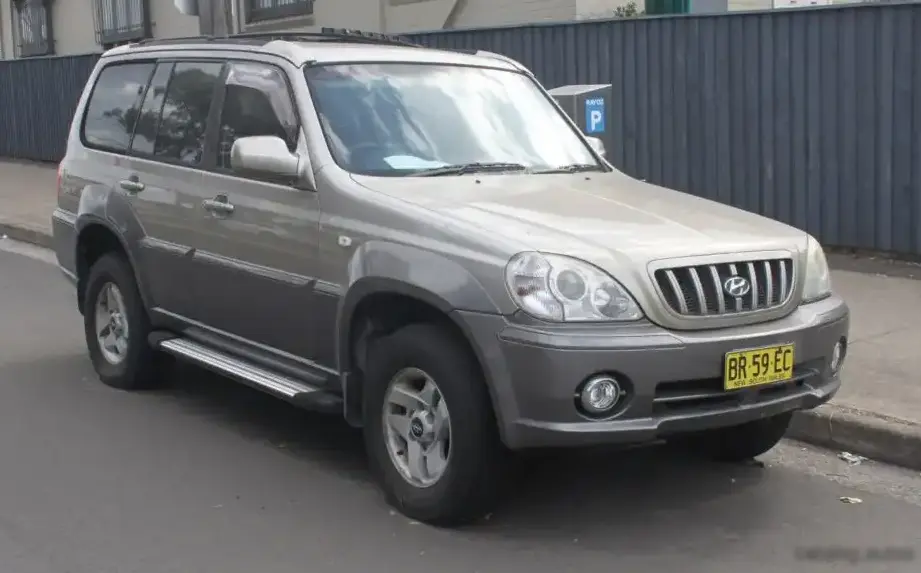
The Hyundai Terracan 2.9 DSL Automatic, produced between 2001 and 2004, represented Hyundai’s entry into the mid-size SUV market, primarily aimed at buyers seeking a robust, capable vehicle with a diesel engine. This particular variant, equipped with the 2.9-liter turbocharged diesel engine and a four-speed automatic transmission, occupied a middle ground within the Terracan lineup, offering a balance between performance, fuel economy, and ease of use. The Terracan, designated as the JP platform, was a significant step for Hyundai, showcasing their ambition to compete with established Japanese and European SUV manufacturers. It was never officially sold in the North American market, but found a niche in regions like Europe, Australia, and parts of Asia.
Technical Specifications
| Brand | Hyundai |
| Model | Terracan |
| Generation | Terracan |
| Type (Engine) | 2.9 16V DSL (150 Hp) Automatic |
| Start of production | 2001 |
| End of production | 2004 |
| Powertrain Architecture | Internal Combustion engine |
| Body type | SUV |
| Seats | 5 |
| Doors | 5 |
| Fuel consumption (urban) | 12.6 l/100 km (18.7 US mpg) |
| Fuel consumption (extra urban) | 8.6 l/100 km (27.4 US mpg) |
| Fuel consumption (combined) | 9.8 l/100 km (24 US mpg) |
| Fuel Type | Diesel |
| Acceleration 0 – 100 km/h | 14.8 sec |
| Acceleration 0 – 62 mph | 14.8 sec |
| Acceleration 0 – 60 mph | 14.1 sec |
| Maximum speed | 168 km/h (104.39 mph) |
| Weight-to-power ratio | 14.8 kg/Hp |
| Weight-to-torque ratio | 6.7 kg/Nm |
| Power | 150 Hp @ 3800 rpm |
| Torque | 333 Nm @ 2000 rpm (245.61 lb.-ft. @ 2000 rpm) |
| Engine layout | Front, Longitudinal |
| Engine Model/Code | J3 |
| Engine displacement | 2902 cm3 (177.09 cu. in.) |
| Number of cylinders | 4 |
| Engine configuration | Inline |
| Cylinder Bore | 97.1 mm (3.82 in.) |
| Piston Stroke | 98 mm (3.86 in.) |
| Compression ratio | 19.3:1 |
| Number of valves per cylinder | 4 |
| Fuel injection system | Diesel Commonrail |
| Engine aspiration | Turbocharger, Intercooler |
| Engine oil capacity | 6 l (6.34 US qt | 5.28 UK qt) |
| Coolant capacity | 9 l (9.51 US qt | 7.92 UK qt) |
| Kerb Weight | 2220 kg (4894.26 lbs.) |
| Max. weight | 2590 kg (5709.97 lbs.) |
| Max load | 370 kg (815.71 lbs.) |
| Trunk (boot) space – minimum | 1170 l (41.32 cu. ft.) |
| Trunk (boot) space – maximum | 1955 l (69.04 cu. ft.) |
| Fuel tank capacity | 75 l (19.81 US gal | 16.5 UK gal) |
| Length | 4710 mm (185.43 in.) |
| Width | 1860 mm (73.23 in.) |
| Height | 1790 mm (70.47 in.) |
| Wheelbase | 2750 mm (108.27 in.) |
| Front track | 1500 mm (59.06 in.) |
| Rear track | 1500 mm (59.06 in.) |
| Drive wheel | All wheel drive (4×4) |
| Number of gears | 4 |
| Gearbox type | Automatic transmission |
| Front suspension | Double wishbone |
| Rear suspension | Coil spring |
| Front brakes | Ventilated discs |
| Rear brakes | Disc |
| Assisting systems | ABS (Anti-lock braking system) |
| Steering type | Steering rack and pinion |
| Power steering | Hydraulic |
| Tires size | 235/75 R15 |
| Wheel rims size | 15 |
Powertrain & Engine Architecture
The heart of the Terracan 2.9 DSL Automatic is the Hyundai J3 engine, a 2.9-liter inline-four cylinder diesel. This engine utilizes a common rail direct injection system, a technology that was becoming increasingly prevalent in diesel engines during the early 2000s. The common rail system allowed for more precise fuel delivery, resulting in improved fuel efficiency, reduced emissions, and enhanced engine refinement. A turbocharger with an intercooler was employed to boost power output, bringing it to 150 horsepower at 3800 rpm and 333 Nm (245.61 lb-ft) of torque at 2000 rpm. The four-speed automatic transmission, while providing convenience, was a relatively conventional unit for the time. It wasn’t known for particularly quick shifts or advanced features, but it was generally reliable. The engine is longitudinally mounted, contributing to a more balanced weight distribution.
Driving Characteristics
The Terracan 2.9 DSL Automatic offered a comfortable, if not particularly sporty, driving experience. The 150 hp engine and four-speed automatic weren’t designed for rapid acceleration; 0-60 mph took around 14.1 seconds. However, the substantial 333 Nm of torque provided adequate pulling power for everyday driving and towing. The automatic transmission’s gear ratios were geared towards fuel economy and relaxed cruising rather than performance. Compared to the manual transmission versions of the Terracan, the automatic felt noticeably slower. Higher-output engine options, such as the later 3.0-liter diesel, offered significantly improved performance. The all-wheel-drive system provided enhanced traction in slippery conditions, making it a capable vehicle for off-road use, though it wasn’t a dedicated off-roader.
Equipment & Trim Levels
The Terracan 2.9 DSL Automatic typically came with a reasonable level of standard equipment. This included air conditioning, power windows, power steering, and an AM/FM radio. Higher trim levels offered features such as leather upholstery, a sunroof, and upgraded audio systems. Interior materials were generally durable but not luxurious. The dashboard layout was functional and straightforward, prioritizing usability over aesthetics. Optional extras included alloy wheels, a rear parking sensor, and a tow hitch.
Chassis & Braking
The Terracan utilized a body-on-frame construction, a traditional SUV design that prioritized robustness and off-road capability. The front suspension consisted of a double wishbone setup, while the rear employed a coil spring arrangement. This suspension configuration provided a comfortable ride, but it wasn’t particularly sporty. Braking duties were handled by ventilated discs at the front and solid discs at the rear. An Anti-lock Braking System (ABS) was standard, enhancing safety. The steering was hydraulic power-assisted, providing reasonable feedback and ease of use.
Market Reception & Comparison
The Terracan 2.9 DSL Automatic received mixed reviews from automotive critics. It was generally praised for its spacious interior, robust construction, and capable all-wheel-drive system. However, the engine was often criticized for being underpowered, and the automatic transmission was considered somewhat dated. Fuel economy was respectable for a vehicle of its size and type, averaging around 24 US mpg in combined driving. Compared to other SUVs in its class, such as the Toyota RAV4 or Honda CR-V (which were typically smaller and more fuel-efficient), the Terracan offered a more rugged and utilitarian experience. It competed more directly with vehicles like the Mitsubishi Pajero and Kia Sorento.
Legacy
The Hyundai Terracan, while not a massive sales success, played an important role in establishing Hyundai as a credible SUV manufacturer. The 2.9 DSL Automatic powertrain, while not known for exceptional performance, proved to be relatively reliable. Today, Terracans are becoming increasingly sought after by enthusiasts and collectors, particularly those looking for a capable and affordable off-road vehicle. Parts availability can be a challenge, but the engine is generally durable and can withstand high mileage with proper maintenance. The Terracan represents a unique chapter in Hyundai’s history, showcasing their early efforts to compete in the global SUV market.
