
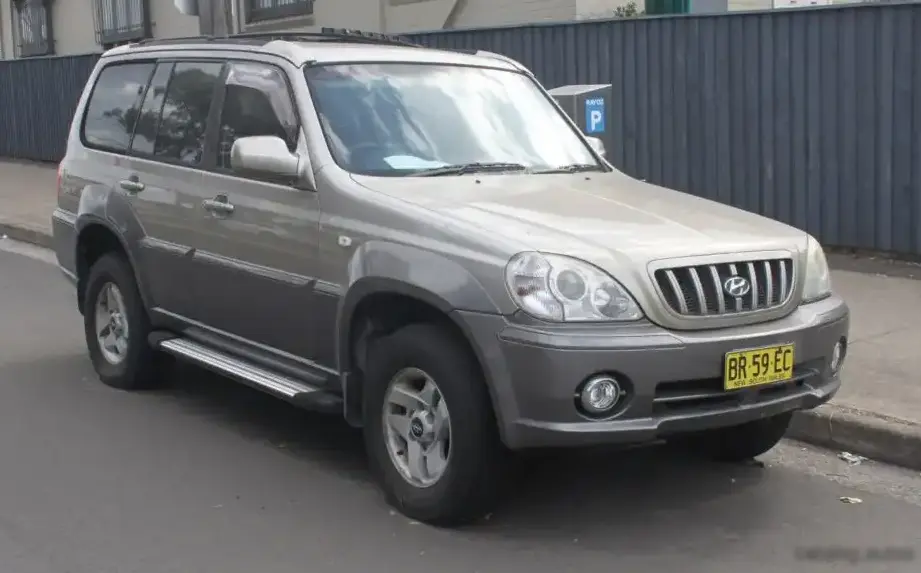
The Hyundai Terracan, produced from 2001 to 2006, was Hyundai’s initial foray into the mid-size SUV market, primarily aimed at competing with established Japanese and American offerings. The 3.5 i V6 24V Automatic variant, equipped with the Sigma / G6CU engine, represented the higher end of the Terracan lineup, offering a blend of power and convenience. This model was particularly significant for Hyundai as it showcased their ambition to produce a capable and well-equipped SUV for a global audience. While sales were strongest in markets outside of North America, the Terracan laid the groundwork for Hyundai’s later success in the SUV segment.
Technical Specifications
| Brand | Hyundai |
| Model | Terracan |
| Generation | Terracan |
| Type (Engine) | 3.5 i V6 24V (195 Hp) Automatic |
| Start of production | 2001 |
| End of production | 2006 |
| Powertrain Architecture | Internal Combustion engine |
| Body type | SUV |
| Seats | 5 |
| Doors | 5 |
| Fuel consumption (urban) | 20.5 l/100 km (11.5 US mpg) |
| Fuel consumption (extra urban) | 12.1 l/100 km (19.4 US mpg) |
| Fuel consumption (combined) | 15.2 l/100 km (15.5 US mpg) |
| Fuel Type | Petrol (Gasoline) |
| Acceleration 0 – 100 km/h | 10.7 sec |
| Acceleration 0 – 62 mph | 10.7 sec |
| Acceleration 0 – 60 mph | 10.2 sec |
| Maximum speed | 185 km/h (114.95 mph) |
| Weight-to-power ratio | 10.2 kg/Hp |
| Weight-to-torque ratio | 6.8 kg/Nm |
| Power | 195 Hp @ 5500 rpm |
| Torque | 294 Nm @ 3000 rpm (216.84 lb.-ft. @ 3000 rpm) |
| Engine layout | Front, Longitudinal |
| Engine Model/Code | Sigma / G6CU |
| Engine displacement | 3497 cm3 (213.4 cu. in.) |
| Number of cylinders | 6 |
| Engine configuration | V-engine |
| Cylinder Bore | 93 mm (3.66 in.) |
| Piston Stroke | 85.8 mm (3.38 in.) |
| Compression ratio | 10:1 |
| Number of valves per cylinder | 4 |
| Fuel injection system | Multi-port manifold injection |
| Engine aspiration | Naturally aspirated engine |
| Valvetrain | DOHC |
| Engine oil capacity | 4.3 l (4.54 US qt | 3.78 UK qt) |
| Coolant capacity | 11 l (11.62 US qt | 9.68 UK qt) |
| Kerb Weight | 1990 kg (4387.2 lbs.) |
| Trunk (boot) space – minimum | 1170 l (41.32 cu. ft.) |
| Trunk (boot) space – maximum | 1955 l (69.04 cu. ft.) |
| Fuel tank capacity | 75 l (19.81 US gal | 16.5 UK gal) |
| Length | 4710 mm (185.43 in.) |
| Width | 1860 mm (73.23 in.) |
| Height | 1790 mm (70.47 in.) |
| Wheelbase | 2750 mm (108.27 in.) |
| Front track | 1500 mm (59.06 in.) |
| Rear track | 1500 mm (59.06 in.) |
| Drive wheel | All wheel drive (4×4) |
| Number of gears | 4 |
| Gearbox type | Automatic transmission |
| Front suspension | Double wishbone |
| Rear suspension | Coil spring |
| Front brakes | Ventilated discs |
| Rear brakes | Disc |
| Assisting systems | ABS (Anti-lock braking system) |
| Steering type | Steering rack and pinion |
| Power steering | Hydraulic Steering |
| Tires size | 235/75 R15 |
| Wheel rims size | 15 |
Powertrain & Engine Architecture
The heart of the Terracan 3.5 i V6 was the Hyundai Sigma engine, specifically the G6CU variant. This 3.5-liter, naturally aspirated V6 engine featured a 60-degree V-angle and utilized a double overhead camshaft (DOHC) valvetrain with four valves per cylinder. The engine employed multi-point fuel injection, delivering fuel directly into the intake ports. The G6CU produced 195 horsepower at 5,500 rpm and 294 Nm (216.84 lb-ft) of torque at 3,000 rpm. The engine’s longitudinal mounting and all-wheel-drive configuration contributed to its robust character. Paired with a four-speed automatic transmission, the powertrain aimed for a balance between performance and ease of driving. This automatic transmission, while providing convenience, wasn’t known for its particularly quick shifts or fuel efficiency compared to more modern automatics.
Driving Characteristics
The Terracan 3.5 V6 Automatic offered adequate performance for its size and intended purpose. Acceleration from 0 to 60 mph took around 10.2 seconds, and it had a top speed of approximately 115 mph. The four-speed automatic transmission, while smooth, did result in noticeable gear changes and wasn’t as responsive as some contemporary transmissions. The torque converter provided a degree of smoothness at lower speeds, but the lack of additional gears meant the engine often operated at higher RPMs during highway cruising. Compared to the available manual transmission or the later 2.5-liter diesel options, the 3.5 V6 Automatic prioritized comfort and ease of use over outright fuel economy or sporty handling. The all-wheel-drive system provided enhanced traction in various conditions, making it a capable vehicle for inclement weather or light off-road use.
Equipment & Trim Levels
The 3.5 i V6 Automatic trim generally represented the upper echelon of the Terracan range. Standard features typically included air conditioning, power windows and locks, a basic audio system, and alloy wheels. Interior upholstery was usually cloth, though leather options were available. Higher-spec versions could include features like a sunroof, upgraded audio systems, and woodgrain interior trim. The dashboard layout was functional but not particularly luxurious, reflecting the Terracan’s positioning as a value-oriented SUV. Optional extras often included a rear parking sensor, upgraded sound system, and a tow package.
Chassis & Braking
The Terracan utilized a body-on-frame construction, a common design for SUVs of that era, prioritizing durability and off-road capability. The front suspension employed a double wishbone setup, while the rear utilized a coil spring arrangement. Braking consisted of ventilated discs at the front and solid discs at the rear. Anti-lock Braking System (ABS) was standard, enhancing safety. The steering was rack and pinion with hydraulic power assistance. The suspension tuning was geared towards comfort, providing a relatively smooth ride on paved roads, though it could feel somewhat bouncy when fully loaded or on rough terrain. The 15-inch wheels were typically fitted with 235/75 R15 tires.
Market Reception & Comparison
The Terracan 3.5 V6 Automatic received mixed reviews. Critics generally praised its spacious interior, comfortable ride, and capable all-wheel-drive system. However, the engine’s fuel economy was a common complaint, averaging around 15.5 US mpg in combined driving. Compared to the 2.5-liter diesel versions, the 3.5 V6 offered more power but significantly lower fuel efficiency. The V6 also tended to be more expensive to maintain due to its more complex engine design. Against competitors like the Toyota 4Runner and Mitsubishi Pajero, the Terracan offered a more affordable price point but lacked the established reputation for reliability and refinement.
Legacy
The Hyundai Terracan, while not a massive sales success, was a crucial stepping stone for Hyundai in the SUV market. The 3.5 i V6 Automatic powertrain, while not known for exceptional longevity, proved reasonably reliable with proper maintenance. Today, Terracans are relatively rare, and well-maintained examples are sought after by enthusiasts. The engine’s simplicity makes it relatively easy to work on for experienced mechanics. The Terracan’s legacy lies in demonstrating Hyundai’s commitment to expanding its product range and challenging established automotive brands. It paved the way for the more successful Santa Fe and Veracruz SUVs that followed.
