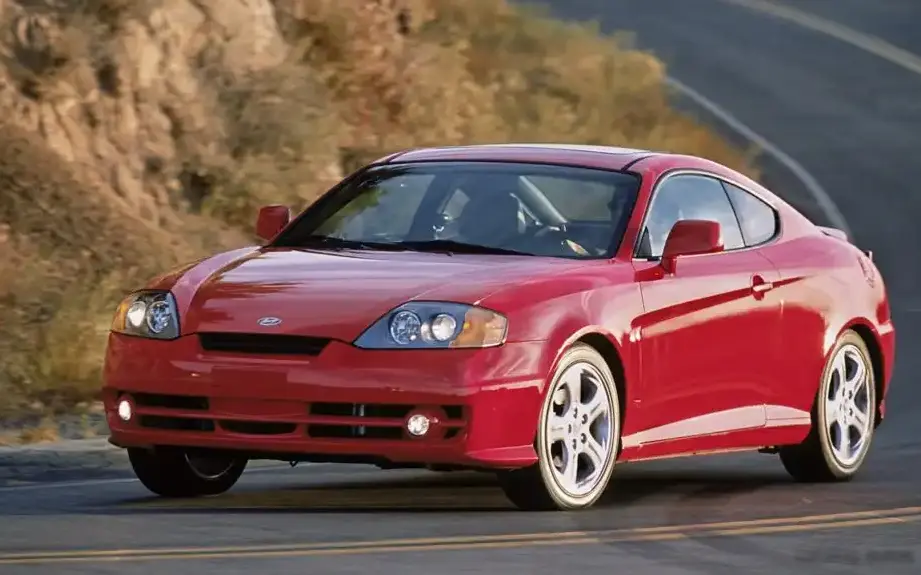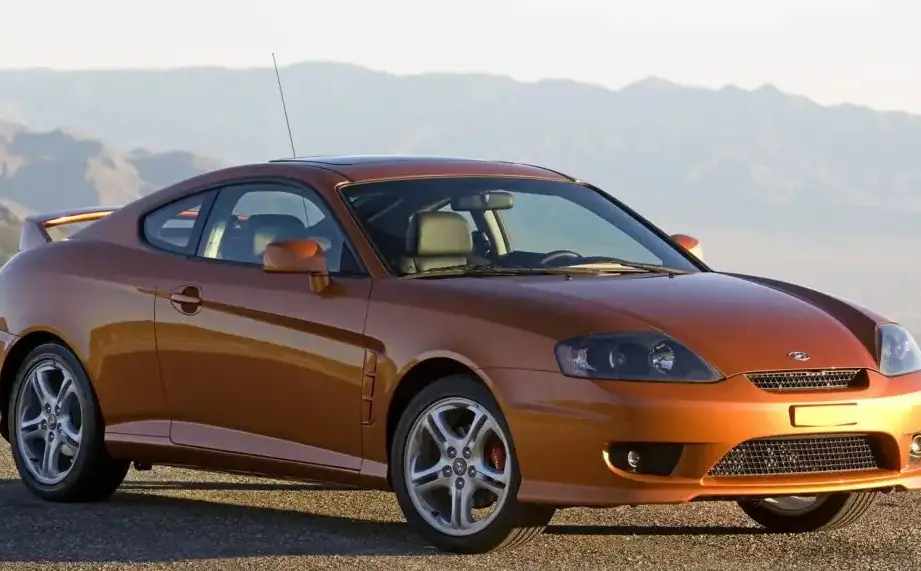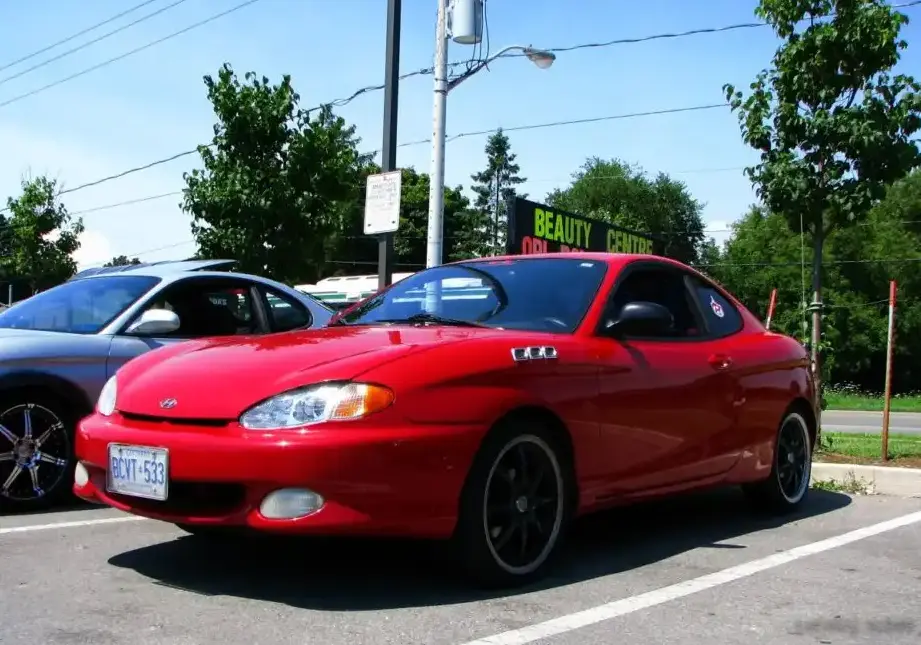
The Hyundai Tiburon, launched in 1996, represented a significant departure for the South Korean automaker, marking its first serious foray into the sporty coupe market. The first generation, internally designated RD, was produced from 1996 to 2002, with the 1.8L 16V variant appearing from 1998 and continuing through 2001. This model aimed to provide an affordable and stylish alternative to established Japanese and European coupes, particularly in North America where it was marketed as a competitor to the Honda Civic Coupe and Toyota Celica. The 1.8L 16V trim occupied a middle ground in the Tiburon lineup, offering a balance between performance and economy, positioned above the base 1.6L engine and below the more powerful 2.0L options.
Technical Specifications
| Brand | Hyundai |
| Model | Tiburon |
| Generation | Tiburon I (RD) |
| Type (Engine) | 1.8 16V (132 Hp) |
| Start of production | 1998 |
| End of production | 2001 |
| Powertrain Architecture | Internal Combustion engine |
| Body type | Coupe |
| Seats | 5 |
| Doors | 3 |
| Fuel consumption (urban) | 10.7 l/100 km (22 US mpg) |
| Fuel consumption (extra urban) | 7.8 l/100 km (30.2 US mpg) |
| Fuel Type | Petrol (Gasoline) |
| Maximum speed | 190 km/h (118.06 mph) |
| Weight-to-power ratio | 9.4 kg/Hp |
| Weight-to-torque ratio | 7.5 kg/Nm |
| Power | 132 Hp @ 6000 rpm |
| Power per litre | 73.5 Hp/l |
| Torque | 166 Nm @ 5000 rpm (122.44 lb.-ft. @ 5000 rpm) |
| Engine layout | Front, Longitudinal |
| Engine Model/Code | Beta / G4GM |
| Engine displacement | 1796 cm3 (109.6 cu. in.) |
| Number of cylinders | 4 |
| Engine configuration | Inline |
| Cylinder Bore | 82 mm (3.23 in.) |
| Piston Stroke | 85 mm (3.35 in.) |
| Compression ratio | 10:1 |
| Number of valves per cylinder | 4 |
| Fuel injection system | Multi-port manifold injection |
| Engine aspiration | Naturally aspirated engine |
| Valvetrain | DOHC |
| Engine oil capacity | 4 l (4.23 US qt | 3.52 UK qt) |
| Coolant | 6 l (6.34 US qt | 5.28 UK qt) |
| Kerb Weight | 1240 kg (2733.73 lbs.) |
| Max. weight | 1600 kg (3527.4 lbs.) |
| Max load | 360 kg (793.66 lbs.) |
| Trunk (boot) space – maximum | 360 l (12.71 cu. ft.) |
| Fuel tank capacity | 55 l (14.53 US gal | 12.1 UK gal) |
| Length | 4340 mm (170.87 in.) |
| Width | 1730 mm (68.11 in.) |
| Height | 1310 mm (51.57 in.) |
| Wheelbase | 2480 mm (97.64 in.) |
| Front track | 1470 mm (57.87 in.) |
| Rear (Back) track | 1450 mm (57.09 in.) |
| Drivetrain Architecture | The Internal combustion engine (ICE) drives the front wheels of the vehicle. |
| Drive wheel | Front wheel drive |
| Number of gears and type of gearbox | 5 gears, manual transmission |
| Front suspension | Spring Strut |
| Rear suspension | Coil spring |
| Front brakes | Ventilated discs |
| Rear brakes | Disc |
| Steering type | Steering rack and pinion |
| Power steering | Hydraulic Steering |
| Tires size | 195/60 R14 |
Powertrain & Engine Architecture
The heart of the Tiburon 1.8 16V is Hyundai’s Beta engine, specifically the G4GM code. This 1.8-liter inline-four cylinder engine utilizes a double overhead camshaft (DOHC) valvetrain with four valves per cylinder, contributing to its relatively high output for its displacement. Fuel delivery is managed by a multi-port fuel injection system, providing precise fuel metering for improved efficiency and performance. The engine’s 10:1 compression ratio strikes a balance between power and fuel economy. The engine is longitudinally mounted, driving the front wheels. While not a particularly advanced engine by late-1990s standards, the Beta engine proved to be reasonably durable and reliable. The 5-speed manual transmission was the standard offering, providing drivers with direct control over the engine’s power.
Driving Characteristics
The 132 horsepower and 122 lb-ft of torque produced by the 1.8L engine provided adequate, though not exhilarating, performance. Acceleration to 60 mph took approximately 9-10 seconds. The manual transmission’s gear ratios were tuned for a balance of everyday drivability and reasonable responsiveness. Compared to the higher-output 2.0L Tiburons, the 1.8L felt noticeably less powerful, particularly during highway passing maneuvers. However, the lighter weight of the 1.8L model, compared to the 2.0L, helped to mitigate some of the power deficit. The 1.8L Tiburon offered a more fuel-efficient driving experience than its more powerful siblings, making it a popular choice for daily commuting.
Equipment & Trim Levels
The 1.8L Tiburon typically came equipped with standard features such as air conditioning, power windows and locks, and an AM/FM stereo. Interior upholstery was typically cloth, with a relatively simple dashboard layout. Optional extras included a sunroof, upgraded stereo system, and alloy wheels. The trim level often dictated the availability of these options. The 1.8L trim was generally considered the entry-level sporty coupe, appealing to buyers who prioritized affordability and fuel economy over outright performance.
Chassis & Braking
The Tiburon RD utilized a front-engine, front-wheel-drive layout. Suspension consisted of a MacPherson strut setup at the front and a coil spring arrangement at the rear. The front brakes were ventilated discs, providing adequate stopping power, while the rear brakes were solid discs. Steering was rack-and-pinion with hydraulic power assistance. The suspension tuning was geared towards a comfortable ride, with a slight bias towards handling. The 1.8L models generally featured slightly smaller tires (195/60 R14) compared to the higher-spec 2.0L versions.
Market Reception & Comparison
The 1.8L Tiburon received mixed reviews from automotive critics. While praised for its styling and affordability, it was often criticized for its lack of refinement and somewhat underwhelming performance. Compared to the 2.0L Tiburon, the 1.8L offered significantly less power, but also better fuel economy. The 1.8L was often seen as a good value for the money, particularly for first-time car buyers or those seeking an affordable sporty coupe. Fuel economy figures were competitive for the era, averaging around 22 mpg in the city and 30 mpg on the highway.
Legacy
The Hyundai Tiburon 1.8L 16V, while not a groundbreaking vehicle, played an important role in establishing Hyundai as a credible competitor in the global automotive market. The Beta engine proved to be relatively reliable, and many examples are still on the road today. In the used car market, the 1.8L Tiburon remains an affordable and accessible option for those seeking a classic 1990s coupe. Maintenance costs are generally low, and parts availability is still reasonable. However, potential buyers should be aware of potential issues such as rust and wear and tear on suspension components. The Tiburon, in all its trims, helped pave the way for Hyundai’s subsequent success with more sophisticated and performance-oriented models.