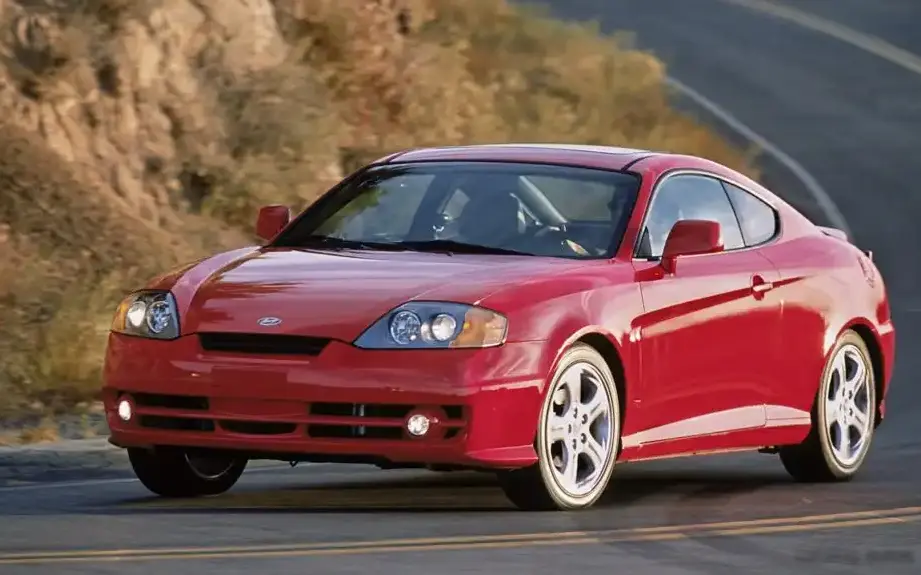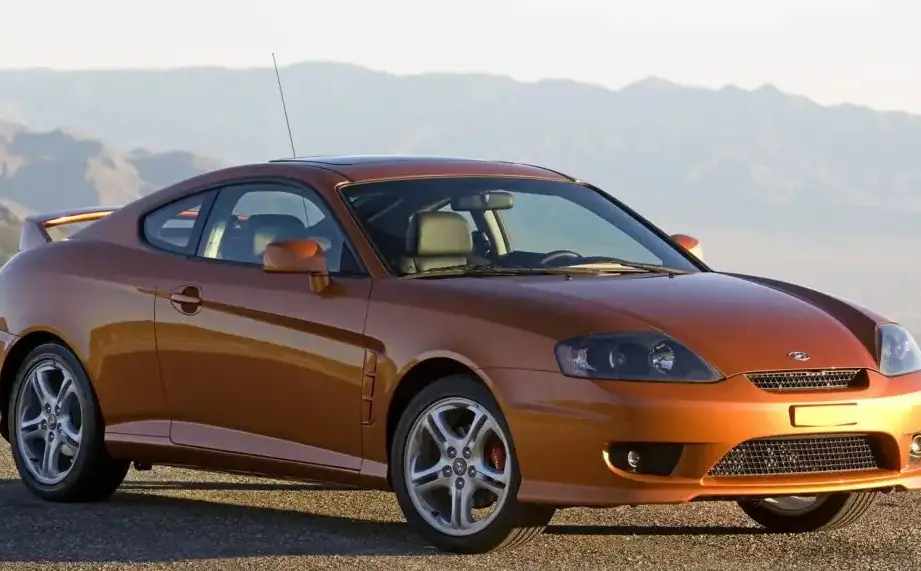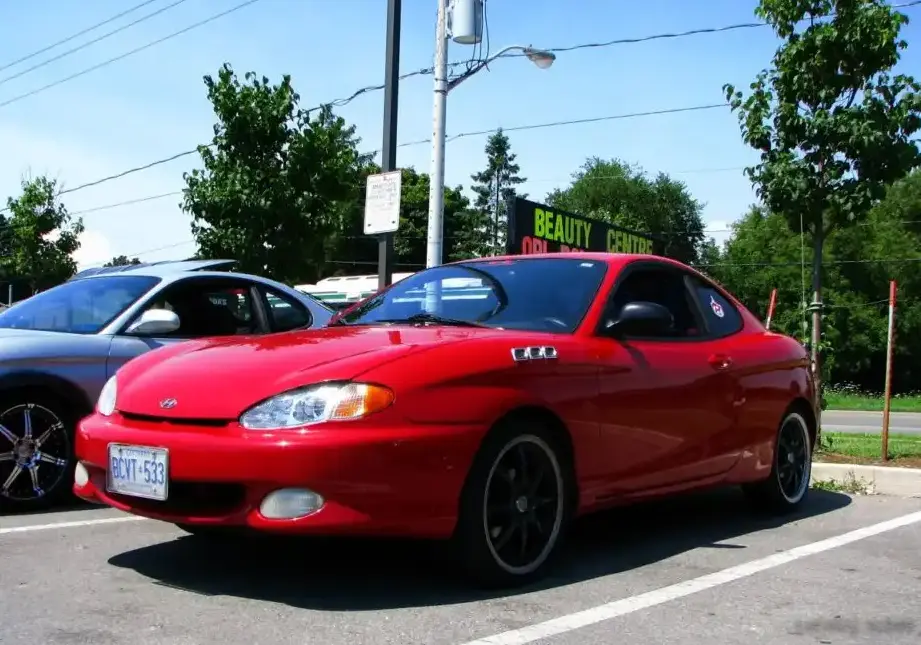
The Hyundai Tiburon, marketed as the Hyundai Coupe in some regions, represented a significant step for the South Korean automaker into the realm of sporty, affordable coupes. The first generation, internally designated RD, was produced from 1996 to 2002, with the 2.0-liter 16V automatic variant appearing from 1999 to 2001. This model aimed to capture a segment of the market traditionally dominated by Japanese and European manufacturers, offering a stylish alternative with a focus on value. The 2.0L automatic trim occupied a middle ground in the Tiburon lineup, positioned above the base 1.6L models and below the more performance-oriented 2.7L V6.
Technical Specifications
| Brand | Hyundai |
| Model | Tiburon |
| Generation | Tiburon I (RD) |
| Type (Engine) | 2.0 i 16V (139 Hp) Automatic |
| Start of production | 1999 year |
| End of production | 2001 year |
| Powertrain Architecture | Internal Combustion engine |
| Body type | Coupe |
| Seats | 4 |
| Doors | 3 |
| Fuel consumption (urban) | 13.3 l/100 km (17.7 US mpg, 21.2 UK mpg, 7.5 km/l) |
| Fuel consumption (extra urban) | 7.9 l/100 km (29.8 US mpg, 35.8 UK mpg, 12.7 km/l) |
| Fuel Type | Petrol (Gasoline) |
| Acceleration 0 – 100 km/h | 10.7 sec |
| Acceleration 0 – 62 mph | 10.7 sec |
| Acceleration 0 – 60 mph | 10.2 sec |
| Maximum speed | 198 km/h (123.03 mph) |
| Weight-to-power ratio | 9 kg/Hp, 111.2 Hp/tonne |
| Weight-to-torque ratio | 6.9 kg/Nm, 145.6 Nm/tonne |
| Power | 139 Hp @ 6000 rpm |
| Power per litre | 70.4 Hp/l |
| Torque | 182 Nm @ 4900 rpm (134.24 lb.-ft. @ 4900 rpm) |
| Engine layout | Front, Transverse |
| Engine Model/Code | Beta / G4GF |
| Engine displacement | 1975 cm3 (120.52 cu. in.) |
| Number of cylinders | 4 |
| Engine configuration | Inline |
| Cylinder Bore | 82 mm (3.23 in.) |
| Piston Stroke | 93.5 mm (3.68 in.) |
| Compression ratio | 10:1 |
| Number of valves per cylinder | 4 |
| Fuel injection system | Multi-port manifold injection |
| Engine aspiration | Naturally aspirated engine |
| Valvetrain | DOHC |
| Engine oil capacity | 4 l (4.23 US qt | 3.52 UK qt) |
| Coolant capacity | 6 l (6.34 US qt | 5.28 UK qt) |
| Kerb Weight | 1250 kg (2755.78 lbs.) |
| Max. weight | 1600 kg (3527.4 lbs.) |
| Max load | 350 kg (771.62 lbs.) |
| Trunk (boot) space – maximum | 362 l (12.78 cu. ft.) |
| Fuel tank capacity | 55 l (14.53 US gal | 12.1 UK gal) |
| Length | 4345 mm (171.06 in.) |
| Width | 1730 mm (68.11 in.) |
| Height | 1310 mm (51.57 in.) |
| Wheelbase | 2475 mm (97.44 in.) |
| Front track | 1465 mm (57.68 in.) |
| Rear (Back) track | 1450 mm (57.09 in.) |
| Drivetrain Architecture | The Internal combustion engine (ICE) drives the front wheels of the vehicle. |
| Drive wheel | Front wheel drive |
| Number of gears and type of gearbox | 4 gears, automatic transmission |
| Front suspension | Spring Strut |
| Rear suspension | Coil spring |
| Front brakes | Ventilated discs |
| Rear brakes | Disc |
| Assisting systems | ABS (Anti-lock braking system) |
| Steering type | Steering rack and pinion |
| Power steering | Hydraulic Steering |
| Tires size | 205/50 R15 |
| Wheel rims size | 15 |
Powertrain & Engine Architecture
The 1999-2001 Tiburon 2.0L Automatic was powered by Hyundai’s Beta engine, specifically the G4GF code. This 1975cc inline-four cylinder engine featured a double overhead camshaft (DOHC) valvetrain with four valves per cylinder. The engine utilized a multi-port fuel injection system, delivering fuel directly into the intake ports. The 10:1 compression ratio was typical for the era, balancing performance and fuel efficiency. Paired with this engine was a four-speed automatic transmission, designed for smooth and convenient operation. This transmission, while not offering the driver engagement of a manual, was a key selling point for buyers prioritizing ease of use. The G4GF engine was known for its relatively simple design, contributing to its overall reliability.
Driving Characteristics
The 2.0L automatic Tiburon offered a comfortable, if not particularly exhilarating, driving experience. With 139 horsepower and 134 lb-ft of torque, acceleration from 0-60 mph took around 10.2 seconds. The four-speed automatic transmission was tuned for fuel economy and smooth shifts, rather than aggressive performance. Compared to the five-speed manual version, the automatic resulted in a noticeable decrease in responsiveness. The automatic’s gear ratios were optimized for cruising, making it well-suited for highway driving. However, it lacked the ability to hold gears for more spirited driving, a characteristic that set it apart from the manual transmission and the higher-output 2.7L V6 models.
Equipment & Trim Levels
The 2.0L automatic Tiburon typically came standard with features such as air conditioning, power windows and locks, and an AM/FM stereo. Interior upholstery was generally cloth, with options for upgraded materials available. Dashboard configuration was straightforward, prioritizing functionality over elaborate design. Optional extras included a sunroof, upgraded sound system, and alloy wheels. The trim level often dictated the availability of these features, with higher trims offering more standard equipment. The automatic transmission was often bundled with convenience packages, further enhancing the vehicle’s appeal to buyers seeking a well-equipped and easy-to-drive coupe.
Chassis & Braking
The Tiburon RD utilized a front-engine, front-wheel-drive layout. The front suspension employed a MacPherson strut design, while the rear featured a coil spring setup. Braking duties were handled by ventilated discs at the front and solid discs at the rear. Anti-lock braking system (ABS) was standard, enhancing safety and control. The suspension tuning was geared towards a comfortable ride, rather than aggressive handling. The relatively lightweight construction of the Tiburon helped to mitigate some of the limitations of the suspension, providing a reasonably balanced driving experience. Stabilizer bars were included, but were relatively modest in size compared to those found on more performance-focused vehicles.
Market Reception & Comparison
The 2.0L automatic Tiburon was generally well-received by critics as an affordable and stylish coupe. However, its performance was often criticized as being somewhat underwhelming compared to competitors like the Honda Civic Coupe or the Nissan 200SX. Fuel economy was respectable, averaging around 29.8 US mpg on the highway. Reliability was generally good, although some owners reported minor issues with the automatic transmission over time. Compared to the 1.6L models, the 2.0L offered a noticeable improvement in performance. However, the 2.7L V6 provided a significant power boost, making it the preferred choice for drivers seeking a more engaging driving experience. The automatic transmission was seen as a compromise, offering convenience at the expense of performance.
Legacy
The Hyundai Tiburon, particularly the first generation, played a crucial role in establishing Hyundai as a credible automotive manufacturer in the US market. The 2.0L automatic variant, while not the most sought-after trim, remains a relatively affordable and reliable option in the used car market. The G4GF engine is known for its durability, and with proper maintenance, can provide many years of service. Today, the Tiburon is often appreciated by enthusiasts for its retro styling and its potential for modification. While not a high-performance machine, the 2.0L automatic Tiburon represents a significant milestone in Hyundai’s history, demonstrating the company’s ambition to compete in the global automotive landscape.