
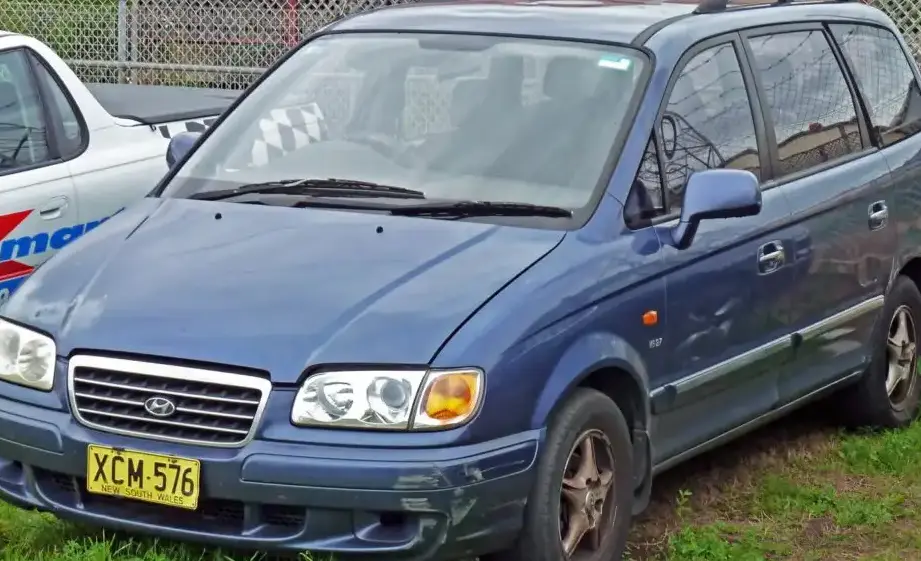
The Hyundai Trajet 2.0 CRDi Automatic, produced between 2001 and 2006, represented Hyundai’s entry into the increasingly popular compact minivan segment. Part of the FO generation Trajet, this variant was positioned as a mid-range offering, balancing fuel efficiency with a reasonable level of performance and convenience features. The Trajet, as a whole, was primarily aimed at the Asian and European markets, offering a seven-seat configuration in a relatively affordable package. This specific 2.0 CRDi Automatic model aimed to appeal to families seeking a practical and economical vehicle for daily transportation.
Technical Specifications
| Brand | Hyundai |
| Model | Trajet |
| Generation | Trajet (FO) |
| Type (Engine) | 2.0 CRDi (113 Hp) Automatic |
| Start of production | 2001 |
| End of production | 2006 |
| Powertrain Architecture | Internal Combustion engine |
| Body type | Minivan |
| Seats | 7 |
| Doors | 5 |
| Fuel consumption (urban) | 9.3 l/100 km (25.3 US mpg) |
| Fuel consumption (extra urban) | 6 l/100 km (39.2 US mpg) |
| Fuel consumption (combined) | 7.2 l/100 km (32.7 US mpg) |
| Fuel Type | Diesel |
| Acceleration 0 – 100 km/h | 14.2 sec |
| Acceleration 0 – 62 mph | 14.2 sec |
| Acceleration 0 – 60 mph | 13.5 sec |
| Maximum speed | 170 km/h (105.63 mph) |
| Weight-to-power ratio | 16.6 kg/Hp |
| Weight-to-torque ratio | 8 kg/Nm |
| Power | 113 Hp @ 4000 rpm |
| Torque | 235 Nm @ 1800 rpm (173.33 lb.-ft. @ 1800 rpm) |
| Engine layout | Front, Transverse |
| Engine Model/Code | D / D4EA |
| Engine displacement | 1991 cm3 (121.5 cu. in.) |
| Number of cylinders | 4 |
| Engine configuration | Inline |
| Cylinder Bore | 83 mm (3.27 in.) |
| Piston Stroke | 92 mm (3.62 in.) |
| Compression ratio | 17.7:1 |
| Number of valves per cylinder | 4 |
| Fuel injection system | Diesel Commonrail |
| Engine aspiration | Turbocharger, Intercooler |
| Valvetrain | OHC |
| Engine oil capacity | 5.9 l (6.23 US qt | 5.19 UK qt) |
| Kerb Weight | 1881 kg (4146.9 lbs.) |
| Max. weight | 2510 kg (5533.6 lbs.) |
| Max load | 629 kg (1386.71 lbs.) |
| Trunk (boot) space – minimum | 304 l (10.74 cu. ft.) |
| Trunk (boot) space – maximum | 2716 l (95.91 cu. ft.) |
| Fuel tank capacity | 65 l (17.17 US gal | 14.3 UK gal) |
| Length | 4695 mm (184.84 in.) |
| Width | 1840 mm (72.44 in.) |
| Height | 1710 mm (67.32 in.) |
| Wheelbase | 2830 mm (111.42 in.) |
| Front track | 1565 mm (61.61 in.) |
| Rear (Back) track | 1565 mm (61.61 in.) |
| Drivetrain Architecture | Front wheel drive |
| Number of gears | 4 |
| Gearbox type | Automatic transmission |
| Front suspension | Wishbone |
| Rear suspension | Coil spring |
| Front brakes | Ventilated discs |
| Rear brakes | Ventilated discs |
| Assisting systems | ABS (Anti-lock braking system) |
| Steering type | Steering rack and pinion |
| Power steering | Hydraulic Steering |
| Tires size | 215/65 R15 |
| Wheel rims size | 15 |
Powertrain & Engine Architecture
The heart of the Trajet 2.0 CRDi Automatic is the Hyundai D4EA engine, a 1.991-liter inline-four cylinder diesel. This engine utilizes a second-generation common rail direct injection system, delivering fuel at extremely high pressures for improved combustion efficiency and reduced emissions. The D4EA is a turbocharged engine, employing a variable geometry turbocharger (VGT) and an intercooler to boost power and torque. The engine features an overhead camshaft (OHC) valvetrain with four valves per cylinder. The automatic transmission is a conventional four-speed unit, chosen for its ease of use and suitability for family transportation. While not known for its sportiness, the transmission was designed for smooth shifts and reliable operation. The engine code ‘D’ is sometimes used interchangeably with ‘D4EA’ to refer to this engine.
Driving Characteristics
The 113 horsepower and 235 Nm (173 lb-ft) of torque produced by the 2.0 CRDi engine in the Trajet Automatic resulted in adequate, but not exhilarating, performance. Acceleration from 0-60 mph took around 13.5 to 14.2 seconds, and top speed was limited to approximately 105 mph. Compared to the manual transmission version of the same engine, the automatic suffered a slight performance penalty due to the transmission’s inherent efficiency losses. The four-speed automatic transmission’s gear ratios were geared more towards fuel economy than outright acceleration. In real-world driving, the Trajet 2.0 CRDi Automatic felt most comfortable at highway speeds, where the engine could operate efficiently and provide sufficient power for overtaking. It wasn’t a vehicle designed for spirited driving, but it offered a comfortable and predictable driving experience.
Equipment & Trim Levels
The 2.0 CRDi Automatic trim typically included features such as air conditioning, power windows, power door locks, and a basic audio system. Higher trim levels, often denoted by additional packages, added features like alloy wheels, a sunroof, upgraded upholstery, and a more sophisticated audio system with CD player. Interior upholstery was typically cloth, with optional leather available on higher-spec models. The dashboard layout was functional and straightforward, prioritizing usability over aesthetic flair. Safety features included ABS brakes and dual front airbags as standard equipment.
Chassis & Braking
The Trajet utilized a front-wheel-drive layout with independent wishbone suspension at the front and a coil spring suspension at the rear. The suspension setup was tuned for comfort, providing a relatively smooth ride over uneven surfaces. Braking duties were handled by ventilated disc brakes on all four wheels, providing adequate stopping power for the vehicle’s weight. The Trajet did not feature advanced suspension technologies like electronic dampers or adaptive suspension.
Market Reception & Comparison
The Hyundai Trajet 2.0 CRDi Automatic received mixed reviews from automotive critics. It was generally praised for its spacious interior, competitive price, and fuel efficiency. However, it was often criticized for its uninspired styling, lackluster performance, and somewhat basic interior materials. Compared to other minivans in its class, such as the Renault Scenic or the Citroën Picasso, the Trajet offered a more affordable alternative, but lacked the refinement and driving dynamics of its European rivals. The 2.0 CRDi engine offered better fuel economy than the gasoline engine options available in the Trajet lineup, making it a popular choice for drivers prioritizing fuel costs.
Legacy
The Hyundai Trajet, while not a runaway success, played an important role in establishing Hyundai as a credible player in the European and Asian minivan markets. The 2.0 CRDi engine, in particular, proved to be a relatively reliable unit, with many examples still on the road today. However, like any vehicle of this age, maintenance is key to longevity. Common issues include wear and tear on suspension components, potential fuel injector problems, and occasional turbocharger issues. On the used car market, the Trajet 2.0 CRDi Automatic represents an affordable and practical option for those seeking a spacious and economical seven-seat vehicle, but potential buyers should be prepared for the vehicle’s age and potential maintenance needs.
