
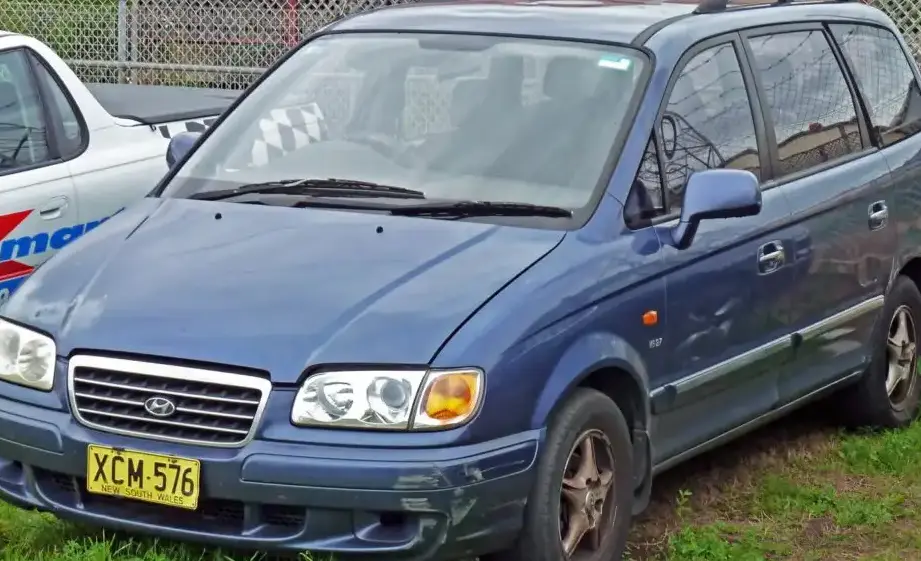
The Hyundai Trajet, introduced in 2000 and produced through 2004, was Hyundai’s initial foray into the compact minivan segment. Specifically, the 2.0i 16V variant, producing 136 horsepower, represented a mid-range offering within the Trajet lineup, positioned between the base engine and potentially higher-trim levels offered in some markets. Designed primarily for the Asian and European markets, the Trajet aimed to provide affordable and practical family transportation with seating for up to seven passengers. It utilized Hyundai’s ‘FO’ platform, and was a key model in establishing Hyundai’s growing presence in the global automotive landscape.
Technical Specifications
| Brand | Hyundai |
| Model | Trajet |
| Generation | Trajet (FO) |
| Type (Engine) | 2.0 i 16V (136 Hp) |
| Start of production | 2000 year |
| End of production | 2004 year |
| Powertrain Architecture | Internal Combustion engine |
| Body type | Minivan |
| Seats | 7 |
| Doors | 5 |
| Fuel consumption (economy) – urban | 12.9 l/100 km (18.2 US mpg, 21.9 UK mpg, 7.8 km/l) |
| Fuel consumption (economy) – extra urban | 7.2 l/100 km (32.7 US mpg, 39.2 UK mpg, 13.9 km/l) |
| Fuel consumption (economy) – combined | 9.3 l/100 km (25.3 US mpg, 30.4 UK mpg, 10.8 km/l) |
| Fuel Type | Petrol (Gasoline) |
| Acceleration 0 – 100 km/h | 13.1 sec |
| Acceleration 0 – 62 mph | 13.1 sec |
| Acceleration 0 – 60 mph | 12.4 sec |
| Maximum speed | 179 km/h (111.23 mph) |
| Weight-to-power ratio | 13.3 kg/Hp, 75.1 Hp/tonne |
| Weight-to-torque ratio | 9.9 kg/Nm, 101 Nm/tonne |
| Power | 136 Hp @ 5800 rpm |
| Power per litre | 68.1 Hp/l |
| Torque | 183 Nm @ 4600 rpm (134.97 lb.-ft. @ 4600 rpm) |
| Engine layout | Front, Transverse |
| Engine Model/Code | Sirius II / G4JP |
| Engine displacement | 1997 cm3 (121.86 cu. in.) |
| Number of cylinders | 4 |
| Engine configuration | Inline |
| Cylinder Bore | 85 mm (3.35 in.) |
| Piston Stroke | 88 mm (3.46 in.) |
| Compression ratio | 10:1 |
| Number of valves per cylinder | 4 |
| Fuel injection system | Multi-port manifold injection |
| Engine aspiration | Naturally aspirated engine |
| Valvetrain | DOHC |
| Engine oil capacity | 4.3 l (4.54 US qt | 3.78 UK qt) |
| Coolant | 7.8 l (8.24 US qt | 6.86 UK qt) |
| Kerb Weight | 1812 kg (3994.78 lbs.) |
| Max. weight | 2400 kg (5291.09 lbs.) |
| Max load | 588 kg (1296.32 lbs.) |
| Trunk (boot) space – minimum | 304 l (10.74 cu. ft.) |
| Trunk (boot) space – maximum | 2716 l (95.91 cu. ft.) |
| Fuel tank capacity | 65 l (17.17 US gal | 14.3 UK gal) |
| Length | 4895 mm (192.72 in.) |
| Width | 1840 mm (72.44 in.) |
| Height | 1710 mm (67.32 in.) |
| Wheelbase | 2830 mm (111.42 in.) |
| Front track | 1565 mm (61.61 in.) |
| Rear (Back) track | 1565 mm (61.61 in.) |
| Drivetrain Architecture | The Internal combustion engine (ICE) drives the front wheels of the vehicle. |
| Drive wheel | Front wheel drive |
| Number of gears and type of gearbox | 5 gears, manual transmission |
| Front suspension | Wishbone |
| Rear suspension | Coil spring |
| Front brakes | Ventilated discs |
| Rear brakes | Ventilated discs |
| Assisting systems | ABS (Anti-lock braking system) |
| Steering type | Steering rack and pinion |
| Power steering | Hydraulic Steering |
| Tires size | 215/65 R15 |
Powertrain & Engine Architecture
The heart of the Trajet 2.0i 16V is the Hyundai Sirius II engine, designated G4JP. This 1.997-liter inline-four cylinder engine utilizes a dual overhead camshaft (DOHC) valvetrain with four valves per cylinder, contributing to its respectable power output for its displacement. The engine employs multi-point fuel injection, a common technology in the early 2000s, delivering fuel directly to each intake port. The 10:1 compression ratio was a standard figure for naturally aspirated gasoline engines of the era. The engine’s 136 horsepower at 5800 rpm and 183 Nm (135 lb-ft) of torque at 4600 rpm provided adequate, though not exceptional, performance for a minivan of its size. The five-speed manual transmission was the standard offering, providing drivers with full control over gear selection. An automatic transmission was also available, though it typically resulted in a slight decrease in fuel economy and acceleration.
Driving Characteristics
The Trajet 2.0i with the manual transmission offered a reasonably engaging driving experience for a minivan. Acceleration to 60 mph took around 12.4 seconds, and top speed was approximately 111 mph. The 5-speed manual allowed for decent control, but the engine lacked significant low-end torque, requiring drivers to downshift frequently when encountering hills or needing to overtake. The automatic transmission, while offering convenience, further emphasized this lack of low-end grunt, resulting in more noticeable hesitation during acceleration. The suspension, tuned for comfort, provided a relatively smooth ride, but handling was predictably soft, leaning noticeably in corners. Compared to potential higher-trim versions with more powerful engines, the 2.0i felt noticeably less responsive, particularly when fully loaded with passengers and cargo.
Equipment & Trim Levels
The 2.0i trim level typically included standard features such as air conditioning, power windows and locks, and a basic audio system. Interior upholstery was generally cloth, with options for upgraded materials in some markets. Dashboard configuration was functional but not particularly luxurious, featuring a straightforward layout with easy-to-read gauges. Optional extras included alloy wheels, a sunroof, and an upgraded audio system with a CD player. Safety features were relatively basic for the time, typically including dual front airbags and ABS brakes.
Chassis & Braking
The Trajet utilized a front-wheel-drive layout with a wishbone front suspension and a coil spring rear suspension. The front brakes were ventilated discs, providing adequate stopping power, while the rear brakes were also ventilated discs. The ABS system helped to maintain steering control during hard braking. The Trajet’s chassis was designed to prioritize ride comfort over sporty handling, resulting in a relatively soft and compliant suspension setup. Stabilizer bars were included, but their thickness was modest, contributing to the vehicle’s tendency to lean in corners.
Market Reception & Comparison
The Hyundai Trajet 2.0i was generally well-received as an affordable and practical family vehicle. Critics praised its spacious interior and competitive pricing, but noted its lack of refinement and relatively modest performance. Compared to other minivans available at the time, such as the Honda Odyssey or Toyota Sienna, the Trajet offered less power and a less sophisticated driving experience. However, it undercut those competitors in price, making it an attractive option for budget-conscious buyers. Fuel economy was average for its class, with combined fuel consumption around 25.3 US mpg. Reliability was generally good, though some owners reported minor issues with the engine’s cooling system.
Legacy
The Hyundai Trajet, while not a runaway success, played an important role in establishing Hyundai as a credible player in the minivan segment. The 2.0i 16V powertrain proved to be reasonably durable, and well-maintained examples continue to be found on the used car market today. While not known for exceptional performance or luxury, the Trajet offered a practical and affordable transportation solution for families, and its legacy lies in its contribution to Hyundai’s growing reputation for value and reliability. The Sirius II engine, in various iterations, continued to be used in other Hyundai models for several years, demonstrating its overall robustness.
