
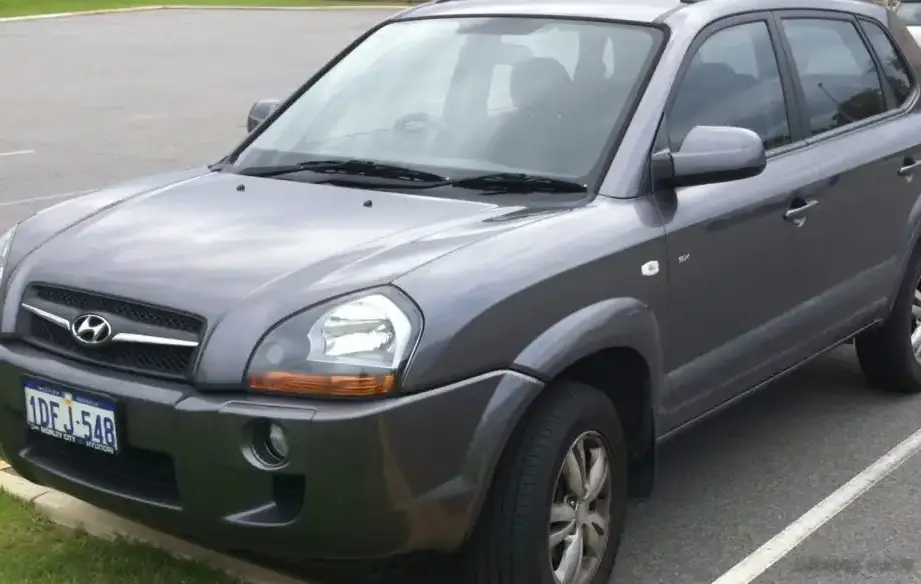
The Hyundai Tucson I 2.0 CRDi, producing 112 horsepower, was a key variant in Hyundai’s initial foray into the compact SUV market. Produced from 2005 to 2006, this model represented a significant step for the Korean automaker, offering a diesel-powered option aimed at European and other international markets where diesel fuel was prevalent. It was positioned as a practical and fuel-efficient choice within the Tucson range, slotting below the more powerful gasoline engine options. The Tucson I, internally designated as the TL, was Hyundai’s first purpose-built SUV, moving away from adapting existing passenger car platforms.
Technical Specifications
| Brand | Hyundai |
| Model | Tucson |
| Generation | Tucson I |
| Type (Engine) | 2.0 CRDi (112 Hp) |
| Start of production | 2005 |
| End of production | 2006 |
| Powertrain Architecture | Internal Combustion engine |
| Body type | SUV |
| Seats | 5 |
| Doors | 5 |
| Fuel consumption (urban) | 9.1 l/100 km (25.8 US mpg) |
| Fuel consumption (extra urban) | 5.8 l/100 km (40.6 US mpg) |
| Fuel Type | Diesel |
| Acceleration 0 – 100 km/h | 13.1 sec |
| Acceleration 0 – 62 mph | 13.1 sec |
| Acceleration 0 – 60 mph | 12.4 sec |
| Maximum speed | 168 km/h (104.39 mph) |
| Weight-to-power ratio | 13.4 kg/Hp |
| Weight-to-torque ratio | 5.9 kg/Nm |
| Power | 112 Hp @ 4000 rpm |
| Torque | 255 Nm @ 2000 rpm (188.08 lb.-ft. @ 2000 rpm) |
| Engine layout | Front, Transverse |
| Engine Model/Code | D4EA |
| Engine displacement | 1991 cm3 (121.5 cu. in.) |
| Number of cylinders | 4 |
| Engine configuration | Inline |
| Cylinder Bore | 83 mm (3.27 in.) |
| Piston Stroke | 92 mm (3.62 in.) |
| Compression ratio | 17.7:1 |
| Number of valves per cylinder | 4 |
| Fuel injection system | Diesel Commonrail |
| Engine aspiration | Turbocharger, Intercooler |
| Valvetrain | OHC |
| Engine oil capacity | 5.9 l (6.23 US qt | 5.19 UK qt) |
| Coolant | 8.7 l (9.19 US qt | 7.65 UK qt) |
| Kerb Weight | 1505 kg (3317.96 lbs.) |
| Max. weight | 2120 kg (4673.8 lbs.) |
| Max load | 615 kg (1355.84 lbs.) |
| Trunk (boot) space – minimum | 644 l (22.74 cu. ft.) |
| Fuel tank capacity | 58 l (15.32 US gal | 12.76 UK gal) |
| Length | 4325 mm (170.28 in.) |
| Width | 1795 mm (70.67 in.) |
| Height | 1680 mm (66.14 in.) |
| Wheelbase | 2630 mm (103.54 in.) |
| Front track | 1540 mm (60.63 in.) |
| Rear (Back) track | 1550 mm (61.02 in.) |
| Drivetrain Architecture | The Internal combustion engine (ICE) drives the front wheels of the vehicle. |
| Drive wheel | Front wheel drive |
| Number of gears and type of gearbox | 5 gears, manual transmission |
| Front suspension | Spring Strut |
| Rear suspension | Transverse stabilizer |
| Front brakes | Ventilated discs |
| Rear brakes | Disc |
| Assisting systems | ABS (Anti-lock braking system) |
| Steering type | Steering rack and pinion |
| Power steering | Hydraulic Steering |
| Tires size | 235/60 R16 |
Powertrain & Engine Architecture
The heart of the Tucson I 2.0 CRDi was the Hyundai D4EA engine, a 1.991-liter inline-four cylinder diesel. This engine utilized a second-generation common rail direct injection system, delivering fuel at extremely high pressures for improved combustion efficiency and reduced emissions. The D4EA featured a single overhead camshaft (OHC) design operating four valves per cylinder. A turbocharger with an intercooler was employed to boost power output, providing 112 horsepower at 4,000 rpm and 255 Nm (188 lb-ft) of torque at 2,000 rpm. This torque figure was a key selling point, offering good low-end grunt for everyday driving and towing. The 2.0 CRDi was paired with a five-speed manual transmission, optimized for fuel economy and smooth operation. While an automatic transmission was available on some Tucson models, it was less common with the 2.0 CRDi engine.
Driving Characteristics
The 2.0 CRDi with the five-speed manual transmission offered a balanced driving experience. Acceleration was adequate, taking around 13.1 seconds to reach 62 mph (100 km/h), but it wasn’t designed for outright speed. The engine’s strength lay in its mid-range torque, making it easy to maintain highway speeds and navigate hilly terrain without frequent downshifts. Compared to the gasoline-powered Tucson variants, the 2.0 CRDi provided significantly better fuel economy. The manual gearbox was light and precise, enhancing driver engagement. However, it lacked the refinement of some of its European competitors, with some engine noise and vibration noticeable at higher revs.
Equipment & Trim Levels
The Tucson I 2.0 CRDi typically came with a reasonable level of standard equipment. This included air conditioning, power windows, central locking, and an audio system. Higher trim levels added features such as alloy wheels, a sunroof, and upgraded interior trim. Interior upholstery was generally cloth, with options for leather available on more expensive models. Safety features included ABS brakes and dual front airbags. The Tucson I was not a particularly luxurious vehicle, but it offered a practical and well-equipped package for its price point.
Chassis & Braking
The Tucson I utilized a front-wheel-drive layout with independent front suspension using MacPherson struts and a multi-link rear suspension. This setup provided a comfortable ride quality, absorbing bumps and imperfections in the road effectively. The front brakes were ventilated discs, offering good stopping power, while the rear brakes were solid discs. The steering was hydraulic power-assisted rack and pinion, providing a responsive and predictable feel. The chassis was designed to balance ride comfort with handling stability, making it a competent performer on both urban streets and country roads.
Market Reception & Comparison
The Hyundai Tucson I 2.0 CRDi was generally well-received by automotive critics as a value-for-money SUV. It offered a compelling combination of fuel efficiency, practicality, and affordability. Compared to its rivals, such as the Honda CR-V and Toyota RAV4, the Tucson I was often priced lower, making it an attractive option for budget-conscious buyers. However, it lacked the brand prestige and refinement of some of its Japanese competitors. The 2.0 CRDi engine was praised for its torque and fuel economy, but some reviewers noted that it could be noisy and lacked the smoothness of more sophisticated diesel engines. Compared to the gasoline engines in the Tucson lineup, the 2.0 CRDi offered superior fuel economy but slightly slower acceleration.
Legacy
The Hyundai Tucson I 2.0 CRDi has proven to be a relatively reliable vehicle in the used car market. The D4EA engine is known for its durability, provided it has been properly maintained. Common issues include turbocharger wear and potential problems with the fuel injection system. However, these issues are generally not catastrophic and can be addressed with routine maintenance and repairs. Today, the Tucson I 2.0 CRDi represents an affordable and practical entry point into the compact SUV segment. Its fuel efficiency and robust engine make it a viable option for those seeking a dependable and economical vehicle.
