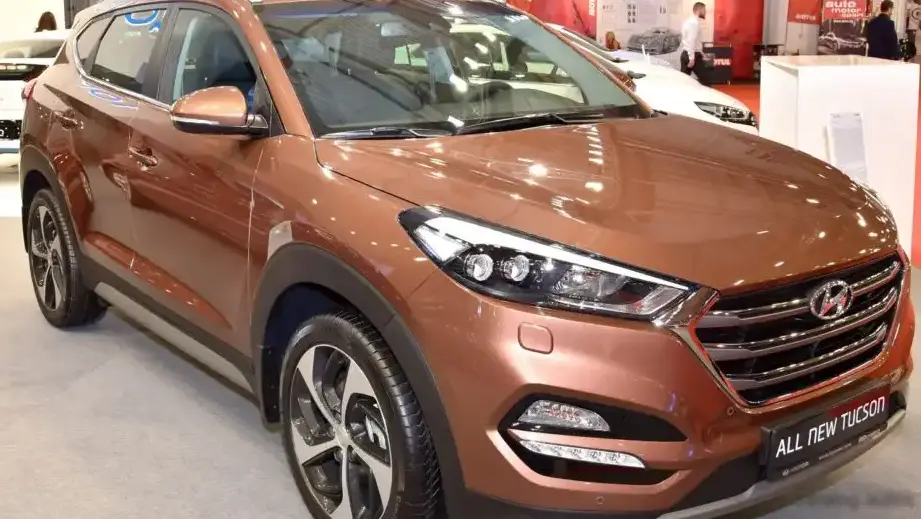
The Hyundai Tucson III 1.6 T-GDI 4WD Automatic, produced between 2015 and 2018, represents a significant step forward for Hyundai’s popular compact SUV. This variant occupied a mid-range position within the Tucson III lineup, offering a balance between performance, fuel efficiency, and all-weather capability. It was primarily marketed towards buyers seeking a practical and well-equipped SUV with the added security of all-wheel drive. The Tucson III, internally designated as the TL, was a crucial model for Hyundai, solidifying its presence in the competitive European and North American SUV markets.
Technical Specifications
| Brand | Hyundai |
| Model | Tucson |
| Generation | Tucson III |
| Type (Engine) | 1.6 T-GDI (177 Hp) 4WD Automatic |
| Start of production | 2015 |
| End of production | 2018 |
| Powertrain Architecture | Internal Combustion engine |
| Body type | SUV |
| Seats | 5 |
| Doors | 5 |
| Fuel consumption (urban) | 9.2 l/100 km (25.6 US mpg) |
| Fuel consumption (extra urban) | 6.5 l/100 km (36.2 US mpg) |
| Fuel consumption (combined) | 7.5 l/100 km (31.4 US mpg) |
| CO2 emissions | 175 g/km |
| Fuel Type | Petrol (Gasoline) |
| Acceleration 0 – 100 km/h | 9.5 sec |
| Acceleration 0 – 62 mph | 9.5 sec |
| Acceleration 0 – 60 mph | 9 sec |
| Maximum speed | 201 km/h (124.9 mph) |
| Emission standard | Euro 6 |
| Weight-to-power ratio | 8.7 kg/Hp |
| Weight-to-torque ratio | 5.8 kg/Nm |
| Power | 177 Hp @ 5500 rpm |
| Torque | 265 Nm @ 1500-4250 rpm (195.45 lb.-ft.) |
| Engine layout | Front, Transverse |
| Engine Model/Code | Gamma II / G4FJ |
| Engine displacement | 1591 cm3 (97.09 cu. in.) |
| Number of cylinders | 4 |
| Engine configuration | Inline |
| Cylinder Bore | 77 mm (3.03 in.) |
| Piston Stroke | 85.44 mm (3.36 in.) |
| Compression ratio | 11:1 |
| Number of valves per cylinder | 4 |
| Fuel injection system | Direct injection |
| Engine aspiration | Turbocharger, Intercooler |
| Valvetrain | DOHC |
| Engine oil capacity | 4.5 l (4.76 US qt | 3.96 UK qt) |
| Coolant | 7.5 l (7.93 US qt | 6.6 UK qt) |
| Kerb Weight | 1534 kg (3381.89 lbs.) |
| Max. weight | 2190 kg (4828.12 lbs.) |
| Max load | 656 kg (1446.23 lbs.) |
| Trunk (boot) space – minimum | 513 l (18.12 cu. ft.) |
| Trunk (boot) space – maximum | 1503 l (53.08 cu. ft.) |
| Fuel tank capacity | 62 l (16.38 US gal | 13.64 UK gal) |
| Max. roof load | 100 kg (220.46 lbs.) |
| Permitted trailer load with brakes (12%) | 2000 kg (4409.25 lbs.) |
| Permitted trailer load without brakes | 750 kg (1653.47 lbs.) |
| Length | 4475 mm (176.18 in.) |
| Width | 1850 mm (72.83 in.) |
| Height | 1655 mm (65.16 in.) |
| Wheelbase | 2670 mm (105.12 in.) |
| Front track | 1604-1608 mm (63.15 – 63.31 in.) |
| Rear (Back) track | 1615-1620 mm (63.58 – 63.78 in.) |
| Ride height (ground clearance) | 172 mm (6.77 in.) |
| Minimum turning circle | 10.6 m (34.78 ft.) |
| Drive wheel | All wheel drive (4×4) |
| Number of gears and type of gearbox | 7 gears, automatic transmission |
| Front suspension | Independent type McPherson |
| Rear suspension | Semi-independent, coil spring |
| Front brakes | Ventilated discs |
| Rear brakes | Disc |
| Assisting systems | ABS (Anti-lock braking system) |
| Steering type | Steering rack and pinion |
| Tires size | 215/70 R16; 225/60 R17; 245/45 R19 |
| Wheel rims size | 6.5J x 16; 7.0J x 17; 7.5J x 19 |
INTRODUCTION
The Hyundai Tucson III, launched in 2015, represented a significant evolution in design and technology for Hyundai’s popular SUV. The 1.6 T-GDI 4WD Automatic variant was introduced as a compelling option for buyers seeking a blend of efficiency and capability. This model year saw a shift towards more sophisticated engine technology, with the introduction of direct injection and turbocharging. Positioned within the Tucson III range, this trim level offered a step up from the base models, providing more power and the added benefit of all-wheel drive for improved traction and handling in various conditions. It competed directly with vehicles like the Nissan Qashqai, Kia Sportage, and Volkswagen Tiguan.
Powertrain & Engine Architecture
At the heart of the Tucson III 1.6 T-GDI 4WD Automatic lies the Gamma II engine, specifically the G4FJ code. This 1.6-liter inline-four cylinder engine utilizes direct fuel injection (DFI) and a single scroll turbocharger with an intercooler. The DFI system allows for precise fuel delivery, optimizing combustion efficiency and power output. The turbocharger boosts power by forcing more air into the engine, resulting in 177 horsepower at 5500 rpm and 265 Nm (195 lb-ft) of torque available from a low 1500 rpm all the way to 4250 rpm. The engine features a dual continuously variable valve timing (D-CVVT) system, further enhancing efficiency and responsiveness. Paired with this engine is a seven-speed dual-clutch transmission (DCT), offering quick and smooth gear changes. This DCT was a significant upgrade over traditional automatic transmissions, contributing to improved fuel economy and a more engaging driving experience.
Driving Characteristics
The 1.6 T-GDI engine, coupled with the seven-speed DCT and all-wheel-drive system, delivers a surprisingly capable driving experience. While not a performance-oriented SUV, the 177 hp provides adequate power for everyday driving and highway cruising. Acceleration from 0 to 60 mph takes around 9 seconds, which is competitive within its class. The DCT provides quick shifts, and the all-wheel-drive system inspires confidence in slippery conditions. Compared to the base 1.6L naturally aspirated engine, the T-GDI version offers a noticeable improvement in responsiveness and overall performance. However, it doesn’t match the punch of the larger 2.0-liter engines available in the Tucson III range. The gear ratios are tuned for a balance between fuel efficiency and usability, with a focus on providing sufficient torque in the lower gears for everyday driving situations.
Equipment & Trim Levels
The 1.6 T-GDI 4WD Automatic trim typically included a generous array of standard features. These commonly included air conditioning, power windows and locks, a touchscreen infotainment system with Bluetooth connectivity, and a rearview camera. Higher trim levels added features such as leather upholstery, heated front seats, a panoramic sunroof, and advanced safety systems like lane departure warning and automatic emergency braking. Interior upholstery was typically cloth on the base trims, with leather options available on higher-spec models. Dashboard configuration featured a modern design with a central touchscreen display and intuitive controls. Optional extras included navigation systems, premium audio systems, and various styling packages.
Chassis & Braking
The Tucson III utilizes a McPherson strut front suspension and a multi-link rear suspension, providing a comfortable and controlled ride. The all-wheel-drive system employs a multi-plate clutch to distribute torque between the front and rear axles, automatically adjusting based on road conditions and driver input. Braking duties are handled by ventilated discs on the front wheels and solid discs on the rear. Anti-lock braking system (ABS) and electronic stability control (ESC) are standard features, enhancing safety and stability. The suspension tuning is geared towards comfort, but it also provides adequate body control during cornering. Stabilizer bars are fitted to both the front and rear axles to reduce body roll.
Market Reception & Comparison
The Hyundai Tucson III 1.6 T-GDI 4WD Automatic was generally well-received by automotive critics. Reviewers praised its stylish design, spacious interior, and well-equipped features list. The engine was noted for its good balance of power and fuel efficiency, although some critics found the DCT transmission to be slightly jerky at low speeds. Compared to other trims in the Tucson III lineup, the 1.6 T-GDI offered a compelling alternative to the larger, more powerful engines, particularly for buyers who prioritized fuel economy and all-weather capability. Fuel economy figures of around 31.4 US mpg combined were competitive within its segment. Reliability reports have generally been positive, with few major issues reported with the engine or transmission.
Legacy
The Hyundai Tucson III 1.6 T-GDI 4WD Automatic has proven to be a reliable and durable SUV in the used car market. The Gamma II engine, while not without its minor quirks, has generally demonstrated good long-term reliability. The DCT transmission, if properly maintained, has also proven to be relatively robust. Today, these models represent a good value proposition for buyers seeking a well-equipped and capable compact SUV at an affordable price point. The introduction of the T-GDI engine and DCT transmission in the Tucson III marked a significant step forward for Hyundai, paving the way for future advancements in powertrain technology.