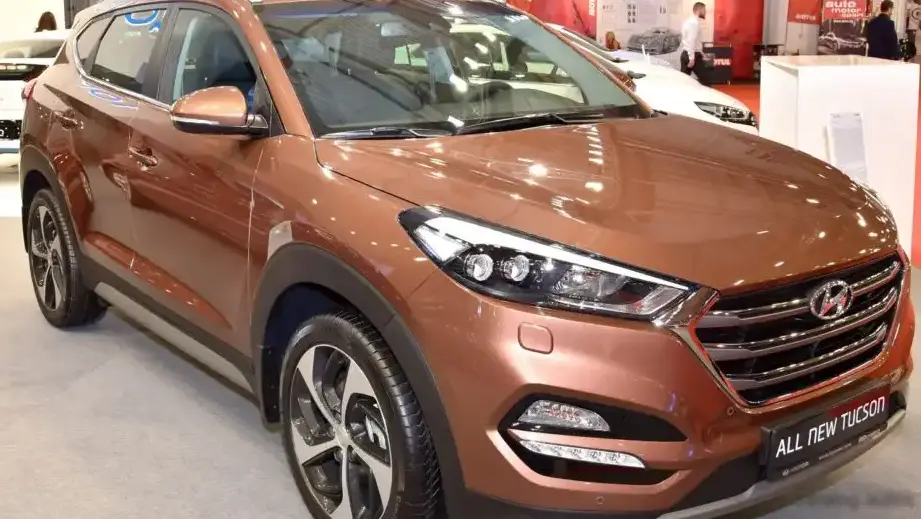
The Hyundai Tucson III 1.7 CRDI (116 hp) was a diesel-powered variant of the third-generation Hyundai Tucson (codenamed TL), produced from 2015 to 2018. Positioned as an entry-level to mid-range offering within the Tucson III lineup, it aimed to provide fuel efficiency and reasonable performance for European and other international markets where diesel engines were popular. This model played a significant role in Hyundai’s efforts to establish itself as a competitive force in the compact SUV segment, offering a value-oriented alternative to established European and Japanese rivals. It was primarily sold in Europe, Asia, and other regions where diesel fuel was readily available and preferred.
Technical Specifications
| Brand | Hyundai |
| Model | Tucson |
| Generation | Tucson III |
| Type (Engine) | 1.7 CRDI (116 Hp) |
| Start of production | 2015 |
| End of production | 2018 |
| Powertrain Architecture | Internal Combustion engine |
| Body type | SUV |
| Seats | 5 |
| Doors | 5 |
| Fuel consumption (urban) | 5.7 l/100 km (41.3 US mpg, 49.6 UK mpg, 17.5 km/l) |
| Fuel consumption (extra urban) | 4.2 l/100 km (56 US mpg, 67.3 UK mpg, 23.8 km/l) |
| Fuel consumption (combined) | 4.7 l/100 km (50 US mpg, 60.1 UK mpg, 21.3 km/l) |
| CO2 emissions | 124 g/km |
| Fuel Type | Diesel |
| Acceleration 0 – 100 km/h | 13.7 sec |
| Acceleration 0 – 62 mph | 13.7 sec |
| Acceleration 0 – 60 mph | 13 sec |
| Maximum speed | 176 km/h (109.36 mph) |
| Emission standard | Euro 6 |
| Weight-to-power ratio | 12.3 kg/Hp, 81.4 Hp/tonne |
| Weight-to-torque ratio | 5.1 kg/Nm, 196.5 Nm/tonne |
| Power | 116 Hp @ 4000 rpm |
| Power per litre | 68.8 Hp/l |
| Torque | 280 Nm @ 1250-2750 rpm (206.52 lb.-ft. @ 1250-2750 rpm) |
| Engine layout | Front, Transverse |
| Engine Model/Code | U II / D4FD |
| Engine displacement | 1685 cm3 (102.83 cu. in.) |
| Number of cylinders | 4 |
| Engine configuration | Inline |
| Cylinder Bore | 77.2 mm (3.04 in.) |
| Piston Stroke | 90 mm (3.54 in.) |
| Compression ratio | 15.7:1 |
| Number of valves per cylinder | 4 |
| Fuel injection system | Diesel Commonrail |
| Engine aspiration | Turbocharger, Intercooler |
| Engine oil capacity | 5.3 l (5.6 US qt | 4.66 UK qt) |
| Coolant | 6.8 l (7.19 US qt | 5.98 UK qt) |
| Kerb Weight | 1425 kg (3141.59 lbs.) |
| Max. weight | 2000 kg (4409.25 lbs.) |
| Max load | 575 kg (1267.66 lbs.) |
| Trunk (boot) space – minimum | 513 l (18.12 cu. ft.) |
| Trunk (boot) space – maximum | 1503 l (53.08 cu. ft.) |
| Fuel tank capacity | 62 l (16.38 US gal | 13.64 UK gal) |
| Max. roof load | 100 kg (220.46 lbs.) |
| Permitted trailer load with brakes (8%) | 2200 kg (4850.17 lbs.) |
| Permitted trailer load without brakes | 750 kg (1653.47 lbs.) |
| Length | 4475 mm (176.18 in.) |
| Width | 1850 mm (72.83 in.) |
| Height | 1655 mm (65.16 in.) |
| Wheelbase | 2670 mm (105.12 in.) |
| Front track | 1604-1608 mm (63.15 – 63.31 in.) |
| Rear (Back) track | 1615-1620 mm (63.58 – 63.78 in.) |
| Ride height (ground clearance) | 172 mm (6.77 in.) |
| Minimum turning circle (turning diameter) | 10.6 m (34.78 ft.) |
| Drivetrain Architecture | The Internal combustion engine (ICE) drives the front wheels of the vehicle. |
| Drive wheel | Front wheel drive |
| Number of gears and type of gearbox | 6 gears, manual transmission |
| Front suspension | Independent type McPherson |
| Rear suspension | Independent multi-link suspension |
| Front brakes | Ventilated discs |
| Rear brakes | Disc |
| Assisting systems | ABS (Anti-lock braking system) |
| Steering type | Steering rack and pinion |
| Tires size | 215/70 R16; 225/60 R17; 245/45 R19 |
| Wheel rims size | 6.5J x 16; 7.0J x 17; 7.5J x 19 |
INTRODUCTION
The Hyundai Tucson III 1.7 CRDI (116 hp) was introduced as part of the Tucson’s third generation (TL), launched in 2015. This generation represented a significant step forward in design and technology for the Tucson, moving it further upmarket and offering a more refined driving experience. The 1.7 CRDI engine was a key component of Hyundai’s strategy to offer a fuel-efficient and affordable option within the Tucson range. It was positioned as the entry-level diesel variant, appealing to buyers prioritizing economy and practicality. The Tucson III was built on the shared platform with the Kia Sportage, and the 1.7 CRDI engine was also used in other Hyundai and Kia models.
Powertrain & Engine Architecture
The heart of this Tucson variant is the U II / D4FD 1.7-liter four-cylinder diesel engine. This engine is a common-rail direct injection (CRDI) unit, meaning fuel is delivered directly into the cylinders at extremely high pressure for optimized combustion. The engine utilizes a turbocharger with an intercooler to boost power and torque, while also improving efficiency. The 1.7 CRDI produces 116 horsepower at 4,000 rpm and 280 Nm (206.52 lb-ft) of torque between 1250 and 2750 rpm. This torque curve provides good low-end responsiveness, making it suitable for everyday driving. The engine features a cast iron block and an aluminum cylinder head with four valves per cylinder. The 6-speed manual transmission was standard, offering a balance between fuel economy and driver control. While an automatic transmission was available on other Tucson III models, it was not offered with the 1.7 CRDI engine.
Driving Characteristics
The 1.7 CRDI Tucson III, with its 116 hp and manual transmission, delivers a driving experience focused on fuel efficiency rather than outright performance. Acceleration from 0 to 100 km/h (0-62 mph) takes approximately 13.7 seconds, and top speed is rated at 176 km/h (109.36 mph). The engine’s strong low-end torque makes it feel more responsive in everyday driving situations, such as overtaking or climbing hills. However, it can feel strained at higher speeds or when fully loaded. The 6-speed manual transmission is well-matched to the engine, providing smooth gear changes and allowing the driver to keep the engine in its optimal power band. Compared to the more powerful 2.0-liter diesel variants, the 1.7 CRDI feels noticeably slower, but it offers a more economical and refined driving experience.
Equipment & Trim Levels
The 1.7 CRDI Tucson III typically came with a reasonable level of standard equipment, though it was generally less lavish than the higher-spec models. Standard features often included air conditioning, a basic audio system with USB connectivity, electric front and rear windows, and central locking. Safety features such as ABS, Electronic Stability Control (ESC), and multiple airbags were also standard. Higher trim levels, such as SE Nav or Premium, added features like alloy wheels, a touchscreen infotainment system with navigation, rear parking sensors, and climate control. Interior upholstery was typically cloth, with options for leather upgrades on higher trims. The dashboard layout was functional and user-friendly, with a focus on practicality rather than luxury.
Chassis & Braking
The Tucson III 1.7 CRDI utilizes a McPherson strut front suspension and a multi-link rear suspension, providing a comfortable and controlled ride. The suspension is tuned to prioritize comfort over sporty handling, making it well-suited for everyday driving. The front brakes are ventilated discs, while the rear brakes are solid discs. ABS (Anti-lock Braking System) is standard, providing enhanced braking performance and stability. The steering is a rack and pinion system, offering precise and responsive steering feel. The weight distribution is well-balanced, contributing to the vehicle’s stability and handling. The 1.7 CRDI models typically came with 16- or 17-inch alloy wheels, depending on the trim level.
Market Reception & Comparison
The Hyundai Tucson III 1.7 CRDI was generally well-received by critics as a practical and fuel-efficient SUV. It was praised for its comfortable ride, spacious interior, and competitive pricing. However, some critics noted that the engine lacked the power and refinement of some of its rivals. Compared to the 2.0-liter diesel variants, the 1.7 CRDI offered significantly better fuel economy, but at the expense of performance. It also compared favorably to competitors like the Nissan Qashqai and Kia Sportage in terms of value for money. Fuel economy figures of around 50 US mpg (combined) were a major selling point for this variant.
Legacy
The Hyundai Tucson III 1.7 CRDI has proven to be a relatively reliable powertrain in the used car market. The 1.7 CRDI engine is known for its durability and relatively low maintenance costs. However, like all diesel engines, it is important to ensure regular servicing and use high-quality fuel. Common issues reported by owners include occasional problems with the diesel particulate filter (DPF) and the turbocharger. Overall, the 1.7 CRDI Tucson III remains a popular choice for buyers looking for a fuel-efficient and affordable compact SUV. Its combination of practicality, comfort, and reliability has ensured its continued presence on roads today.