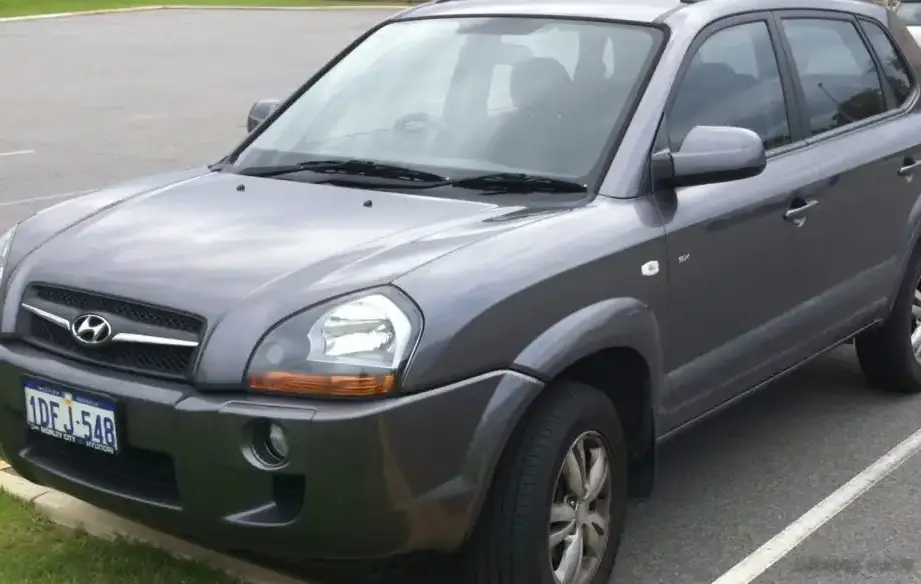
The Hyundai Tucson III (facelift, introduced in 2018) 1.6 CRDi producing 136 horsepower represents a significant iteration within the Tucson’s third generation (TL), built from 2015 to 2020. This facelift, arriving mid-cycle, brought styling revisions, updated technology, and powertrain refinements to Hyundai’s popular compact SUV. The 1.6 CRDi 136 hp variant, paired with a six-speed automatic transmission, was positioned as a mainstream offering, balancing fuel efficiency with acceptable performance for everyday driving. Production of this specific configuration ran from 2018 until April 2019, primarily aimed at the European market where diesel engines remained highly prevalent.
Technical Specifications
| Brand | Hyundai |
| Model | Tucson |
| Generation | Tucson III (facelift 2018) |
| Type (Engine) | 1.6 CRDi (136 Hp) |
| Start of production | 2018 |
| End of production | April, 2019 |
| Powertrain Architecture | Internal Combustion engine |
| Body type | SUV |
| Seats | 5 |
| Doors | 5 |
| Fuel consumption (urban) | 5.3 l/100 km (44.4 US mpg, 53.3 UK mpg, 18.9 km/l) |
| Fuel consumption (extra urban) | 4.8 l/100 km (49 US mpg, 58.9 UK mpg, 20.8 km/l) |
| Fuel consumption (combined) | 5 l/100 km (47 US mpg, 56.5 UK mpg, 20 km/l) |
| CO2 emissions | 132 g/km |
| Fuel Type | Diesel |
| Acceleration 0 – 100 km/h | 11.2 sec |
| Acceleration 0 – 62 mph | 11.2 sec |
| Acceleration 0 – 60 mph | 10.6 sec |
| Maximum speed | 180 km/h (111.85 mph) |
| Emission standard | Euro 6d – TEMP |
| Weight-to-power ratio | 11.1 kg/Hp, 90.2 Hp/tonne |
| Weight-to-torque ratio | 4.7 kg/Nm, 212.3 Nm/tonne |
| Power | 136 Hp @ 4000 rpm |
| Power per litre | 85.1 Hp/l |
| Torque | 320 Nm @ 2000-2250 rpm (236.02 lb.-ft. @ 2000-2250 rpm) |
| Engine layout | Front, Transverse |
| Engine Model/Code | D4FE |
| Engine displacement | 1598 cm3 (97.52 cu. in.) |
| Number of cylinders | 4 |
| Engine configuration | Inline |
| Cylinder Bore | 77 mm (3.03 in.) |
| Piston Stroke | 85.8 mm (3.38 in.) |
| Number of valves per cylinder | 4 |
| Fuel injection system | Diesel Commonrail |
| Engine aspiration | Turbocharger, Intercooler |
| Engine oil capacity | 4.4 l (4.65 US qt | 3.87 UK qt) |
| Coolant | 7.1 l (7.5 US qt | 6.25 UK qt) |
| Kerb Weight | 1507-1666 kg (3322.37 – 3672.9 lbs.) |
| Max. weight | 2120 kg (4673.8 lbs.) |
| Max load | 454-613 kg (1000.9 – 1351.43 lbs.) |
| Trunk (boot) space – minimum | 513 l (18.12 cu. ft.) |
| Trunk (boot) space – maximum | 1503 l (53.08 cu. ft.) |
| Fuel tank capacity | 62 l (16.38 US gal | 13.64 UK gal) |
| Max. roof load | 100 kg (220.46 lbs.) |
| Permitted trailer load with brakes (12%) | 1400 kg (3086.47 lbs.) |
| Permitted trailer load without brakes | 750 kg (1653.47 lbs.) |
| Permitted towbar download | 100 kg (220.46 lbs.) |
| Length | 4480 mm (176.38 in.) |
| Width | 1850 mm (72.83 in.) |
| Height | 1655 mm (65.16 in.) |
| Wheelbase | 2670 mm (105.12 in.) |
| Front track | 1604-1620 mm (63.15 – 63.78 in.) |
| Rear (Back) track | 1615-1631 mm (63.58 – 64.21 in.) |
| Ride height (ground clearance) | 172 mm (6.77 in.) |
| Drivetrain Architecture | The Internal combustion engine (ICE) drives the front wheels of the vehicle. |
| Drive wheel | Front wheel drive |
| Number of gears and type of gearbox | 6 gears, automatic transmission |
| Front brakes | Ventilated discs |
| Rear brakes | Disc |
| Assisting systems | ABS (Anti-lock braking system) |
| Steering type | Steering rack and pinion |
| Power steering | Electric Steering |
Powertrain & Engine Architecture
The heart of this Tucson variant is the Hyundai D4FE 1.6-liter inline-four cylinder diesel engine. This engine utilizes a common-rail direct injection system, delivering fuel at extremely high pressure for optimized combustion. A turbocharger with an intercooler is employed to boost power output and improve torque across a wider rev range. The D4FE engine is known for its relatively quiet operation compared to some older diesel designs. The engine produces 136 horsepower at 4,000 rpm and a substantial 320 Nm (236 lb-ft) of torque between 2,000 and 2,250 rpm. This torque output is a key characteristic of diesel engines, providing strong low-end pulling power. The engine is paired with a six-speed automatic transmission, offering smooth gear changes and convenience for daily driving. This transmission is a conventional torque-converter automatic, prioritizing comfort over outright performance.
Driving Characteristics
The 1.6 CRDi automatic Tucson delivers a comfortable and predictable driving experience. Acceleration from 0-60 mph takes around 10.6 seconds, which is adequate for most driving situations but doesn’t offer particularly brisk performance. The automatic transmission is well-tuned for everyday use, providing smooth shifts and responsive downshifts when needed. The abundance of low-end torque makes overtaking at highway speeds relatively effortless. Compared to the more powerful 2.0-liter diesel variants, this 1.6-liter engine feels less strained when climbing hills or carrying a full load. However, it lacks the outright punch of the larger engine. The automatic transmission, while convenient, does result in a slight reduction in fuel economy compared to the available manual transmission.
Equipment & Trim Levels
The 1.6 CRDi 136 hp automatic typically came equipped with a reasonable level of standard features. These generally included air conditioning, a touchscreen infotainment system with Bluetooth connectivity, alloy wheels, and a suite of safety features such as ABS, ESC (Electronic Stability Control), and multiple airbags. Higher trim levels offered additional features like leather upholstery, a panoramic sunroof, heated seats, and advanced driver-assistance systems such as lane departure warning and automatic emergency braking. Interior upholstery was typically cloth on base models, with leather options available on higher trims. The dashboard layout was functional and user-friendly, with a focus on practicality.
Chassis & Braking
The Tucson III utilizes a front-wheel-drive platform with independent suspension at the front (typically MacPherson struts) and a multi-link suspension at the rear. This setup provides a good balance between ride comfort and handling. The braking system consists of ventilated discs at the front and solid discs at the rear. ABS (Anti-lock Braking System) is standard, providing enhanced braking performance in emergency situations. Stabilizer bars are fitted to both the front and rear axles to reduce body roll during cornering.
Market Reception & Comparison
The 1.6 CRDi automatic Tucson was generally well-received by automotive critics as a practical and fuel-efficient option. It was praised for its comfortable ride, spacious interior, and reasonable running costs. However, some reviewers noted that the engine could feel underpowered when fully loaded or driving on steep inclines. Compared to the 2.0-liter diesel variants, the 1.6 CRDi offered better fuel economy but less performance. It also represented a more affordable entry point into the Tucson range. Against competitors like the Nissan Qashqai and Kia Sportage, the Tucson 1.6 CRDi offered a competitive package in terms of price, features, and warranty.
Legacy
The Hyundai Tucson III 1.6 CRDi automatic has proven to be a relatively reliable powertrain in the used car market. The D4FE engine is known for its durability, and the six-speed automatic transmission is generally dependable. Regular maintenance, including oil changes and filter replacements, is crucial for ensuring long-term reliability. Common issues reported by owners include occasional problems with the diesel particulate filter (DPF), particularly on vehicles that are primarily used for short journeys. Overall, this variant represents a sensible and economical choice for buyers seeking a practical and reliable compact SUV.