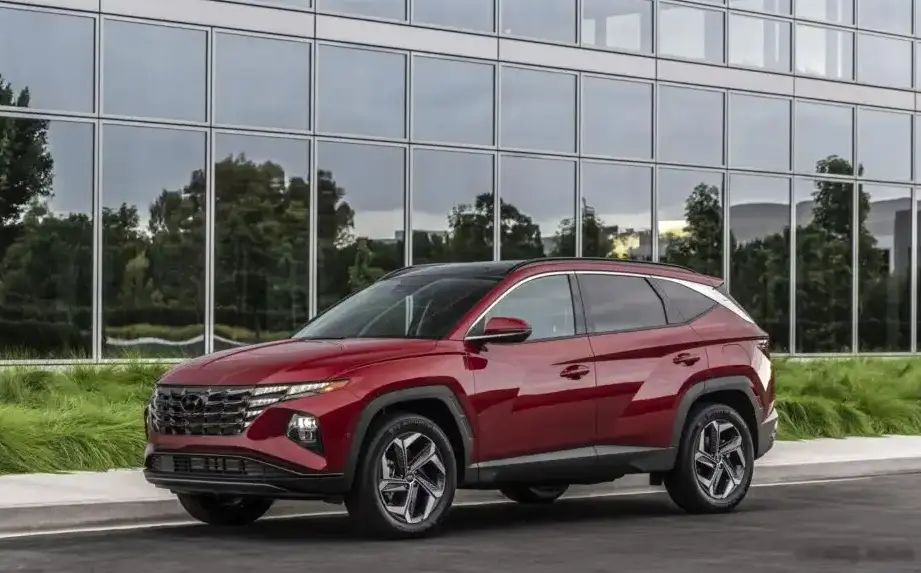
The Hyundai Tucson IV 1.6 T-GDI, producing 150 horsepower, was a key variant in the fourth generation of Hyundai’s popular compact SUV, launched in December 2020 and continuing through the 2024 model year. Positioned as a mid-range offering within the Tucson IV lineup, it aimed to balance fuel efficiency with acceptable performance for everyday driving. This model represented Hyundai’s continued push into the competitive SUV segment, offering a modern design and a suite of technology features. The Tucson IV, built on the N3 platform, marked a significant step forward in terms of space, comfort, and overall refinement compared to its predecessor.
Technical Specifications
| Brand | Hyundai |
| Model | Tucson |
| Generation | Tucson IV |
| Type (Engine) | 1.6 T-GDI (150 Hp) |
| Start of production | December, 2020 |
| End of production | May, 2024 |
| Powertrain Architecture | Internal Combustion engine |
| Body type | SUV |
| Seats | 5 |
| Doors | 5 |
| Fuel consumption at Low speed (WLTP) | 8.3-8.4 l/100 km (28.3 – 28 US mpg, 34 – 33.6 UK mpg, 12 – 11.9 km/l) |
| Fuel consumption at Medium speed (WLTP) | 6.4-6.6 l/100 km (36.8 – 35.6 US mpg, 44.1 – 42.8 UK mpg, 15.6 – 15.2 km/l) |
| Fuel consumption at high speed (WLTP) | 5.7-5.9 l/100 km (41.3 – 39.9 US mpg, 49.6 – 47.9 UK mpg, 17.5 – 16.9 km/l) |
| Fuel consumption at very high speed (WLTP) | 7.0-7.2 l/100 km (33.6 – 32.7 US mpg, 40.4 – 39.2 UK mpg, 14.3 – 13.9 km/l) |
| Combined fuel consumption (WLTP) | 6.7-6.8 l/100 km (35.1 – 34.6 US mpg, 42.2 – 41.5 UK mpg, 14.9 – 14.7 km/l) |
| CO2 emissions (WLTP) | 151-155 g/km |
| Fuel consumption (economy) – urban (NEDC, WLTP equivalent) | 7.6 l/100 km (30.9 US mpg, 37.2 UK mpg, 13.2 km/l) |
| Fuel consumption (economy) – extra urban (NEDC, WLTP equivalent) | 5.5 l/100 km (42.8 US mpg, 51.4 UK mpg, 18.2 km/l) |
| Fuel consumption (economy) – combined (NEDC, WLTP equivalent) | 6.3 l/100 km (37.3 US mpg, 44.8 UK mpg, 15.9 km/l) |
| CO2 emissions (NEDC, WLTP equivalent) | 144 g/km |
| Fuel Type | Petrol (Gasoline) |
| Acceleration 0 – 100 km/h | 10.3 sec |
| Acceleration 0 – 62 mph | 10.3 sec |
| Acceleration 0 – 60 mph | 9.8 sec |
| Maximum speed | 189 km/h (117.44 mph) |
| Emission standard | Euro 6d |
| Weight-to-power ratio | 9.5 kg/Hp, 105.3 Hp/tonne |
| Weight-to-torque ratio | 5.7 kg/Nm, 175.4 Nm/tonne |
| Power | 150 Hp @ 5500 rpm |
| Power per litre | 93.9 Hp/l |
| Torque | 250 Nm @ 1500-4000 rpm (184.39 lb.-ft. @ 1500-4000 rpm) |
| Engine layout | Front, Transverse |
| Engine Model/Code | G4FP |
| Engine displacement | 1598 cm3 (97.52 cu. in.) |
| Number of cylinders | 4 |
| Engine configuration | Inline |
| Cylinder Bore | 75.6 mm (2.98 in.) |
| Piston Stroke | 89 mm (3.5 in.) |
| Compression ratio | 10.5:1 |
| Number of valves per cylinder | 4 |
| Fuel injection system | Direct injection |
| Engine aspiration | Twin-Turbo, Intercooler |
| Valvetrain | DOHC |
| Engine oil capacity | 4.8 l (5.07 US qt | 4.22 UK qt) |
| Coolant | 7.9 l (8.35 US qt | 6.95 UK qt) |
| Kerb Weight | 1425-1575 kg (3141.59 – 3472.28 lbs.) |
| Max. weight | 2050 kg (4519.48 lbs.) |
| Max load | 475-625 kg (1047.2 – 1377.89 lbs.) |
| Trunk (boot) space – minimum | 620 l (21.9 cu. ft.) |
| Trunk (boot) space – maximum | 1799 l (63.53 cu. ft.) |
| Fuel tank capacity | 54 l (14.27 US gal | 11.88 UK gal) |
| Max. roof load | 100 kg (220.46 lbs.) |
| Permitted trailer load with brakes (12%) | 1650 kg (3637.63 lbs.) |
| Permitted trailer load without brakes | 750 kg (1653.47 lbs.) |
| Permitted towbar download | 100 kg (220.46 lbs.) |
| Length | 4500 mm (177.17 in.) |
| Width | 1865 mm (73.43 in.) |
| Width including mirrors | 2130 mm (83.86 in.) |
| Height | 1651 mm (65 in.) |
| Wheelbase | 2680 mm (105.51 in.) |
| Front track | 1615-1630 mm (63.58 – 64.17 in.) |
| Rear (Back) track | 1622-1637 mm (63.86 – 64.45 in.) |
| Front overhang | 895 mm (35.24 in.) |
| Rear overhang | 925 mm (36.42 in.) |
| Ride height (ground clearance) | 170 mm (6.69 in.) |
| Drag coefficient (Cd) | 0.315 |
| Minimum turning circle (turning diameter) | 10.92 m (35.83 ft.) |
| Approach angle | 17.4° |
| Departure angle | 25.7° |
| Ramp-over (brakeover) angle | 17.3° |
| Drivetrain Architecture | The Internal combustion engine (ICE) drives the front wheels of the vehicle. |
| Drive wheel | Front wheel drive |
| Number of gears and type of gearbox | 6 gears, manual transmission |
| Front suspension | Independent, type McPherson with coil spring and anti-roll bar |
| Rear suspension | Independent multi-link spring suspension with stabilizer |
| Front brakes | Ventilated discs, 291 mm |
| Rear brakes | Disc, 302 mm |
| Assisting systems | ABS (Anti-lock braking system) |
| Steering type | Steering rack and pinion |
| Power steering | Electric Steering |
| Tires size | 215/65 R17; 235/55 R18; 235/50 R19 |
| Wheel rims size | 7.0J x 17; 7.5J x 18; 7.5J x 19 |
Powertrain & Engine Architecture
The heart of the Tucson IV 1.6 T-GDI is the Hyundai-Kia G4FP engine, a 1.6-liter turbocharged four-cylinder gasoline engine. This engine utilizes direct injection technology, contributing to improved fuel efficiency and power output. The G4FP engine is part of Hyundai’s “Smartstream” engine family, designed for reduced friction and optimized combustion. The engine employs a twin-scroll turbocharger, which helps to minimize turbo lag and provide a more responsive driving experience. The engine’s valvetrain features a Dual Overhead Camshaft (DOHC) configuration with four valves per cylinder. The 150 horsepower and 250 Nm (184 lb-ft) of torque are delivered between 1500 and 4000 rpm, providing a broad torque band for everyday usability. This variant was typically paired with a 6-speed manual transmission, although a 7-speed dual-clutch transmission (DCT) was also available in some markets. The DCT offered quicker shifts and a more sporty feel, but the manual transmission was favored by drivers prioritizing fuel economy and simplicity.
Driving Characteristics
The 1.6 T-GDI engine, when coupled with the manual transmission, provided adequate performance for typical driving scenarios. Acceleration from 0-60 mph took approximately 9.8 seconds, and the top speed was around 117 mph. While not a particularly sporty setup, the engine offered sufficient power for highway merging and overtaking. The broad torque band meant that the engine felt responsive at lower speeds, making it well-suited for urban driving. Compared to higher-output engine options in the Tucson IV range, such as the 2.5-liter naturally aspirated engine, the 1.6 T-GDI prioritized fuel efficiency over outright performance. The manual transmission allowed for greater driver control, but the gear ratios were tuned for economy rather than aggressive acceleration. The DCT version offered quicker acceleration and a more refined driving experience, but at the expense of some fuel economy.
Equipment & Trim Levels
The 1.6 T-GDI variant was typically offered in SE, SEL, and Limited trim levels. The base SE trim included standard features such as a touchscreen infotainment system with Apple CarPlay and Android Auto compatibility, a rearview camera, and basic safety features like lane departure warning and forward collision avoidance assist. The SEL trim added features like heated front seats, a power driver’s seat, and upgraded interior materials. The Limited trim offered premium features such as leather upholstery, a panoramic sunroof, and a premium sound system. Optional extras included adaptive cruise control, blind-spot monitoring, and a hands-free power liftgate.
Chassis & Braking
The Tucson IV 1.6 T-GDI utilized a McPherson strut front suspension and a multi-link rear suspension. This setup provided a comfortable ride quality while maintaining reasonable handling characteristics. The front brakes were ventilated discs measuring 291mm, while the rear brakes were solid discs measuring 302mm. Anti-lock Braking System (ABS) was standard. The suspension tuning was geared towards comfort rather than sporty handling, making it well-suited for everyday driving. Stabilizer bars were included on both the front and rear axles to reduce body roll during cornering.
Market Reception & Comparison
The Tucson IV 1.6 T-GDI was generally well-received by critics for its fuel efficiency and comfortable ride. However, some reviewers noted that the engine could feel strained when fully loaded or driving uphill. Compared to the 2.5-liter engine option, the 1.6 T-GDI offered better fuel economy but less overall power. The 1.6 T-GDI was positioned as a more affordable and fuel-efficient alternative to the higher-output engines, appealing to buyers who prioritized practicality and value. Fuel economy figures averaged around 35 mpg combined, making it a competitive option in the compact SUV segment.
Legacy
The G4FP 1.6 T-GDI engine has proven to be a relatively reliable powertrain, although some owners have reported issues with the turbocharger and fuel injectors. Regular maintenance, including oil changes and timely replacement of wear items, is crucial for ensuring long-term reliability. On the used car market, the Tucson IV 1.6 T-GDI represents a good value proposition, offering a well-equipped and fuel-efficient SUV at a competitive price point. Its blend of practicality, comfort, and technology continues to make it a popular choice among used car buyers.