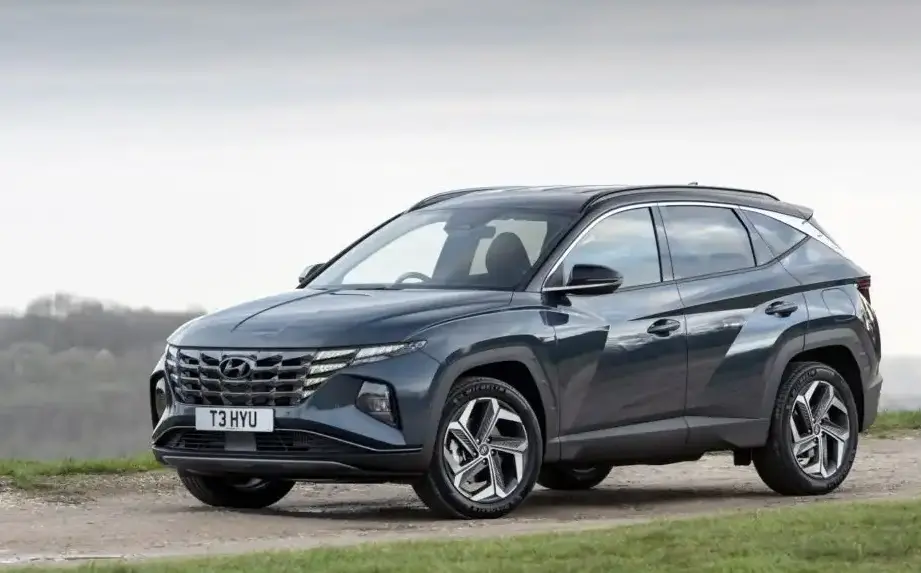
Technical Specifications
| Brand | Hyundai |
| Model | Tucson |
| Generation | Tucson IV |
| Type (Engine) | 1.6 T-GDI (230 Hp) HEV Automatic |
| Start of production | December, 2020 |
| End of production | May, 2024 |
| Powertrain Architecture | FHEV (Full Hybrid Electric Vehicle) |
| Body type | SUV |
| Seats | 5 |
| Doors | 5 |
| Fuel consumption at Low speed (WLTP) | 5.7-5.9 l/100 km (41.3 – 39.9 US mpg, 49.6 – 47.9 UK mpg, 17.5 – 16.9 km/l) |
| Fuel consumption at Medium speed (WLTP) | 4.7-4.8 l/100 km (50 – 49 US mpg, 60.1 – 58.9 UK mpg, 21.3 – 20.8 km/l) |
| Fuel consumption at high speed (WLTP) | 4.8-4.9 l/100 km (49 – 48 US mpg, 58.9 – 57.6 UK mpg, 20.8 – 20.4 km/l) |
| Fuel consumption at very high speed (WLTP) | 6.7-7 l/100 km (35.1 – 33.6 US mpg, 42.2 – 40.4 UK mpg, 14.9 – 14.3 km/l) |
| Combined fuel consumption (WLTP) | 5.6-5.7 l/100 km (42 – 41.3 US mpg, 50.4 – 49.6 UK mpg, 17.9 – 17.5 km/l) |
| CO2 emissions (WLTP) | 127-131 g/km |
| Fuel consumption (economy) – urban (NEDC, WLTP equivalent) | 5.3 l/100 km (44.4 US mpg, 53.3 UK mpg, 18.9 km/l) |
| Fuel consumption (economy) – extra urban (NEDC, WLTP equivalent) | 4.7 l/100 km (50 US mpg, 60.1 UK mpg, 21.3 km/l) |
| Fuel consumption (economy) – combined (NEDC, WLTP equivalent) | 4.9 l/100 km (48 US mpg, 57.6 UK mpg, 20.4 km/l) |
| CO2 emissions (NEDC, WLTP equivalent) | 112 g/km |
| Fuel Type | Petrol (Gasoline) |
| Acceleration 0 – 100 km/h | 8.0 sec |
| Acceleration 0 – 62 mph | 8.0 sec |
| Acceleration 0 – 60 mph | 7.6 sec |
| Maximum speed | 193 km/h (119.92 mph) |
| Emission standard | Euro 6d |
| Weight-to-power ratio | 6.8 kg/Hp, 147.1 Hp/tonne |
| Weight-to-torque ratio | 5.9 kg/Nm, 169.4 Nm/tonne |
| Gross battery capacity | 1.49 kWh |
| Battery voltage | 270 V |
| Battery technology | Lithium-polymer (LiPo) |
| Electric motor power | 60 Hp |
| Electric motor Torque | 264 Nm @ 1600 rpm (194.72 lb.-ft. @ 1600 rpm) |
| Electric motor type | Synchronous |
| System power | 230 Hp @ 5500 rpm |
| Internal combustion engine power | 180 Hp @ 5500 rpm |
| Power per litre | 112.6 Hp/l |
| Torque | 265 Nm @ 1500-4500 rpm (195.45 lb.-ft. @ 1500-4500 rpm) |
| Engine layout | Front, Transverse |
| Engine Model/Code | G4FT |
| Engine displacement | 1598 cm3 (97.52 cu. in.) |
| Number of cylinders | 4 |
| Engine configuration | Inline |
| Cylinder Bore | 75.6 mm (2.98 in.) |
| Piston Stroke | 89 mm (3.5 in.) |
| Compression ratio | 10.5:1 |
| Number of valves per cylinder | 4 |
| Fuel injection system | Direct injection |
| Engine aspiration | Twin-Turbo, Intercooler |
| Valvetrain | DOHC |
| Engine oil capacity | 4.8 l (5.07 US qt | 4.22 UK qt) |
| Coolant | 7.8 l (8.24 US qt | 6.86 UK qt) |
| Kerb Weight | 1564-1685 kg (3448.03 – 3714.79 lbs.) |
| Max. weight | 2175 kg (4795.05 lbs.) |
| Max load | 490-611 kg (1080.27 – 1347.02 lbs.) |
| Trunk (boot) space – minimum | 616 l (21.75 cu. ft.) |
| Trunk (boot) space – maximum | 1795 l (63.39 cu. ft.) |
| Fuel tank capacity | 52 l (13.74 US gal | 11.44 UK gal) |
| Max. roof load | 100 kg (220.46 lbs.) |
| Permitted trailer load with brakes (12%) | 1650 kg (3637.63 lbs.) |
| Permitted trailer load without brakes | 750 kg (1653.47 lbs.) |
| Permitted towbar download | 100 kg (220.46 lbs.) |
| Length | 4500 mm (177.17 in.) |
| Width | 1865 mm (73.43 in.) |
| Width including mirrors | 2130 mm (83.86 in.) |
| Height | 1651 mm (65 in.) |
| Wheelbase | 2680 mm (105.51 in.) |
| Front track | 1615-1630 mm (63.58 – 64.17 in.) |
| Rear (Back) track | 1622-1637 mm (63.86 – 64.45 in.) |
| Front overhang | 895 mm (35.24 in.) |
| Rear overhang | 925 mm (36.42 in.) |
| Ride height (ground clearance) | 170 mm (6.69 in.) |
| Drag coefficient (Cd) | 0.315 |
| Minimum turning circle (turning diameter) | 10.92 m (35.83 ft.) |
| Approach angle | 17.4° |
| Departure angle | 25.7° |
| Ramp-over (brakeover) angle | 17.3° |
| Drivetrain Architecture | The Internal combustion engine (ICE) and electric motor drive the front wheels of the car with the ability to work in full electric or mixed mode. |
| Drive wheel | Front wheel drive |
| Number of gears and type of gearbox | 6 gears, automatic transmission |
| Front suspension | Independent, type McPherson with coil spring and anti-roll bar |
| Rear suspension | Independent multi-link spring suspension with stabilizer |
| Front brakes | Ventilated discs, 291 mm |
| Rear brakes | Disc, 302 mm |
| Assisting systems | ABS (Anti-lock braking system) |
| Steering type | Steering rack and pinion |
| Power steering | Electric Steering |
| Tires size | 215/65 R17; 235/50 R19 |
| Wheel rims size | 7.0J x 17; 7.5J x 19 |
The Hyundai Tucson IV 1.6 T-GDI 230 hp HEV Automatic, launched in December 2020, is a key model within Hyundai’s fourth-generation Tucson range. Built on the N3 platform, this variant combines a 1.6-liter turbocharged gasoline direct injection (T-GDI) engine with a 48V mild hybrid system and a six-speed automatic transmission. This powertrain configuration aimed to provide a compelling blend of performance and fuel economy, appealing to buyers seeking a practical and efficient SUV. The Tucson IV represented a significant design departure from previous generations, adopting a bolder, more angular aesthetic. This specific trim level was positioned as a strong contender in the competitive compact SUV market, particularly against rivals like the Toyota RAV4 Hybrid, Honda CR-V, and Nissan Qashqai.
Powertrain & Engine Architecture
At the heart of the Tucson IV 1.6 T-GDI HEV is the G4FT engine, a 1.6-liter inline-four cylinder gasoline engine. This engine utilizes direct fuel injection and is coupled with a twin-scroll turbocharger and intercooler to enhance power output and efficiency. The engine produces 180 horsepower and 265 Nm (195.45 lb-ft) of torque. The hybrid system incorporates a 60 hp electric motor powered by a 1.49 kWh lithium-polymer battery. The combined system output is 230 horsepower. The six-speed automatic transmission is specifically tuned to work seamlessly with the hybrid system, optimizing gear changes for both fuel efficiency and responsiveness. The engine employs a DOHC valvetrain and a compression ratio of 10.5:1. The 48V mild hybrid system assists during acceleration and allows for smoother start-stop operation, contributing to reduced emissions.
Driving Characteristics
The 1.6 T-GDI HEV Automatic delivers a refined driving experience. Acceleration from 0-60 mph takes approximately 7.6 seconds, and 0-100 km/h in 8.0 seconds, making it adequately quick for everyday driving. The electric motor provides instant torque, supplementing the gasoline engine during acceleration, resulting in a responsive feel. The six-speed automatic transmission shifts smoothly, and the hybrid system intelligently manages power delivery between the engine and electric motor. Compared to lower-powered Tucson variants, this version offers noticeably more punch, especially when overtaking or climbing hills. However, it doesn’t possess the outright performance of some competitors with larger displacement engines. The steering is light and precise, and the suspension provides a comfortable ride, absorbing bumps and imperfections in the road well.
Equipment & Trim Levels
The 1.6 T-GDI HEV Automatic typically came well-equipped, often including features such as a touchscreen infotainment system with Apple CarPlay and Android Auto compatibility, a digital instrument cluster, automatic climate control, and a suite of advanced driver-assistance systems (ADAS) like lane keeping assist, adaptive cruise control, and automatic emergency braking. Interior upholstery was typically cloth or leatherette, depending on the specific sub-trim level. Optional extras included a panoramic sunroof, premium sound system, heated and ventilated front seats, and a power liftgate. The overall interior design emphasized a modern and spacious feel.
Chassis & Braking
The Tucson IV utilizes a McPherson strut front suspension and a multi-link rear suspension, providing a good balance of ride comfort and handling. Stabilizer bars are fitted to both axles to reduce body roll during cornering. The braking system consists of ventilated discs at the front and solid discs at the rear. ABS (Anti-lock Braking System) is standard. The Tucson’s chassis is designed to provide a stable and predictable driving experience, with a focus on comfort rather than outright sportiness. The weight distribution is well-balanced, contributing to confident handling.
Market Reception & Comparison
The Hyundai Tucson IV 1.6 T-GDI HEV Automatic was generally well-received by automotive critics. It was praised for its stylish design, spacious interior, fuel efficiency, and comprehensive list of standard features. Compared to the base engine options, the 1.6 T-GDI HEV offered a significant performance upgrade without a substantial increase in fuel consumption. Against competitors like the Toyota RAV4 Hybrid, the Tucson offered a more modern interior and a more engaging driving experience, while the RAV4 often held an edge in terms of long-term reliability reputation. Fuel economy figures of 5.6-5.7 l/100 km (42-41.3 US mpg) were competitive within its class.
Legacy
The Hyundai Tucson IV 1.6 T-GDI HEV Automatic has established itself as a reliable and practical choice in the used car market. The G4FT engine, while turbocharged, has proven to be relatively robust when properly maintained. The hybrid system components, including the battery pack, have demonstrated good longevity. Regular maintenance, including oil changes and coolant flushes, is crucial for ensuring the long-term health of the powertrain. As with any modern vehicle, software updates and attention to potential recalls are important. The Tucson IV’s blend of style, efficiency, and technology continues to make it an attractive option for buyers seeking a versatile and well-rounded compact SUV.