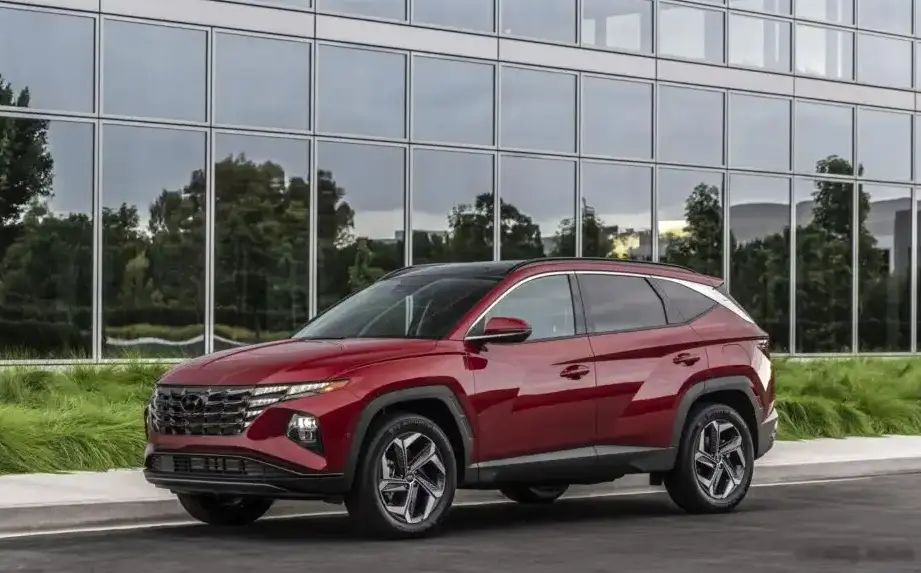
The Hyundai Tucson IV D2.0 SmartStream (186 Hp) 4WD Automatic represents a significant offering within the fourth generation of Hyundai’s popular Tucson SUV, produced from 2021 to 2024. This variant, powered by a 2.0-liter diesel engine, was positioned as a mid-range option, balancing fuel efficiency with respectable performance and all-weather capability thanks to its four-wheel-drive system. It catered to buyers seeking a practical and well-equipped family SUV with the added security of an automatic transmission and the benefits of a diesel powertrain. The Tucson IV, built on the N3 platform, marked a substantial leap forward in design, technology, and overall refinement for the Tucson nameplate.
Technical Specifications
| Brand | Hyundai |
| Model | Tucson |
| Generation | Tucson IV |
| Type (Engine) | D2.0 SmartStream (186 Hp) 4WD Automatic |
| Start of production | 2021 |
| End of production | 2024 |
| Powertrain Architecture | Internal Combustion engine |
| Body type | SUV |
| Seats | 5 |
| Doors | 5 |
| Fuel consumption (urban) | 7.7 l/100 km (30.5 US mpg) |
| Fuel consumption (extra urban) | 5.4 l/100 km (43.6 US mpg) |
| Fuel consumption (combined) | 6.3 l/100 km (37.3 US mpg) |
| CO2 emissions | 163 g/km |
| Fuel Type | Diesel |
| Emission standard | Euro 5 |
| Weight-to-power ratio | 9 kg/Hp |
| Weight-to-torque ratio | 4 kg/Nm |
| Power | 186 Hp @ 4000 rpm |
| Torque | 416 Nm @ 2000-2750 rpm (306.83 lb.-ft. @ 2000-2750 rpm) |
| Engine layout | Front, Transverse |
| Engine displacement | 1998 cm3 (121.93 cu. in.) |
| Number of cylinders | 4 |
| Engine configuration | Inline |
| Cylinder Bore | 83 mm (3.27 in.) |
| Piston Stroke | 92.3 mm (3.63 in.) |
| Compression ratio | 16:1 |
| Number of valves per cylinder | 4 |
| Fuel injection system | Diesel Commonrail |
| Engine aspiration | Turbocharger, Intercooler |
| Valvetrain | HLA |
| Engine oil capacity | 5.6 l (5.92 US qt | 4.93 UK qt) |
| Coolant capacity | 8.93 l (9.44 US qt | 7.86 UK qt) |
| Kerb Weight | 1680-1810 kg (3703.77 – 3990.37 lbs.) |
| Max. weight | 2315 kg (5103.7 lbs.) |
| Max load | 505-635 kg (1113.33 – 1399.94 lbs.) |
| Trunk (boot) space – minimum | 539 l (19.03 cu. ft.) |
| Trunk (boot) space – maximum | 1860 l (65.69 cu. ft.) |
| Fuel tank capacity | 54 l (14.27 US gal | 11.88 UK gal) |
| Max. roof load | 100 kg (220.46 lbs.) |
| Permitted trailer load with brakes (12%) | 1900 kg (4188.78 lbs.) |
| Permitted trailer load without brakes | 750 kg (1653.47 lbs.) |
| Permitted towbar download | 100 kg (220.46 lbs.) |
| Length | 4630-4640 mm (182.28 – 182.68 in.) |
| Width | 1865 mm (73.43 in.) |
| Height | 1665 mm (65.55 in.) |
| Wheelbase | 2755 mm (108.46 in.) |
| Front track | 1615 mm (63.58 in.) |
| Rear track | 1622 mm (63.86 in.) |
| Ride height (ground clearance) | 181 mm (7.13 in.) |
| Minimum turning circle | 11.8 m (38.71 ft.) |
| Approach angle | 18.3° |
| Departure angle | 22.6-25.6° |
| Ramp-over angle | 17.3° |
| Drivetrain Architecture | All wheel drive (4×4) |
| Number of gears | 8 |
| Type of gearbox | Automatic transmission |
| Front suspension | Independent type McPherson |
| Rear suspension | Independent multi-link suspension |
| Front brakes | Ventilated discs, 305×25 mm |
| Rear brakes | Disc, 300×10 mm |
| Assisting systems | ABS (Anti-lock braking system) |
| Steering type | Steering rack and pinion |
| Power steering | Electric Steering |
| Tires size | 235/55 R19 101H |
| Wheel rims size | 7.5J x 19 |
Powertrain & Engine Architecture
At the heart of the Tucson IV D2.0 SmartStream 4WD Automatic lies Hyundai’s 2.0-liter four-cylinder diesel engine. This engine, internally designated as part of the SmartStream family, utilizes a cast iron block and aluminum cylinder head. The engine employs a common-rail direct injection system, delivering fuel at extremely high pressures for optimized combustion. A variable geometry turbocharger (VGT) with an intercooler further enhances performance and efficiency. The engine’s valvetrain features Hydraulic Lash Adjusters (HLA) for quiet operation and reduced maintenance. The 8-speed automatic transmission, sourced from Hyundai’s own development, is designed for smooth and efficient gear changes. This transmission features a torque converter and electronically controlled shifting, adapting to driving conditions and driver input. The all-wheel-drive system operates primarily as front-wheel drive, engaging the rear wheels automatically when traction is lost, providing enhanced stability in adverse weather conditions.
Driving Characteristics
The 186 horsepower and 306.83 lb.-ft. of torque produced by the D2.0 SmartStream engine provide adequate performance for everyday driving. While not a sports-oriented SUV, the Tucson IV offers sufficient acceleration for highway merging and overtaking. The 8-speed automatic transmission contributes to a relaxed driving experience, with well-spaced gear ratios. Compared to the higher-output gasoline engines available in the Tucson IV lineup, the diesel variant prioritizes fuel economy and low-end torque. The automatic transmission, while convenient, doesn’t offer the same level of driver engagement as the available manual transmission options. The all-wheel-drive system provides enhanced traction and stability, particularly on slippery surfaces, making it a suitable choice for drivers in regions with inclement weather.
Equipment & Trim Levels
The D2.0 SmartStream 4WD Automatic trim typically included a comprehensive suite of standard features. These generally included automatic climate control, a touchscreen infotainment system with Apple CarPlay and Android Auto compatibility, a rearview camera, and a range of safety features such as lane departure warning, forward collision avoidance assist, and automatic emergency braking. Interior upholstery was typically cloth or a combination of cloth and leatherette, depending on optional packages. Higher trim levels offered upgrades such as leather seats, a panoramic sunroof, a premium sound system, and advanced driver-assistance systems like adaptive cruise control and blind-spot monitoring.
Chassis & Braking
The Tucson IV utilizes an independent McPherson strut suspension at the front and an independent multi-link suspension at the rear, providing a comfortable and controlled ride. Stabilizer bars are fitted to both axles to reduce body roll during cornering. The braking system consists of ventilated discs at the front and solid discs at the rear. Anti-lock braking system (ABS) is standard, along with electronic brake-force distribution (EBD) and brake assist. The steering system is an electric power-assisted rack and pinion system, offering precise and responsive steering feel.
Market Reception & Comparison
The Hyundai Tucson IV D2.0 SmartStream 4WD Automatic was generally well-received by automotive critics. It was praised for its fuel efficiency, comfortable ride, spacious interior, and comprehensive feature set. Compared to other diesel-powered SUVs in its class, the Tucson IV offered a competitive combination of performance, economy, and value. The diesel engine provided superior fuel economy compared to the gasoline engines, making it an attractive option for drivers who cover long distances. However, some critics noted that the diesel engine could be slightly noisy compared to its gasoline counterparts. Reliability reports have been generally positive, with few major issues reported with the powertrain.
Legacy
The Hyundai Tucson IV D2.0 SmartStream 4WD Automatic has proven to be a reliable and durable SUV. The 2.0-liter diesel engine, when properly maintained, is known for its longevity. On the used car market, these models continue to hold their value, attracting buyers seeking a practical, fuel-efficient, and well-equipped SUV. The combination of all-wheel drive and an automatic transmission makes it a popular choice for drivers in regions with challenging weather conditions. As Hyundai continues to innovate in the SUV segment, the Tucson IV D2.0 SmartStream 4WD Automatic remains a testament to the brand’s commitment to quality and value.