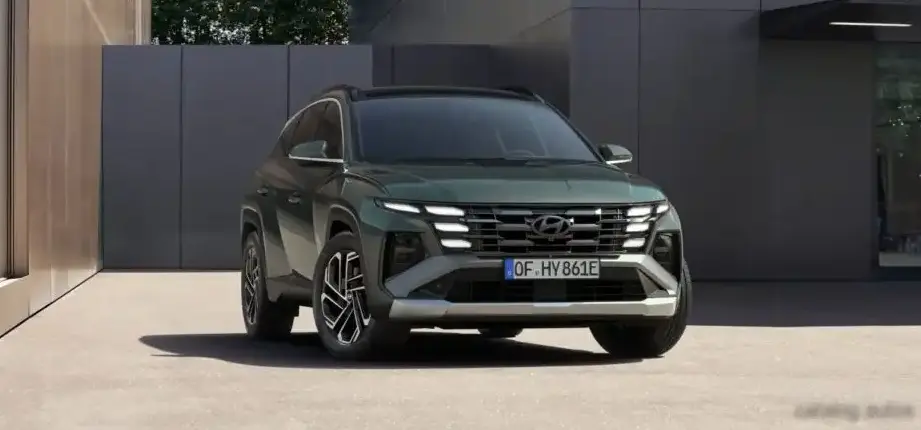
The Hyundai Tucson IV, specifically the facelifted 2024 model year equipped with the 1.6 CRDi (136 horsepower) mild hybrid powertrain and a dual-clutch transmission (DCT) with all-wheel drive, represents a significant offering in the increasingly competitive compact SUV segment. Introduced in May 2024, this variant builds upon the already successful fourth generation (NX4) Tucson, which debuted in 2020. The facelift brings styling updates and refined technology, while the 1.6 CRDi MHEV 4WD DCT trim aims to balance fuel efficiency, reasonable performance, and all-weather capability for European and increasingly, North American buyers. This configuration positions itself as a mid-range option within the Tucson lineup, appealing to customers seeking a practical and economical SUV without sacrificing features or driving confidence.
Technical Specifications
| Brand | Hyundai |
| Model | Tucson |
| Generation | Tucson IV (facelift 2024) |
| Type (Engine) | 1.6 CRDi (136 Hp) Mild Hybrid 4WD DCT |
| Start of production | May, 2024 |
| Powertrain Architecture | MHEV (Mild Hybrid Electric Vehicle) |
| Body type | SUV |
| Seats | 5 |
| Doors | 5 |
| Combined fuel consumption (WLTP) | 5.9 l/100 km (39.9 US mpg, 47.9 UK mpg, 16.9 km/l) |
| CO2 emissions (WLTP) | 155 g/km |
| Fuel Type | Diesel |
| Acceleration 0 – 100 km/h | 11.6 sec |
| Acceleration 0 – 62 mph | 11.6 sec |
| Acceleration 0 – 60 mph | 11 sec |
| Maximum speed | 180 km/h (111.85 mph) |
| Emission standard | Euro 6e |
| Weight-to-power ratio | 12.9 kg/Hp, 77.7 Hp/tonne |
| Weight-to-torque ratio | 5.5 kg/Nm, 182.8 Nm/tonne |
| Battery voltage | 48 V |
| Power | 136 Hp @ 4000 rpm |
| Power per litre | 85.1 Hp/l |
| Torque | 320 Nm @ 2000-2250 rpm (236.02 lb.-ft. @ 2000-2250 rpm) |
| Engine layout | Front, Transverse |
| Engine Model/Code | D4FE |
| Engine displacement | 1598 cm3 (97.52 cu. in.) |
| Number of cylinders | 4 |
| Engine configuration | Inline |
| Cylinder Bore | 77 mm (3.03 in.) |
| Piston Stroke | 85.8 mm (3.38 in.) |
| Number of valves per cylinder | 4 |
| Fuel injection system | Diesel Commonrail |
| Engine aspiration | Turbocharger, Intercooler |
| Engine oil capacity | 4.4 l (4.65 US qt | 3.87 UK qt) |
| Coolant | 7.2 l (7.61 US qt | 6.34 UK qt) |
| Kerb Weight | 1751 kg (3860.29 lbs.) |
| Trunk (boot) space – minimum | 546 l (19.28 cu. ft.) |
| Trunk (boot) space – maximum | 1725 l (60.92 cu. ft.) |
| Fuel tank capacity | 54 l (14.27 US gal | 11.88 UK gal) |
| Permitted trailer load with brakes (12%) | 1650 kg (3637.63 lbs.) |
| Permitted trailer load without brakes | 750 kg (1653.47 lbs.) |
| Permitted towbar download | 100 kg (220.46 lbs.) |
| Length | 4510 mm (177.56 in.) |
| Width | 1865 mm (73.43 in.) |
| Height | 1650 mm (64.96 in.) |
| Wheelbase | 2680 mm (105.51 in.) |
| Front track | 1615 mm (63.58 in.) |
| Rear (Back) track | 1622 mm (63.86 in.) |
| Ride height (ground clearance) | 170 mm (6.69 in.) |
| Drivetrain Architecture | ICE and electric motor drive front wheels, rear drive via clutch |
| Drive wheel | All wheel drive (4×4) |
| Number of gears and type of gearbox | 7 gears, automatic transmission DCT |
| Front suspension | Independent type McPherson |
| Rear suspension | Independent multi-link suspension |
| Front brakes | Ventilated discs |
| Rear brakes | Disc |
| Assisting systems | ABS (Anti-lock braking system) |
| Steering type | Steering rack and pinion |
| Power steering | Electric Steering |
| Tires size | 215/65 R17; 235/55 R18; 235/50 R19 |
| Wheel rims size | 7.0J x 17; 7.5J x 18; 7.5J x 19 |
INTRODUCTION
The 2024 Hyundai Tucson IV 1.6 CRDi Mild Hybrid 4WD DCT is a front-wheel-drive biased all-wheel drive compact SUV that slots into the middle of Hyundai’s Tucson range. The Tucson IV, launched in 2020, represented a bold design departure for Hyundai, and the 2024 facelift refines this aesthetic with updated front and rear styling. This particular variant is powered by a 1.6-liter turbocharged diesel engine coupled with a 48-volt mild hybrid system and a seven-speed dual-clutch transmission. The inclusion of all-wheel drive provides enhanced traction and stability, particularly in adverse weather conditions, making it a popular choice in regions with variable climates. It’s designed to appeal to buyers who prioritize fuel economy and practicality without sacrificing a degree of performance and comfort.
Powertrain & Engine Architecture
At the heart of this Tucson variant lies the Hyundai-Kia D4FE 1.6-liter four-cylinder diesel engine. This engine utilizes a common-rail direct injection system, delivering fuel directly into the combustion chamber at extremely high pressure for optimized combustion. The engine is turbocharged with a variable geometry turbocharger (VGT) and intercooled, boosting power output and improving torque delivery. The mild hybrid system, utilizing a 48V battery, provides a small amount of electric assistance during acceleration and allows for extended stop/start functionality, further enhancing fuel efficiency. The engine produces 136 horsepower at 4,000 rpm and 320 Nm (236 lb-ft) of torque between 2,000 and 2,250 rpm. The seven-speed dual-clutch transmission (DCT) offers quick and smooth gear changes, contributing to a more engaging driving experience compared to a traditional automatic transmission. The DCT is known for its efficiency and responsiveness, although some drivers may notice a slight hesitation at low speeds.
Driving Characteristics
The 1.6 CRDi MHEV 4WD DCT Tucson delivers a comfortable and composed driving experience. While not overtly sporty, the engine provides adequate power for everyday driving situations, including highway cruising and overtaking. The DCT transmission shifts quickly and efficiently, although it can feel slightly jerky at low speeds. The all-wheel-drive system provides enhanced traction and stability, particularly on slippery surfaces. Compared to the higher-output gasoline engines available in the Tucson lineup, this diesel variant prioritizes fuel economy over outright performance. The 0-62 mph acceleration time of 11.6 seconds reflects this focus. The gear ratios are tuned for efficiency, with taller gearing in higher gears to reduce engine speed and fuel consumption at cruising speeds. The mild hybrid system provides a subtle boost during acceleration, but its primary benefit is in reducing emissions and improving fuel economy.
Equipment & Trim Levels
The 2024 Tucson IV 1.6 CRDi MHEV 4WD DCT typically comes well-equipped as standard. Features generally include automatic climate control, a touchscreen infotainment system with Apple CarPlay and Android Auto compatibility, a rearview camera, and a suite of advanced driver-assistance systems (ADAS) such as lane-keeping assist, forward collision avoidance assist, and adaptive cruise control. Interior upholstery is typically cloth, with options for leather upgrades. Higher trim levels may add features such as a panoramic sunroof, heated and ventilated front seats, a premium sound system, and a larger touchscreen display. Exterior features typically include alloy wheels, LED headlights, and roof rails.
Chassis & Braking
The Tucson IV utilizes a front independent McPherson strut suspension and a rear independent multi-link suspension. This setup provides a good balance between ride comfort and handling. The suspension is tuned to prioritize comfort, but it still offers reasonable body control in corners. The steering is electrically assisted and provides a light and precise feel. Braking duties are handled by ventilated discs at the front and solid discs at the rear. The ABS (Anti-lock Braking System) and Electronic Stability Control (ESC) are standard features, providing enhanced safety and control. The weight distribution is fairly balanced, contributing to stable handling characteristics.
Market Reception & Comparison
The Hyundai Tucson IV has been well-received by critics and consumers alike, praised for its stylish design, spacious interior, and comprehensive feature set. The 1.6 CRDi MHEV 4WD DCT variant is particularly appealing to buyers who prioritize fuel economy and practicality. Compared to the gasoline-powered Tucson models, the diesel variant offers significantly better fuel economy, although it comes with a slightly higher price tag. Compared to other diesel SUVs in its class, the Tucson offers a competitive combination of performance, fuel efficiency, and value. Some reviewers have noted that the DCT transmission can be slightly hesitant at low speeds, but overall, the driving experience is generally positive.
Legacy
The Hyundai D4FE engine family has proven to be relatively reliable, and the addition of the mild hybrid system is not expected to significantly impact long-term durability. The DCT transmission, while more complex than a traditional automatic, has also demonstrated reasonable reliability in other Hyundai-Kia vehicles. In the used car market, the 2024 Tucson IV 1.6 CRDi MHEV 4WD DCT is expected to hold its value well, thanks to its fuel efficiency, practicality, and all-wheel-drive capability. Regular maintenance, including oil changes and filter replacements, is crucial for ensuring the longevity of this powertrain. The Tucson’s reputation for reliability and value is likely to make it a popular choice among used car buyers for years to come.