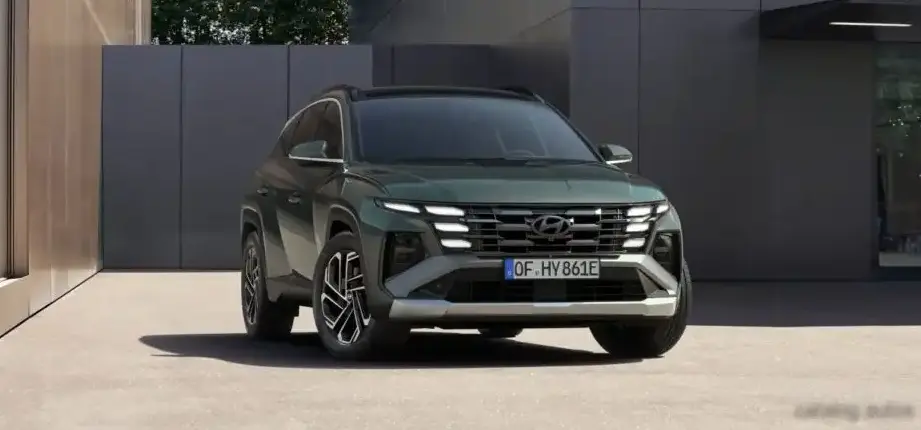
The Hyundai Tucson IV (facelift, introduced in 2024) 1.6 T-GDI with 180 horsepower and all-wheel drive (AWD) paired with a dual-clutch transmission (DCT) represents a significant offering within Hyundai’s popular compact SUV lineup. Production commenced in September 2025, building upon the foundation of the fourth-generation Tucson (NX4) launched in 2020. This variant is positioned as a mid-range option, balancing performance, fuel efficiency, and available technology, appealing to buyers seeking a well-rounded and modern SUV experience. The facelift brought styling updates and technological enhancements to the already successful Tucson platform.
Technical Specifications
| Brand | Hyundai |
| Model | Tucson |
| Generation | Tucson IV (facelift 2024) |
| Type (Engine) | 1.6 T-GDI (180 Hp) AWD DCT |
| Start of production | September, 2025 |
| Powertrain Architecture | Internal Combustion engine |
| Body type | SUV |
| Seats | 5 |
| Doors | 5 |
| Combined fuel consumption (WLTP) | 7.6-7.7 l/100 km (30.9 – 30.5 US mpg, 37.2 – 36.7 UK mpg, 13.2 – 13 km/l) |
| CO2 emissions (WLTP) | 172-174 g/km |
| Fuel Type | Petrol (Gasoline) |
| Acceleration 0 – 100 km/h | 9.1 sec |
| Acceleration 0 – 62 mph | 9.1 sec |
| Acceleration 0 – 60 mph | 8.6 sec |
| Maximum speed | 204 km/h (126.76 mph) |
| Emission standard | Euro 6e-bis |
| Weight-to-power ratio | 8.7 kg/Hp, 115.4 Hp/tonne |
| Weight-to-torque ratio | 5.9 kg/Nm, 169.9 Nm/tonne |
| Power | 180 Hp @ 6000 rpm |
| Power per litre | 112.6 Hp/l |
| Torque | 265 Nm @ 1500-4500 rpm (195.45 lb.-ft. @ 1500-4500 rpm) |
| Engine layout | Front, Transverse |
| Engine Model/Code | G4FY |
| Engine displacement | 1598 cm3 (97.52 cu. in.) |
| Number of cylinders | 4 |
| Engine configuration | Inline |
| Cylinder Bore | 75.6 mm (2.98 in.) |
| Piston Stroke | 89 mm (3.5 in.) |
| Number of valves per cylinder | 4 |
| Fuel injection system | Direct injection |
| Engine aspiration | Turbocharger, Intercooler |
| Engine oil capacity | 4.8 l (5.07 US qt | 4.22 UK qt) |
| Coolant | 7.9 l (8.35 US qt | 6.95 UK qt) |
| Kerb Weight | 1560-1703 kg (3439.21 – 3754.47 lbs.) |
| Max. weight | 2160 kg (4761.98 lbs.) |
| Max load | 457-600 kg (1007.51 – 1322.77 lbs.) |
| Trunk (boot) space – minimum | 620 l (21.9 cu. ft.) |
| Trunk (boot) space – maximum | 1799 l (63.53 cu. ft.) |
| Fuel tank capacity | 54 l (14.27 US gal | 11.88 UK gal) |
| Max. roof load | 100 kg (220.46 lbs.) |
| Permitted trailer load with brakes (12%) | 1650 kg (3637.63 lbs.) |
| Permitted trailer load without brakes | 750 kg (1653.47 lbs.) |
| Permitted towbar download | 100 kg (220.46 lbs.) |
| Length | 4525 mm (178.15 in.) |
| Width | 1865 mm (73.43 in.) |
| Height | 1650 mm (64.96 in.) |
| Wheelbase | 2680 mm (105.51 in.) |
| Front track | 1615 mm (63.58 in.) |
| Rear (Back) track | 1622 mm (63.86 in.) |
| Ride height (ground clearance) | 170 mm (6.69 in.) |
| Drivetrain Architecture | The Internal combustion engine (ICE) drives the front wheels permanently, and the rear wheels are driven through an electrically or mechanically operated clutch if necessary. |
| Drive wheel | All wheel drive (4×4) |
| Number of gears and type of gearbox | 7 gears, automatic transmission DCT |
| Front suspension | Independent type McPherson |
| Rear suspension | Independent multi-link suspension |
| Front brakes | Ventilated discs |
| Rear brakes | Disc |
| Assisting systems | ABS (Anti-lock braking system) |
| Steering type | Steering rack and pinion |
| Power steering | Electric Steering |
| Tires size | 235/50 R19 |
| Wheel rims size | 7.5J x 19 |
INTRODUCTION
The Hyundai Tucson IV facelift’s 1.6 T-GDI 180 hp AWD DCT model is a key component of Hyundai’s strategy to offer a compelling and technologically advanced SUV in the highly competitive compact segment. Introduced for the 2025 model year, this variant builds upon the success of the NX4 Tucson, which debuted in 2020. The facelift brought revised styling, upgraded interior features, and enhanced safety technologies. This particular engine and drivetrain combination aims to provide a balance between performance, fuel economy, and all-weather capability, making it a popular choice for families and individuals alike. It slots into the Tucson lineup above the base engine options and below the hybrid and plug-in hybrid models.
Powertrain & Engine Architecture
At the heart of this Tucson variant lies the Hyundai-Kia Smartstream G4FY 1.6-liter turbocharged gasoline direct injection (TGDI) engine. This engine utilizes a four-cylinder inline configuration and employs a single-scroll turbocharger with an integrated intercooler to boost power and efficiency. The engine code ‘G4FY’ signifies a specific iteration of this engine family. The direct injection system precisely meters fuel into the combustion chambers, optimizing combustion and reducing emissions. The engine produces 180 horsepower at 6000 rpm and 265 Nm (195.45 lb-ft) of torque between 1500 and 4500 rpm. This broad torque curve contributes to responsive acceleration in everyday driving situations. Paired with the engine is a 7-speed dual-clutch transmission (DCT). This DCT offers quicker and smoother gear changes compared to a traditional automatic transmission, enhancing both performance and fuel efficiency. The DCT is designed to deliver a more engaging driving experience while maintaining the convenience of an automatic.
Driving Characteristics
The 1.6 T-GDI engine, when coupled with the 7-speed DCT and AWD system, delivers a composed and capable driving experience. Acceleration from 0-60 mph takes approximately 8.6 seconds, and 0-100 km/h in 9.1 seconds, making it adequately quick for most driving scenarios. The DCT provides crisp shifts, and the AWD system offers enhanced traction in various weather conditions. Compared to the base engine options, this variant provides noticeably more power and responsiveness. While not as sporty as some competitors, the Tucson 1.6 T-GDI offers a comfortable ride and predictable handling. The DCT’s gear ratios are tuned for a balance between acceleration and fuel economy, with taller gears for highway cruising and shorter gears for quicker response in city driving. The AWD system operates primarily in front-wheel drive, engaging the rear wheels when slip is detected, maximizing efficiency.
Equipment & Trim Levels
The 1.6 T-GDI AWD DCT Tucson typically comes well-equipped, often positioned as a mid-level trim. Standard features generally include automatic climate control, a touchscreen infotainment system with Apple CarPlay and Android Auto compatibility, a rearview camera, and a suite of advanced driver-assistance systems (ADAS) such as lane-keeping assist, forward collision avoidance assist, and adaptive cruise control. Interior upholstery is typically cloth or a combination of cloth and leatherette. Higher trim levels offer upgrades such as leather seats, a panoramic sunroof, a premium sound system, and additional ADAS features. Optional extras often include navigation, heated and ventilated seats, and a power liftgate.
Chassis & Braking
The Tucson IV utilizes a front independent McPherson strut suspension and a rear independent multi-link suspension. This setup provides a comfortable ride and good handling characteristics. The suspension is tuned to balance ride comfort and body control. Braking duties are handled by ventilated discs at the front and solid discs at the rear. The inclusion of ABS (Anti-lock Braking System) is standard, along with electronic stability control and traction control. The steering system is an electric power-assisted rack and pinion system, providing precise and responsive steering feel. The standard tire size is 235/50 R19, offering a good balance between grip and ride comfort.
Market Reception & Comparison
The Hyundai Tucson IV, including the 1.6 T-GDI AWD DCT variant, has been well-received by automotive critics and consumers alike. It’s praised for its stylish design, spacious interior, and comprehensive feature set. The 1.6 T-GDI engine is considered a good compromise between performance and fuel economy. Compared to the base engine options, the 1.6 T-GDI offers a significant performance upgrade. Compared to the hybrid and plug-in hybrid models, it offers a lower price point but sacrifices some fuel efficiency. Reliability has been generally good, with Hyundai’s reputation for building durable vehicles. Fuel economy is rated at 7.6-7.7 l/100 km, which is competitive within its class.
Legacy
The Hyundai Tucson IV 1.6 T-GDI AWD DCT powertrain is expected to have good long-term reliability, benefiting from Hyundai’s continued improvements in engine and transmission technology. The Smartstream engine family has proven to be durable, and the DCT is generally reliable when properly maintained. As the Tucson IV ages and enters the used car market, this variant is likely to remain a popular choice due to its balance of performance, features, and fuel efficiency. Its all-wheel-drive system will also make it attractive to buyers in regions with inclement weather. Regular maintenance, including oil changes and DCT fluid replacements, will be crucial to ensuring the longevity of this powertrain.