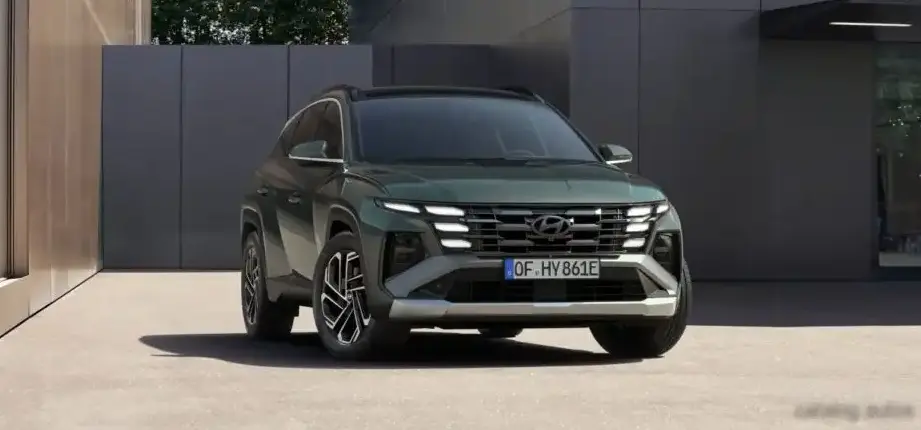
The Hyundai Tucson IV (facelift, introduced in 2024) 1.6 T-GDI 239 hp Full Hybrid AWD Automatic represents a significant offering in Hyundai’s compact SUV lineup. Production commenced in September 2025, positioning this variant as a premium choice within the fourth-generation Tucson range (internally designated as the NX4). This model builds upon the success of the Tucson IV, incorporating a full hybrid powertrain with all-wheel drive, aimed at maximizing fuel efficiency and providing enhanced all-weather capability. It caters to buyers seeking a balance between performance, economy, and sophisticated technology.
Technical Specifications
| Brand | Hyundai |
| Model | Tucson |
| Generation | Tucson IV (facelift 2024) |
| Type (Engine) | 1.6 T-GDI (239 Hp) Full Hybrid AWD Automatic |
| Start of production | September, 2025 |
| Powertrain Architecture | FHEV (Full Hybrid Electric Vehicle) |
| Body type | SUV |
| Seats | 5 |
| Doors | 5 |
| Combined fuel consumption (WLTP) | 6.4-6.5 l/100 km (36.8 – 36.2 US mpg, 44.1 – 43.5 UK mpg, 15.6 – 15.4 km/l) |
| CO2 emissions (WLTP) | 146-148 g/km |
| Fuel Type | Petrol (Gasoline) |
| Acceleration 0 – 100 km/h | 8 sec |
| Acceleration 0 – 62 mph | 8 sec |
| Acceleration 0 – 60 mph | 7.6 sec |
| Maximum speed | 196 km/h (121.79 mph) |
| Emission standard | Euro 6e-bis |
| Weight-to-power ratio | 6.8 kg/Hp, 146.2 Hp/tonne |
| Weight-to-torque ratio | 4.3 kg/Nm, 231.8 Nm/tonne |
| Gross battery capacity | 1.5 kWh |
| Battery technology | Lithium-ion (Li-Ion) |
| Battery location | Below the floor, under the rear seats |
| Electric motor power | 65 Hp |
| Electric motor Torque | 250 Nm (184.39 lb.-ft.) |
| Electric motor type | Synchronous |
| System power | 239 Hp |
| System torque | 379 Nm (279.54 lb.-ft.) |
| Power | 180 Hp @ 6000 rpm |
| Torque | 265 Nm @ 1500-4500 rpm (195.45 lb.-ft. @ 1500-4500 rpm) |
| Engine layout | Front, Transverse |
| Engine Model/Code | G4FZ |
| Engine displacement | 1598 cm3 (97.52 cu. in.) |
| Number of cylinders | 4 |
| Engine configuration | Inline |
| Cylinder Bore | 75.6 mm (2.98 in.) |
| Piston Stroke | 89 mm (3.5 in.) |
| Number of valves per cylinder | 4 |
| Fuel injection system | Direct injection |
| Engine aspiration | Turbocharger, Intercooler |
| Engine oil capacity | 4.8 l (5.07 US qt | 4.22 UK qt) |
| Coolant | 7.8 l (8.24 US qt | 6.86 UK qt) |
| Kerb Weight | 1635-1761 kg (3604.56 – 3882.34 lbs.) |
| Max. weight | 2250 kg (4960.4 lbs.) |
| Max load | 489-615 kg (1078.06 – 1355.84 lbs.) |
| Trunk (boot) space – minimum | 616 l (21.75 cu. ft.) |
| Trunk (boot) space – maximum | 1795 l (63.39 cu. ft.) |
| Fuel tank capacity | 52 l (13.74 US gal | 11.44 UK gal) |
| Max. roof load | 100 kg (220.46 lbs.) |
| Permitted trailer load with brakes (12%) | 1510 kg (3328.98 lbs.) |
| Permitted trailer load without brakes | 750 kg (1653.47 lbs.) |
| Permitted towbar download | 100 kg (220.46 lbs.) |
| Length | 4525 mm (178.15 in.) |
| Width | 1865 mm (73.43 in.) |
| Height | 1650 mm (64.96 in.) |
| Wheelbase | 2680 mm (105.51 in.) |
| Front track | 1615 mm (63.58 in.) |
| Rear (Back) track | 1622 mm (63.86 in.) |
| Ride height (ground clearance) | 170 mm (6.69 in.) |
| Drivetrain Architecture | The Internal combustion engine (ICE) and the electric motor permanently drive the front wheels of the vehicle, capable of running in full electric or mixed mode, and if necessary through the electrically or mechanically controlled clutch, the rear wheels are driven. |
| Drive wheel | All wheel drive (4×4) |
| Number of gears and type of gearbox | 6 gears, automatic transmission |
| Front suspension | Independent type McPherson |
| Rear suspension | Independent multi-link suspension |
| Front brakes | Ventilated discs |
| Rear brakes | Disc |
| Assisting systems | ABS (Anti-lock braking system) |
| Steering type | Steering rack and pinion |
| Power steering | Electric Steering |
| Tires size | 235/50 R19 |
| Wheel rims size | 7.5J x 19 |
INTRODUCTION
The Hyundai Tucson IV facelift, specifically the 1.6 T-GDI 239 hp Full Hybrid AWD Automatic, represents a significant evolution of Hyundai’s popular compact SUV. Introduced in 2024 with production starting in 2025, this variant is built on the 1HX0/A3 platform. It’s positioned as a higher-trim level, offering a compelling blend of fuel efficiency, performance, and all-weather capability thanks to its full hybrid powertrain and all-wheel-drive system. This model aims to appeal to buyers who prioritize practicality, technology, and a refined driving experience.
Powertrain & Engine Architecture
At the heart of this Tucson variant lies the G4FZ 1.6-liter turbocharged gasoline engine. This engine utilizes direct injection and is paired with a 65 hp electric motor and a 1.5 kWh lithium-ion battery pack. The combined system output is 239 hp and 379 Nm (279.54 lb-ft) of torque. The engine employs a conventional timing belt and four valves per cylinder. The turbocharger and intercooler enhance performance by increasing air intake density. The automatic transmission is a 6-speed unit, specifically tuned to work seamlessly with the hybrid system, optimizing fuel efficiency and providing smooth gear changes. The electric motor is integrated into the transmission housing, allowing for electric-only driving at lower speeds and assisting the gasoline engine during acceleration.
Driving Characteristics
The 1.6 T-GDI Full Hybrid AWD Automatic Tucson delivers a refined and comfortable driving experience. The electric motor provides instant torque, resulting in brisk acceleration, especially from a standstill. The 0-60 mph time of approximately 7.6 seconds is respectable for a compact SUV. The automatic transmission is well-programmed, offering smooth and timely shifts. While not as sporty as some competitors, the Tucson provides adequate power for everyday driving and highway cruising. The all-wheel-drive system enhances traction and stability in adverse weather conditions. Compared to lower-powered Tucson variants, this model offers a noticeable performance upgrade. However, it doesn’t quite match the responsiveness of higher-output engine options available in other markets.
Equipment & Trim Levels
The 1.6 T-GDI Full Hybrid AWD Automatic typically comes well-equipped, reflecting its position as a premium trim level. Standard features often include leather upholstery, heated and ventilated front seats, a large touchscreen infotainment system with navigation, a premium sound system, and a suite of advanced driver-assistance systems (ADAS) such as adaptive cruise control, lane-keeping assist, and automatic emergency braking. Optional extras may include a panoramic sunroof, a head-up display, and upgraded interior trim materials. The interior design emphasizes a modern and minimalist aesthetic, with high-quality materials and a user-friendly layout.
Chassis & Braking
The Tucson IV utilizes an independent McPherson strut suspension at the front and an independent multi-link suspension at the rear. This setup provides a comfortable ride and good handling characteristics. The all-wheel-drive system contributes to enhanced stability and traction. The braking system consists of ventilated discs at the front and solid discs at the rear, providing adequate stopping power. Anti-lock braking system (ABS) and electronic stability control (ESC) are standard features. The suspension is tuned to prioritize comfort over outright sportiness, but it still offers a reasonably controlled and predictable driving experience.
Market Reception & Comparison
The Hyundai Tucson IV facelift, particularly the 1.6 T-GDI Full Hybrid AWD Automatic, has been well-received by automotive critics. It’s praised for its fuel efficiency, comfortable ride, spacious interior, and comprehensive list of standard features. Compared to other trims in the Tucson lineup, this variant offers a significant performance upgrade and enhanced all-weather capability. Fuel economy is a strong point, with combined WLTP figures ranging from 6.4 to 6.5 l/100 km (36.8 – 36.2 US mpg). Reliability is generally considered good, although long-term data is still emerging. Competitors in this segment include the Toyota RAV4 Hybrid, Honda CR-V Hybrid, and Mazda CX-5.
Legacy
The 1.6 T-GDI Full Hybrid powertrain is expected to prove reliable, building on Hyundai’s reputation for durability. The hybrid system, while complex, is designed for longevity. The Tucson IV’s overall build quality and refinement represent a step forward for the Hyundai brand. In the used car market, this variant is likely to hold its value well due to its fuel efficiency, all-wheel-drive capability, and comprehensive feature set. As the model matures, it will be interesting to observe long-term reliability trends and the demand for this specific powertrain configuration.