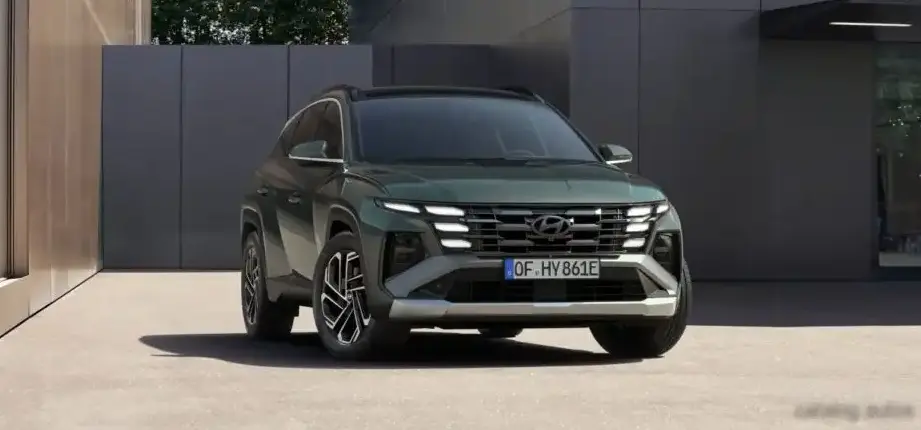
The Hyundai Tucson IV (facelift, introduced in May 2024) 1.6T, producing 160 horsepower, represents a key offering within Hyundai’s popular compact SUV lineup. This variant, positioned as a mid-range option, aimed to balance fuel efficiency with adequate performance for everyday driving. Production of this specific configuration continued through September 2025. It builds upon the foundation of the fourth-generation Tucson (internally designated as NX4), which debuted in 2020, incorporating styling updates and revised technology for the 2024 model year. The 1.6T trim served as a bridge between the base engine options and the more powerful hybrid and plug-in hybrid models, catering to buyers seeking a conventional gasoline powertrain with a degree of refinement.
Technical Specifications
| Brand | Hyundai |
| Model | Tucson |
| Generation | Tucson IV (facelift 2024) |
| Type (Engine) | 1.6T (160 Hp) |
| Start of production | May, 2024 |
| End of production | September, 2025 |
| Powertrain Architecture | Internal Combustion engine |
| Body type | SUV |
| Seats | 5 |
| Doors | 5 |
| Fuel consumption at Low speed (WLTP) | 9.0-9.1 l/100 km (26.1 – 25.8 US mpg, 31.4 – 31 UK mpg, 11.1 – 11 km/l) |
| Fuel consumption at Medium speed (WLTP) | 6.7-6.9 l/100 km (35.1 – 34.1 US mpg, 42.2 – 40.9 UK mpg, 14.9 – 14.5 km/l) |
| Fuel consumption at high speed (WLTP) | 5.8-6.0 l/100 km (40.6 – 39.2 US mpg, 48.7 – 47.1 UK mpg, 17.2 – 16.7 km/l) |
| Fuel consumption at very high speed (WLTP) | 6.8-7.1 l/100 km (34.6 – 33.1 US mpg, 41.5 – 39.8 UK mpg, 14.7 – 14.1 km/l) |
| Combined fuel consumption (WLTP) | 6.8-7.0 l/100 km (34.6 – 33.6 US mpg, 41.5 – 40.4 UK mpg, 14.7 – 14.3 km/l) |
| CO2 emissions (WLTP) | 154-158 g/km |
| Fuel Type | Petrol (Gasoline) |
| Acceleration 0 – 100 km/h | 9.9 sec |
| Acceleration 0 – 62 mph | 9.9 sec |
| Acceleration 0 – 60 mph | 9.4 sec |
| Maximum speed | 192 km/h (119.3 mph) |
| Emission standard | Euro 6e |
| Weight-to-power ratio | 10.1 kg/Hp, 98.9 Hp/tonne |
| Weight-to-torque ratio | 6.1 kg/Nm, 163.8 Nm/tonne |
| Power | 160 Hp @ 5500 rpm |
| Power per litre | 100.1 Hp/l |
| Torque | 265 Nm @ 1500-4500 rpm (195.45 lb.-ft. @ 1500-4500 rpm) |
| Engine layout | Front, Transverse |
| Engine Model/Code | G4FP |
| Engine displacement | 1598 cm3 (97.52 cu. in.) |
| Number of cylinders | 4 |
| Engine configuration | Inline |
| Cylinder Bore | 75.6 mm (2.98 in.) |
| Piston Stroke | 89 mm (3.5 in.) |
| Compression ratio | 10.5:1 |
| Number of valves per cylinder | 4 |
| Fuel injection system | Direct injection |
| Engine aspiration | Turbocharger, Intercooler |
| Valvetrain | DOHC |
| Engine oil capacity | 4.8 l (5.07 US qt | 4.22 UK qt) |
| Coolant | 7.9 l (8.35 US qt | 6.95 UK qt) |
| Kerb Weight | 1618 kg (3567.08 lbs.) |
| Max. weight | 2095 kg (4618.68 lbs.) |
| Max load | 477 kg (1051.6 lbs.) |
| Trunk (boot) space – minimum | 620 l (21.9 cu. ft.) |
| Trunk (boot) space – maximum | 1799 l (63.53 cu. ft.) |
| Fuel tank capacity | 54 l (14.27 US gal | 11.88 UK gal) |
| Max. roof load | 100 kg (220.46 lbs.) |
| Permitted trailer load with brakes (12%) | 1510 kg (3328.98 lbs.) |
| Permitted trailer load without brakes | 750 kg (1653.47 lbs.) |
| Length | 4510 mm (177.56 in.) |
| Width | 1865 mm (73.43 in.) |
| Height | 1650-1653 mm (64.96 – 65.08 in.) |
| Wheelbase | 2680 mm (105.51 in.) |
| Front track | 1615-1630 mm (63.58 – 64.17 in.) |
| Rear (Back) track | 1622-1637 mm (63.86 – 64.45 in.) |
| Minimum turning circle (turning diameter) | 11 m (36.09 ft.) |
| Drivetrain Architecture | The Internal combustion engine (ICE) drives the front wheels of the vehicle. |
| Drive wheel | Front wheel drive |
| Number of gears and type of gearbox | 6 gears, manual transmission |
| Front suspension | Independent type McPherson |
| Rear suspension | Independent multi-link suspension |
| Front brakes | Ventilated discs |
| Rear brakes | Disc |
| Assisting systems | ABS (Anti-lock braking system) |
| Steering type | Steering rack and pinion |
| Power steering | Electric Steering |
| Tires size | 215/65 R17; 235/55 R18; 235/50 R19 |
| Wheel rims size | 7.0J x 17; 7.5J x 18; 7.5J x 19 |
Powertrain & Engine Architecture
The heart of the Tucson 1.6T is Hyundai’s G4FP engine, a 1.6-liter turbocharged inline-four cylinder gasoline engine. This engine utilizes direct fuel injection, a technology that improves combustion efficiency and power output. The G4FP engine features a twin-scroll turbocharger with an intercooler, which helps to reduce turbo lag and provide a more responsive driving experience. The engine employs a Dual Continuously Variable Valve Timing (D-CVVT) system, optimizing valve timing for improved performance and fuel economy across the engine’s operating range. The 6-speed automatic transmission was specifically tuned to work with the engine’s torque curve, providing smooth shifts and efficient power delivery. While a 7-speed dual-clutch transmission (DCT) was available on some Tucson trims, the 1.6T typically paired with the conventional automatic.
Driving Characteristics
The 160 horsepower and 195 lb-ft of torque offered by the 1.6T engine provided adequate performance for daily commuting and highway driving. Acceleration from 0-60 mph took approximately 9.4 seconds. Compared to the more powerful engine options (like the 2.5L naturally aspirated engine), the 1.6T felt less eager to accelerate, particularly when fully loaded. However, the turbocharger provided a noticeable boost in power during overtaking maneuvers. The 6-speed automatic transmission generally shifted smoothly, but could sometimes feel hesitant during quick downshifts. The gear ratios were optimized for fuel efficiency, rather than outright performance. Overall, the driving experience was comfortable and refined, prioritizing ease of use over sporty handling.
Equipment & Trim Levels
The 1.6T trim typically included standard features such as automatic climate control, a touchscreen infotainment system with Apple CarPlay and Android Auto compatibility, and a suite of safety features including forward collision avoidance assist, lane keeping assist, and driver attention warning. Interior upholstery was typically cloth, with available upgrades to leatherette. Higher trim levels within the 1.6T range offered features like a panoramic sunroof, heated front seats, and a premium audio system. Optional extras included adaptive cruise control, blind-spot monitoring, and a hands-free power liftgate.
Chassis & Braking
The Tucson IV utilizes a front-wheel-drive platform with independent suspension at all four corners. The front suspension employs a McPherson strut design, while the rear features a multi-link setup. This configuration provides a comfortable ride quality and decent handling characteristics. The 1.6T models were equipped with ventilated front disc brakes and solid rear discs. ABS (Anti-lock Braking System) was standard, along with electronic stability control and traction control. The suspension tuning was geared towards comfort, with a focus on absorbing bumps and minimizing body roll.
Market Reception & Comparison
The Tucson 1.6T was generally well-received by automotive critics as a practical and fuel-efficient option within the compact SUV segment. Reviewers praised its comfortable ride, spacious interior, and comprehensive list of standard features. However, some critics noted that the engine could feel underpowered, especially when compared to competitors offering more powerful engine options. In terms of fuel economy, the 1.6T delivered competitive figures, achieving around 34.6 mpg combined. Compared to the higher-output 2.5L engine, the 1.6T offered better fuel economy but less performance. The 1.6T also represented a more affordable entry point into the Tucson lineup compared to the hybrid and plug-in hybrid models.
Legacy
The Hyundai Tucson IV 1.6T has established itself as a reliable and affordable used car option. The G4FP engine, while not known for exceptional performance, has proven to be relatively durable with proper maintenance. Common maintenance items include regular oil changes, air filter replacements, and spark plug replacements. The 6-speed automatic transmission is also generally reliable, although some owners have reported minor issues with shifting smoothness. As a whole, the 1.6T variant of the Tucson IV represents a sensible choice for buyers seeking a practical and fuel-efficient compact SUV with a proven track record.