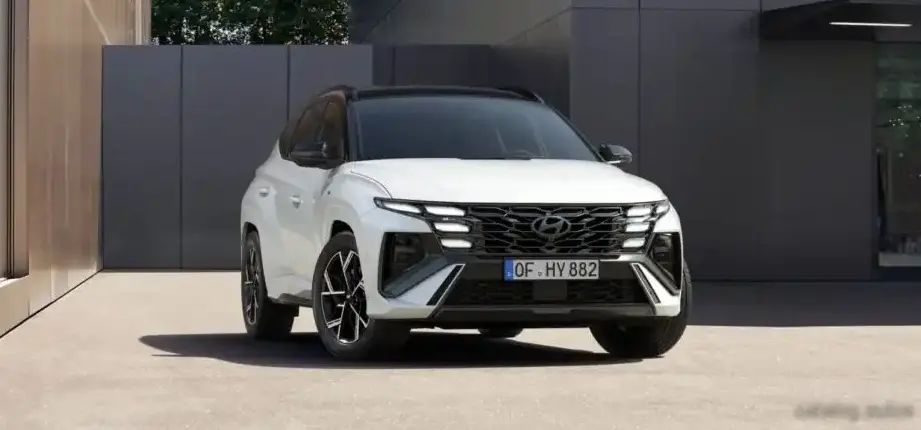
The Hyundai Tucson IV facelift, introduced in May 2024, represents a mid-cycle refresh of the fourth-generation Tucson, a compact SUV that has become a significant player in the global market. The 1.6T Full Hybrid Automatic variant, producing 215 horsepower, occupies a key position in the Tucson lineup, offering a balance of performance, fuel efficiency, and technology. Production of this specific configuration is slated to continue through September 2025. This model is primarily targeted towards buyers seeking a practical, well-equipped SUV with the benefits of hybrid technology, appealing to a broad demographic within the family vehicle segment.
Technical Specifications
| Brand | Hyundai |
| Model | Tucson |
| Generation | Tucson IV (facelift 2024) |
| Type (Engine) | 1.6T (215 Hp) Full Hybrid Automatic |
| Start of production | May, 2024 |
| End of production | September, 2025 |
| Powertrain Architecture | FHEV (Full Hybrid Electric Vehicle) |
| Body type | SUV |
| Seats | 5 |
| Doors | 5 |
| Fuel consumption at Low speed (WLTP) | 4.7-5.1 l/100 km (50 – 46.1 US mpg) |
| Fuel consumption at Medium speed (WLTP) | 3.8-4.4 l/100 km (61.9 – 53.5 US mpg) |
| Fuel consumption at high speed (WLTP) | 5.2-5.3 l/100 km (45.2 – 44.4 US mpg) |
| Fuel consumption at very high speed (WLTP) | 7.5-7.7 l/100 km (31.4 – 30.5 US mpg) |
| Combined fuel consumption (WLTP) | 5.7-5.9 l/100 km (41.3 – 39.9 US mpg) |
| CO2 emissions (WLTP) | 129-134 g/km |
| Fuel Type | Petrol (Gasoline) |
| Acceleration 0 – 100 km/h | 8.2 sec |
| Acceleration 0 – 62 mph | 8.2 sec |
| Acceleration 0 – 60 mph | 7.8 sec |
| Maximum speed | 187 km/h (116.2 mph) |
| Emission standard | Euro 6e |
| Weight-to-power ratio | 7.9 kg/Hp, 126.4 Hp/tonne |
| Weight-to-torque ratio | 6.4 kg/Nm, 155.2 Nm/tonne |
| Battery technology | Lithium-polymer (LiPo) |
| Battery location | Below the floor, under the rear seats |
| Electric motor power | 60 Hp |
| Electric motor Torque | 265 Nm (195.45 lb.-ft.) |
| Electric motor type | Synchronous |
| System power | 215 Hp @ 5500 rpm |
| System torque | 264 Nm @ 1500-4500 rpm (194.72 lb.-ft. @ 1500-4500 rpm) |
| Engine layout | Front, Transverse |
| Engine Model/Code | G4FT |
| Engine displacement | 1598 cm3 (97.52 cu. in.) |
| Number of cylinders | 4 |
| Engine configuration | Inline |
| Cylinder Bore | 75.6 mm (2.98 in.) |
| Piston Stroke | 89 mm (3.5 in.) |
| Compression ratio | 10.5:1 |
| Number of valves per cylinder | 4 |
| Fuel injection system | Direct injection |
| Engine aspiration | Turbocharger, Intercooler |
| Valvetrain | DOHC |
| Engine oil capacity | 4.8 l (5.07 US qt | 4.22 UK qt) |
| Coolant | 7.8 l (8.24 US qt | 6.86 UK qt) |
| Kerb Weight | 1701 kg (3750.06 lbs.) |
| Max. weight | 2190 kg (4828.12 lbs.) |
| Max load | 489 kg (1078.06 lbs.) |
| Trunk (boot) space – minimum | 616 l (21.75 cu. ft.) |
| Trunk (boot) space – maximum | 1795 l (63.39 cu. ft.) |
| Fuel tank capacity | 52 l (13.74 US gal | 11.44 UK gal) |
| Max. roof load | 100 kg (220.46 lbs.) |
| Permitted trailer load with brakes (12%) | 1360 kg (2998.29 lbs.) |
| Permitted trailer load without brakes | 750 kg (1653.47 lbs.) |
| Length | 4510 mm (177.56 in.) |
| Width | 1865 mm (73.43 in.) |
| Height | 1650-1653 mm (64.96 – 65.08 in.) |
| Wheelbase | 2680 mm (105.51 in.) |
| Front track | 1615-1630 mm (63.58 – 64.17 in.) |
| Rear (Back) track | 1622-1637 mm (63.86 – 64.45 in.) |
| Minimum turning circle (turning diameter) | 11 m (36.09 ft.) |
| Drivetrain Architecture | The Internal combustion engine (ICE) and electric motor drive the front wheels of the car with the ability to work in full electric or mixed mode. |
| Drive wheel | Front wheel drive |
| Number of gears and type of gearbox | 6 gears, automatic transmission |
| Front suspension | Independent type McPherson |
| Rear suspension | Independent multi-link suspension |
| Front brakes | Disc |
| Rear brakes | Disc |
| Assisting systems | ABS (Anti-lock braking system) |
| Steering type | Steering rack and pinion |
| Power steering | Electric Steering |
| Tires size | 215/65 R17; 235/55 R18; 235/50 R19 |
| Wheel rims size | 7.0J x 17; 7.5J x 18; 7.5J x 19 |
INTRODUCTION
The Hyundai Tucson IV facelift’s 1.6T Full Hybrid Automatic, launched in May 2024, builds upon the success of the fourth-generation Tucson (introduced in 2020). This variant is a key component of Hyundai’s strategy to offer a diverse range of powertrain options, catering to evolving consumer preferences for fuel efficiency and reduced emissions. Positioned as a mid-range offering within the Tucson lineup, it slots between the base gasoline models and the more expensive plug-in hybrid variants. The “facelift” designation indicates cosmetic and technological updates to the existing fourth-generation model, enhancing its appeal in a competitive segment.
Powertrain & Engine Architecture
At the heart of this Tucson variant lies Hyundai’s ‘G4FT’ 1.6-liter turbocharged four-cylinder gasoline engine. This engine utilizes direct fuel injection and a twin-scroll turbocharger to deliver a balance of power and efficiency. The engine produces 180 horsepower and 195 lb-ft of torque on its own. Coupled with a 60 horsepower electric motor and a lithium-polymer battery pack, the combined system output reaches 215 horsepower and 264 lb-ft of torque. The engine features a DOHC (Dual Overhead Camshaft) valvetrain and a compression ratio of 10.5:1. The powertrain utilizes a six-speed automatic transmission, specifically tuned to work seamlessly with the hybrid system. The transmission’s programming prioritizes smooth transitions and efficient operation, optimizing fuel economy without sacrificing responsiveness. The electric motor is integrated into the transmission housing, creating a compact and efficient hybrid system.
Driving Characteristics
The 1.6T Full Hybrid Automatic Tucson offers a refined and comfortable driving experience. The electric motor provides instant torque, resulting in brisk acceleration, particularly from a standstill. Hyundai claims a 0-60 mph time of 7.8 seconds. In typical driving scenarios, the hybrid system intelligently switches between electric, gasoline, and combined power modes, maximizing efficiency. The automatic transmission shifts smoothly and predictably, contributing to a relaxed driving experience. Compared to the base gasoline engine, the hybrid variant offers significantly improved fuel economy and a more responsive feel. While not as sporty as some competitors, the Tucson 1.6T Hybrid provides ample power for everyday driving and highway cruising. The gear ratios are optimized for both fuel efficiency and acceleration, with a focus on providing usable torque across a wide range of engine speeds.
Equipment & Trim Levels
The 1.6T Full Hybrid Automatic trim typically includes a generous array of standard features. These commonly include a touchscreen infotainment system with Apple CarPlay and Android Auto compatibility, a suite of advanced driver-assistance systems (ADAS) such as lane-keeping assist, forward collision avoidance, and adaptive cruise control, and automatic climate control. Interior upholstery is typically cloth or leatherette, depending on optional packages. Higher trim levels offer upgrades such as leather seats, a panoramic sunroof, a premium sound system, and ventilated front seats. Optional extras often include a head-up display, a surround-view monitor, and a wireless charging pad.
Chassis & Braking
The Tucson IV utilizes a front-wheel-drive platform, although all-wheel drive is available as an option. The suspension consists of an independent McPherson strut setup at the front and an independent multi-link setup at the rear, providing a comfortable ride and predictable handling. The chassis is engineered to minimize body roll and maximize stability. Braking duties are handled by disc brakes on all four wheels, equipped with ABS (Anti-lock Braking System) and electronic brake-force distribution. The steering system is an electric power-assisted rack and pinion system, offering precise and responsive steering feel.
Market Reception & Comparison
The Hyundai Tucson IV facelift, particularly the 1.6T Full Hybrid Automatic variant, has been well-received by automotive critics and consumers alike. Reviewers praise its fuel efficiency, comfortable ride, and well-equipped interior. Compared to other trims in the Tucson lineup, the hybrid model offers a compelling balance of performance and economy. The 1.6T Hybrid generally achieves better fuel economy than the base gasoline engine and provides a more refined driving experience. While the plug-in hybrid variant offers even greater fuel efficiency and electric-only range, it comes at a higher price point. Competitors in this segment include the Toyota RAV4 Hybrid, Honda CR-V Hybrid, and Nissan Rogue Hybrid.
Legacy
Hyundai’s hybrid technology has proven to be reliable in recent years, and the 1.6T Full Hybrid powertrain is expected to offer long-term durability. The use of a lithium-polymer battery pack contributes to its longevity and performance. In the used car market, the Tucson IV facelift 1.6T Hybrid is anticipated to hold its value well, due to its fuel efficiency and desirable features. The combination of a turbocharged engine, electric motor, and automatic transmission provides a versatile and efficient powertrain that is well-suited to the demands of modern driving. As hybrid technology continues to evolve, this Tucson variant represents a significant step towards a more sustainable automotive future.