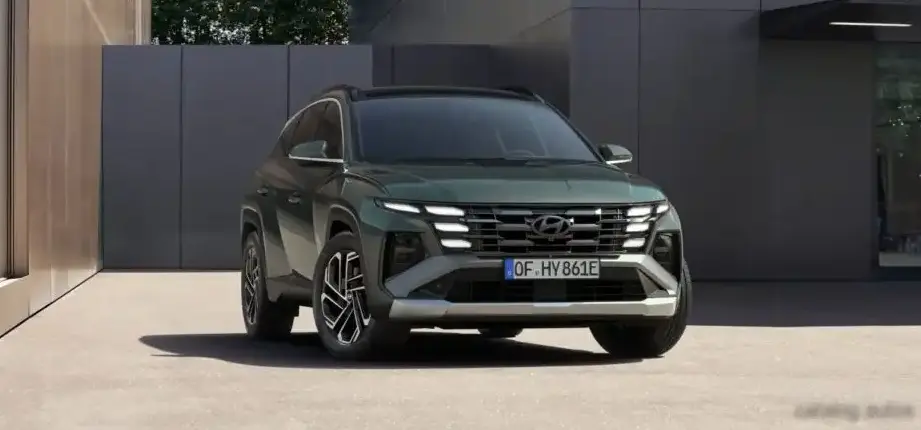
The Hyundai Tucson IV facelift, introduced in May 2024, represents a significant update to Hyundai’s popular compact SUV. Among the powertrain options available, the 1.6T Plug-in Hybrid Automatic, producing 253 horsepower, occupies a premium position in the lineup, blending efficiency with respectable performance. Production of this variant is slated to continue through November 2025. This model is primarily targeted towards the European and North American markets, where demand for fuel-efficient and environmentally conscious vehicles is high. It builds upon the foundation of the fourth-generation Tucson (NX4), known for its bold styling and spacious interior, while adding the benefits of plug-in hybrid technology.
Technical Specifications
| Brand | Hyundai |
| Model | Tucson |
| Generation | Tucson IV (facelift 2024) |
| Type (Engine) | 1.6T (253 Hp) Plug-in Hybrid Automatic |
| Start of production | May, 2024 |
| End of production | November, 2025 |
| Powertrain Architecture | PHEV (Plug-in Hybrid Electric Vehicle) |
| Body type | SUV |
| Seats | 5 |
| Doors | 5 |
| CO2 emissions (WLTP) | 29 g/km |
| Fuel Type | Petrol / electricity |
| Acceleration 0 – 100 km/h | 8.2 sec |
| Acceleration 0 – 62 mph | 8.2 sec |
| Acceleration 0 – 60 mph | 7.8 sec |
| Maximum speed | 187 km/h (116.2 mph) |
| Emission standard | Euro 6e |
| Weight-to-power ratio | 7.4 kg/Hp, 134.9 Hp/tonne |
| Weight-to-torque ratio | 6.2 kg/Nm, 162 Nm/tonne |
| Battery technology | Lithium-polymer (LiPo) |
| Battery location | Below the floor, under the rear seats |
| Electric motor power | 91 Hp |
| Electric motor Torque | 304 Nm (224.22 lb.-ft.) |
| Electric motor location | Between the combustion engine and the transmission |
| Electric motor type | Synchronous |
| System power | 253 Hp @ 5500 rpm |
| System torque | 304 Nm @ 1500-4500 rpm (224.22 lb.-ft. @ 1500-4500 rpm) |
| Engine layout | Front, Transverse |
| Engine Model/Code | G4FP |
| Engine displacement | 1598 cm3 (97.52 cu. in.) |
| Number of cylinders | 4 |
| Engine configuration | Inline |
| Cylinder Bore | 75.6 mm (2.98 in.) |
| Piston Stroke | 89 mm (3.5 in.) |
| Compression ratio | 10.5:1 |
| Number of valves per cylinder | 4 |
| Fuel injection system | Direct injection |
| Engine aspiration | Turbocharger, Intercooler |
| Valvetrain | DOHC |
| Engine oil capacity | 4.8 l (5.07 US qt | 4.22 UK qt) |
| Coolant | 6.8 l (7.19 US qt | 5.98 UK qt) |
| Kerb Weight | 1876 kg (4135.87 lbs.) |
| Max. weight | 2350 kg (5180.86 lbs.) |
| Max load | 474 kg (1044.99 lbs.) |
| Trunk (boot) space – minimum | 558 l (19.71 cu. ft.) |
| Trunk (boot) space – maximum | 1795 l (63.39 cu. ft.) |
| Fuel tank capacity | 42 l (11.1 US gal | 9.24 UK gal) |
| Max. roof load | 100 kg (220.46 lbs.) |
| Permitted trailer load with brakes (12%) | 1210 kg (2667.59 lbs.) |
| Permitted trailer load without brakes | 750 kg (1653.47 lbs.) |
| Length | 4510 mm (177.56 in.) |
| Width | 1865 mm (73.43 in.) |
| Height | 1650-1653 mm (64.96 – 65.08 in.) |
| Wheelbase | 2680 mm (105.51 in.) |
| Front track | 1615-1630 mm (63.58 – 64.17 in.) |
| Rear (Back) track | 1622-1637 mm (63.86 – 64.45 in.) |
| Minimum turning circle | 11 m (36.09 ft.) |
| Drivetrain Architecture | Front wheel drive. PHEV. |
| Number of gears and type of gearbox | 6 gears, automatic transmission |
| Front suspension | Independent type McPherson |
| Rear suspension | Independent multi-link suspension |
| Front brakes | Disc |
| Rear brakes | Disc |
| Assisting systems | ABS (Anti-lock braking system) |
| Steering type | Steering rack and pinion |
| Power steering | Electric Steering |
| Tires size | 215/65 R17; 235/55 R18; 235/50 R19 |
| Wheel rims size | 7.0J x 17; 7.5J x 18; 7.5J x 19 |
Powertrain & Engine Architecture
At the heart of the Tucson 1.6T Plug-in Hybrid lies the Hyundai-Kia Smartstream G4FP 1.6-liter turbocharged four-cylinder engine. This engine utilizes direct injection and a sophisticated turbocharging system to deliver a balance of power and efficiency. The engine produces 180 horsepower and 188 lb-ft of torque on its own. Coupled with the 91 horsepower electric motor, the combined system output reaches 253 horsepower and 304 lb-ft of torque. The electric motor is strategically positioned between the engine and the six-speed automatic transmission. The transmission itself is a conventional torque-converter automatic, chosen for its smoothness and reliability. The lithium-polymer battery pack, located under the rear seats, provides an electric-only range of approximately 33 miles (WLTP cycle), allowing for zero-emission commuting for many drivers. The engine incorporates a particulate filter to meet stringent Euro 6e emission standards.
Driving Characteristics
The 1.6T Plug-in Hybrid Automatic offers a refined driving experience. In electric mode, the Tucson is near-silent and provides brisk acceleration for city driving. When the gasoline engine engages, the transition is seamless. The combined power output delivers confident acceleration, with a 0-60 mph time of around 7.8 seconds. The six-speed automatic transmission is well-tuned, providing smooth gear changes. Compared to the standard gasoline-powered Tucson, the plug-in hybrid variant offers significantly improved fuel economy, especially for drivers who frequently utilize the electric driving mode. While not as sporty as some competitors, the Tucson prioritizes comfort and ease of driving. The added weight of the battery pack does slightly impact handling, but the well-tuned suspension minimizes body roll.
Equipment & Trim Levels
The 1.6T Plug-in Hybrid Automatic typically comes well-equipped, often representing the higher trim levels of the Tucson range. Standard features generally include leather upholstery, heated and ventilated front seats, a large touchscreen infotainment system with navigation, a premium sound system, and a suite of advanced driver-assistance systems (ADAS) such as adaptive cruise control, lane-keeping assist, and automatic emergency braking. Optional extras may include a panoramic sunroof, a head-up display, and a 360-degree camera system. Interior trim levels vary, with higher trims offering more luxurious materials and finishes.
Chassis & Braking
The Tucson 1.6T Plug-in Hybrid utilizes a front-wheel-drive layout as standard, although all-wheel drive is often available as an option. The suspension consists of independent McPherson struts at the front and an independent multi-link setup at the rear, providing a comfortable ride and good handling characteristics. Disc brakes are fitted on all four wheels, providing ample stopping power. The electronic stability control (ESC) system and anti-lock braking system (ABS) are standard features, enhancing safety and control.
Market Reception & Comparison
The Hyundai Tucson Plug-in Hybrid has been well-received by critics and consumers alike. It is praised for its fuel efficiency, comfortable ride, spacious interior, and long warranty. Compared to other plug-in hybrid SUVs in its class, the Tucson offers a competitive price point and a generous level of standard equipment. Its fuel economy is comparable to rivals like the Toyota RAV4 Prime and Mitsubishi Outlander PHEV, but its electric range is slightly shorter. Reliability has been generally good, with Hyundai’s reputation for building durable vehicles.
Legacy
The Hyundai Tucson IV 1.6T Plug-in Hybrid Automatic represents a significant step forward in Hyundai’s commitment to electrification. The Smartstream engine and plug-in hybrid technology demonstrate the brand’s engineering prowess. As a used car, this variant is expected to hold its value well due to its fuel efficiency and environmental benefits. The powertrain is generally considered reliable, although regular maintenance, including battery health checks, is crucial for long-term durability. The Tucson Plug-in Hybrid has established itself as a popular choice for environmentally conscious buyers seeking a practical and comfortable SUV.