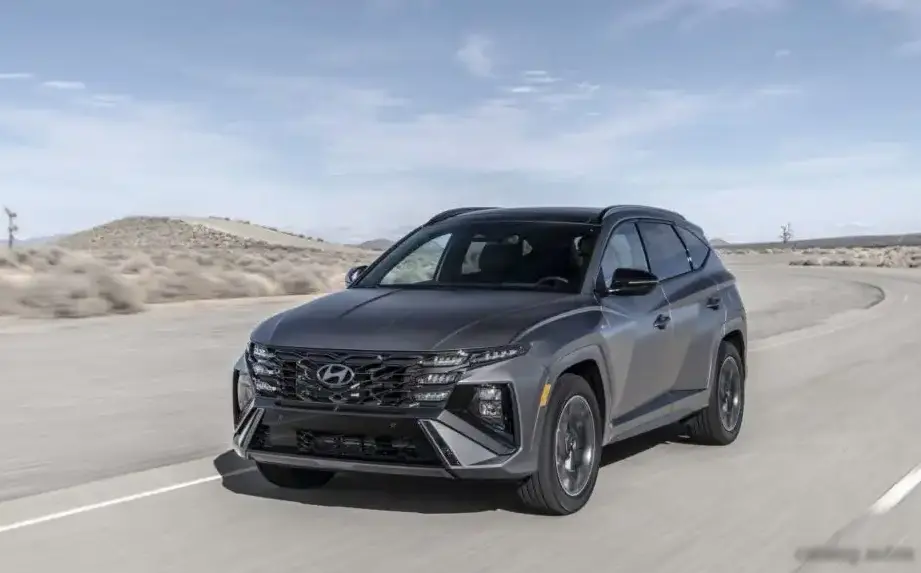
The Hyundai Tucson IV, specifically the facelifted 2024 model year equipped with the 2.5-liter naturally aspirated engine producing 187 horsepower and paired with an 8-speed automatic transmission and HTRAC all-wheel drive, represents a significant offering in the compact SUV segment. Introduced in March 2024, this variant builds upon the already successful fourth generation (NX4) Tucson, known for its bold styling and feature-rich interior. The 2.5L HTRAC AWD Automatic positions itself as a mid-range option within the Tucson lineup, offering a balance between performance, fuel efficiency, and all-weather capability. It slots above the base 2.5L front-wheel drive model and below the hybrid and plug-in hybrid variants.
Technical Specifications
| Brand | Hyundai |
| Model | Tucson |
| Generation | Tucson IV (facelift 2024) |
| Type (Engine) | 2.5L (187 Hp) HTRAC AWD Automatic |
| Start of production | March, 2024 |
| Powertrain Architecture | Internal Combustion engine |
| Body type | SUV |
| Seats | 5 |
| Doors | 5 |
| Fuel Type | Petrol (Gasoline) |
| Emission standard | SULEV30 |
| Power | 187 Hp @ 6100 rpm |
| Power per litre | 74.9 Hp/l |
| Torque | 241 Nm @ 4000 rpm |
| Torque (lb-ft) | 177.75 lb.-ft. @ 4000 rpm |
| Engine layout | Front, Transverse |
| Engine Model/Code | Smartstream |
| Engine displacement | 2497 cm3 |
| Engine displacement (cu. in.) | 152.38 cu. in. |
| Number of cylinders | 4 |
| Engine configuration | Inline |
| Compression ratio | 13:1 |
| Number of valves per cylinder | 4 |
| Fuel injection system | Direct injection and Multi-port manifold injection |
| Engine aspiration | Naturally aspirated engine |
| Valvetrain | DOHC, CVVT |
| Engine oil capacity | 5.6 l |
| Engine oil capacity (US qt) | 5.92 US qt |
| Engine oil capacity (UK qt) | 4.93 UK qt |
| Trunk (boot) space – minimum | 1096 l |
| Trunk (boot) space – minimum (cu. ft.) | 38.7 cu. ft. |
| Trunk (boot) space – maximum | 2118 l |
| Trunk (boot) space – maximum (cu. ft.) | 74.8 cu. ft. |
| Fuel tank capacity | 54 l |
| Fuel tank capacity (US gal) | 14.27 US gal |
| Fuel tank capacity (UK gal) | 11.88 UK gal |
| Max. roof load | 100 kg |
| Max. roof load (lbs.) | 220.46 lbs. |
| Permitted trailer load with brakes (12%) | 907 kg |
| Permitted trailer load with brakes (lbs.) | 1999.59 lbs. |
| Permitted trailer load without brakes | 748 kg |
| Permitted trailer load without brakes (lbs.) | 1649.06 lbs. |
| Length | 4641 mm |
| Length (in.) | 182.72 in. |
| Width | 1864 mm |
| Width (in.) | 73.39 in. |
| Height | 1684 mm |
| Height (in.) | 66.3 in. |
| Wheelbase | 2756 mm |
| Wheelbase (in.) | 108.5 in. |
| Front track | 1615-1621 mm |
| Front track (in.) | 63.58 – 63.82 in. |
| Rear (Back) track | 1623-1628 mm |
| Rear (Back) track (in.) | 63.9 – 64.09 in. |
| Front overhang | 904 mm |
| Front overhang (in.) | 35.59 in. |
| Rear overhang | 980 mm |
| Rear overhang (in.) | 38.58 in. |
| Ride height (ground clearance) | 211 mm |
| Ride height (ground clearance) (in.) | 8.31 in. |
| Drag coefficient (Cd) | 0.33 |
| Minimum turning circle (turning diameter) | 11.8 m |
| Minimum turning circle (turning diameter) (ft.) | 38.71 ft. |
| Drivetrain Architecture | The Internal combustion engine (ICE) drives the front wheels permanently, and the rear wheels are driven through an electrically or mechanically operated clutch if necessary. |
| Drive wheel | All wheel drive (4×4) |
| Number of gears and type of gearbox | 8 gears, automatic transmission |
| Front suspension | Independent, type McPherson with coil spring and anti-roll bar |
| Rear suspension | Independent multi-link spring suspension with stabilizer |
| Front brakes | Ventilated discs, 325×30 mm |
| Rear brakes | Disc, 300×10 mm |
| Assisting systems | ABS (Anti-lock braking system) |
| Steering type | Steering rack and pinion |
| Power steering | Electric Steering |
| Wheel rims size | 17; 19 |
Powertrain & Engine Architecture
At the heart of the 2024 Tucson 2.5L HTRAC AWD Automatic lies Hyundai’s Smartstream 2.5-liter inline-four cylinder engine. This engine, part of Hyundai’s newer engine family, utilizes a combination of direct injection and multi-port fuel injection to optimize combustion efficiency and power delivery. The engine features a dual overhead camshaft (DOHC) valvetrain with continuously variable valve timing (CVVT) on both intake and exhaust sides, further enhancing performance and fuel economy. The engine produces 187 horsepower at 6,100 rpm and 177.75 lb-ft of torque at 4,000 rpm. The engine is transversely mounted in the front of the vehicle.
The engine is mated to an 8-speed automatic transmission, replacing the older 6-speed unit found in previous Tucson generations. This new transmission offers smoother shifts and a wider gear ratio spread, contributing to improved acceleration and highway cruising efficiency. The HTRAC all-wheel drive system is a key component, employing an electronically controlled multi-plate clutch to distribute torque between the front and rear axles as needed, providing enhanced traction in various driving conditions.
Driving Characteristics
The 2.5L Tucson delivers adequate performance for everyday driving. Acceleration is reasonably brisk, though not particularly sporty. The 8-speed automatic transmission generally shifts smoothly and responsively, although occasional hesitation can be noticed during quick acceleration maneuvers. Compared to the more powerful turbocharged engines available in the Tucson lineup, the 2.5L feels less eager to rev and requires more planning when overtaking or merging onto highways. The HTRAC all-wheel drive system provides confident handling in inclement weather, offering increased stability and grip on slippery surfaces. The gear ratios are tuned for a balance of fuel efficiency and usability, prioritizing comfortable cruising over outright performance.
Equipment & Trim Levels
The 2.5L HTRAC AWD Automatic trim typically includes a generous array of standard features. These commonly include an 8-inch touchscreen infotainment system with Apple CarPlay and Android Auto compatibility, a suite of advanced driver-assistance systems (ADAS) such as forward collision avoidance assist, lane keeping assist, and driver attention warning, and comfortable cloth upholstery. Higher sub-trims within the 2.5L range may add features like a larger touchscreen display, leather upholstery, a panoramic sunroof, and premium audio systems. Optional extras often include adaptive cruise control, blind-spot monitoring, and a hands-free power liftgate.
Chassis & Braking
The Tucson IV utilizes a fully independent suspension system, featuring a McPherson strut setup at the front and a multi-link suspension at the rear. This configuration provides a comfortable ride quality and good handling characteristics. Stabilizer bars are fitted to both axles to reduce body roll during cornering. The braking system consists of ventilated discs at the front and solid discs at the rear. Anti-lock braking system (ABS) is standard, along with electronic brake-force distribution (EBD) and brake assist. The Tucson’s steering is electrically assisted, providing light and precise steering feel.
Market Reception & Comparison
The 2024 Hyundai Tucson 2.5L HTRAC AWD Automatic has been generally well-received by automotive critics. It’s praised for its spacious interior, comfortable ride, and comprehensive suite of standard features. Compared to other compact SUVs in its class, the Tucson offers a competitive value proposition, particularly considering its standard equipment and warranty coverage. Fuel economy is respectable, though not class-leading, with EPA estimates typically around 26 mpg combined. Reliability is generally considered good, although long-term data for the facelifted 2024 model is still emerging. Compared to the turbocharged Tucson variants, the 2.5L offers a lower price point but sacrifices some performance. Compared to the hybrid and plug-in hybrid models, it lacks the superior fuel efficiency but avoids the higher initial cost.
Legacy
The Smartstream 2.5-liter engine and 8-speed automatic transmission combination represent a significant upgrade for the Tucson lineup. While it may not offer the exhilarating performance of some competitors, its reliability and fuel efficiency make it a practical choice for many buyers. In the used car market, the 2024 Tucson 2.5L HTRAC AWD Automatic is expected to hold its value well, thanks to Hyundai’s strong reputation for quality and its comprehensive warranty. The HTRAC all-wheel drive system is a particularly desirable feature, enhancing the vehicle’s appeal in regions with harsh winter weather or challenging road conditions.