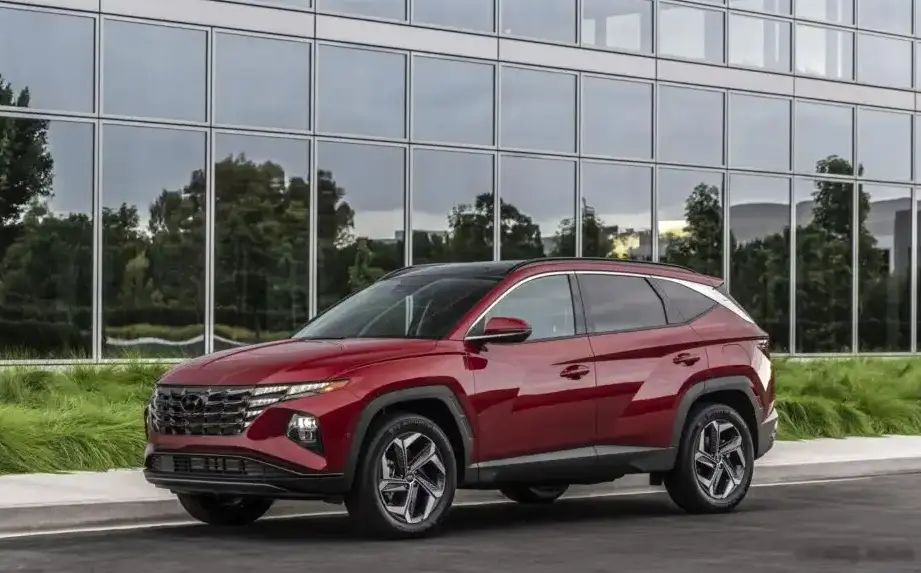
The Hyundai Tucson IV G2.0 SmartStream Automatic, produced from 2021 to 2024, represents a significant iteration in Hyundai’s popular compact SUV lineup. This variant, powered by a 2.0-liter naturally aspirated gasoline engine producing 156 horsepower, was positioned as a mainstream offering within the fourth-generation Tucson (NX4) range, appealing to buyers prioritizing fuel efficiency and a comfortable driving experience over outright performance. It served as a key model in Hyundai’s strategy to expand its presence in the competitive North American and European SUV markets, offering a compelling alternative to established rivals like the Honda CR-V and Toyota RAV4.
Technical Specifications
| Brand | Hyundai |
| Model | Tucson |
| Generation | Tucson IV |
| Type (Engine) | G2.0 SmartStream (156 Hp) Automatic |
| Start of production | 2021 year |
| End of production | 2024 year |
| Powertrain Architecture | Internal Combustion engine |
| Body type | SUV |
| Seats | 5 |
| Doors | 5 |
| Fuel consumption (economy) – urban | 11 l/100 km (21.4 US mpg, 25.7 UK mpg, 9.1 km/l) |
| Fuel consumption (economy) – extra urban | 6.5 l/100 km (36.2 US mpg, 43.5 UK mpg, 15.4 km/l) |
| Fuel consumption (economy) – combined | 8.1 l/100 km (29 US mpg, 34.9 UK mpg, 12.3 km/l) |
| CO2 emissions | 184 g/km |
| Fuel Type | Petrol (Gasoline) |
| Emission standard | Euro 5 |
| Weight-to-power ratio | 9.2 kg/Hp, 109.2 Hp/tonne |
| Weight-to-torque ratio | 7.4 kg/Nm, 134.5 Nm/tonne |
| Power | 156 Hp @ 6200 rpm |
| Power per litre | 78 Hp/l |
| Torque | 192 Nm @ 4500 rpm (141.61 lb.-ft. @ 4500 rpm) |
| Engine layout | Front, Transverse |
| Engine displacement | 1999 cm3 (121.99 cu. in.) |
| Number of cylinders | 4 |
| Engine configuration | Inline |
| Cylinder Bore | 81 mm (3.19 in.) |
| Piston Stroke | 97 mm (3.82 in.) |
| Compression ratio | 10.8:1 |
| Number of valves per cylinder | 4 |
| Fuel injection system | Multi-port manifold injection |
| Engine aspiration | Naturally aspirated engine |
| Valvetrain | HLA |
| Engine oil capacity | 4.3 l (4.54 US qt | 3.78 UK qt) |
| Kerb Weight | 1428-1530 kg (3148.2 – 3373.07 lbs.) |
| Max. weight | 2030 kg (4475.38 lbs.) |
| Max load | 500-602 kg (1102.31 – 1327.18 lbs.) |
| Trunk (boot) space – minimum | 539 l (19.03 cu. ft.) |
| Trunk (boot) space – maximum | 1860 l (65.69 cu. ft.) |
| Fuel tank capacity | 54 l (14.27 US gal | 11.88 UK gal) |
| Max. roof load | 100 kg (220.46 lbs.) |
| Permitted trailer load with brakes (12%) | 1650 kg (3637.63 lbs.) |
| Permitted trailer load without brakes | 750 kg (1653.47 lbs.) |
| Permitted towbar download | 100 kg (220.46 lbs.) |
| Length | 4630-4640 mm (182.28 – 182.68 in.) |
| Width | 1865 mm (73.43 in.) |
| Height | 1665 mm (65.55 in.) |
| Wheelbase | 2755 mm (108.46 in.) |
| Front track | 1615-1620 mm (63.58 – 63.78 in.) |
| Rear (Back) track | 1622-1627 mm (63.86 – 64.06 in.) |
| Ride height (ground clearance) | 181 mm (7.13 in.) |
| Minimum turning circle (turning diameter) | 11.8 m (38.71 ft.) |
| Approach angle | 18.3° |
| Departure angle | 22.6-25.6° |
| Ramp-over (brakeover) angle | 17.8° |
| Drivetrain Architecture | The Internal combustion engine (ICE) drives the front wheels of the vehicle. |
| Drive wheel | Front wheel drive |
| Number of gears and type of gearbox | 6 gears, automatic transmission |
| Front suspension | Independent type McPherson |
| Rear suspension | Independent multi-link suspension |
| Front brakes | Ventilated discs, 305×25 mm |
| Rear brakes | Disc, 300×10 mm |
| Assisting systems | ABS (Anti-lock braking system) |
| Steering type | Steering rack and pinion |
| Power steering | Electric Steering |
| Tires size | 235/65 R17 104H; 235/55 R19 101H |
| Wheel rims size | 7.0J x 17; 7.5J x 19 |
INTRODUCTION
The Hyundai Tucson IV G2.0 SmartStream Automatic, launched in 2021, is a front-wheel-drive compact SUV built on the N3 platform, also known as the 1HX0/A3 platform. This generation of the Tucson marked a significant departure in design, adopting a bolder, more angular aesthetic. The G2.0 SmartStream variant was designed to offer a balance of affordability, fuel economy, and practicality, targeting families and individuals seeking a reliable and comfortable daily driver. It occupied the middle ground in the Tucson IV lineup, positioned below the more powerful turbocharged engines and hybrid options.
Powertrain & Engine Architecture
At the heart of the Tucson IV G2.0 SmartStream Automatic lies the Hyundai SmartStream G2.0 engine, an inline-four cylinder, naturally aspirated gasoline engine. This engine, designated as the F2.0L, utilizes multi-point fuel injection and a dual continuously variable valve timing (CVVT) system to optimize fuel efficiency and power delivery. The engine produces 156 horsepower at 6,200 rpm and 192 Nm (141.61 lb-ft) of torque at 4,500 rpm. The engine’s architecture prioritizes thermal efficiency through features like a cooled exhaust gas recirculation (EGR) system. The engine is paired with a conventional 6-speed automatic transmission, chosen for its smooth operation and reliability. This transmission features a torque converter and electronically controlled gear shifts. While not offering the sporty responsiveness of a dual-clutch transmission, it provides a comfortable and predictable driving experience.
Driving Characteristics
The 156 hp and 192 Nm of torque delivered by the G2.0 SmartStream engine, coupled with the 6-speed automatic, results in a driving experience geared towards comfort and efficiency rather than outright performance. Acceleration is adequate for everyday driving situations, but it won’t provide the briskness of the turbocharged variants. The automatic transmission is tuned for smooth shifts and prioritizes fuel economy, sometimes resulting in hesitant downshifts when quick acceleration is needed. The gear ratios are optimized for cruising, making it a comfortable highway companion. Compared to the manual transmission versions of the 2.0L, the automatic offers greater convenience, but at the expense of some driver engagement. The front-wheel-drive configuration contributes to a lighter vehicle weight, further aiding fuel economy, but limits traction in adverse weather conditions.
Equipment & Trim Levels
The Tucson IV G2.0 SmartStream Automatic typically came standard with a respectable array of features. Base trims included air conditioning, power windows and locks, a touchscreen infotainment system with Apple CarPlay and Android Auto compatibility, and a suite of safety features such as lane keeping assist, forward collision avoidance assist, and automatic emergency braking. Higher trim levels added features like leather upholstery, a panoramic sunroof, heated and ventilated front seats, a premium sound system, and a larger touchscreen display. Optional extras included navigation, adaptive cruise control, and a hands-free power liftgate. Interior upholstery generally consisted of cloth on lower trims, with leather options available on higher-spec models. Dashboard configurations were modern and user-friendly, with a focus on intuitive controls.
Chassis & Braking
The Tucson IV G2.0 SmartStream Automatic utilizes an independent McPherson strut suspension in the front and an independent multi-link suspension in the rear. This suspension setup provides a comfortable ride quality, effectively absorbing bumps and irregularities in the road surface. Stabilizer bars are included both front and rear to reduce body roll during cornering. Braking duties are handled by ventilated discs in the front and solid discs in the rear. The braking system is equipped with ABS (Anti-lock Braking System) and electronic brake-force distribution (EBD) to enhance safety and control. The chassis is designed to provide a stable and predictable driving experience, prioritizing comfort and handling balance over sporty dynamics.
Market Reception & Comparison
The Hyundai Tucson IV G2.0 SmartStream Automatic received generally positive reviews from automotive critics. It was praised for its comfortable ride, spacious interior, and comprehensive list of standard features. However, some critics noted that the engine lacked the punch of its turbocharged counterparts and that the automatic transmission could feel sluggish at times. In terms of fuel economy, the G2.0 SmartStream variant offered competitive figures compared to other naturally aspirated engines in its class. Reliability reports have been generally favorable, with few major issues reported. Compared to the more expensive turbocharged models, the G2.0 SmartStream offered a more affordable entry point into the Tucson IV lineup, making it an attractive option for budget-conscious buyers.
Legacy
The Hyundai Tucson IV G2.0 SmartStream Automatic has proven to be a reliable and durable vehicle, maintaining a solid reputation in the used car market. The SmartStream engine, while not the most powerful, is known for its longevity and relatively low maintenance costs. The 6-speed automatic transmission is also considered to be a robust and dependable unit. As a result, these models continue to hold their value reasonably well. The Tucson IV, in general, helped solidify Hyundai’s position as a major player in the compact SUV segment, and the G2.0 SmartStream variant played a key role in attracting a wider range of customers to the brand.