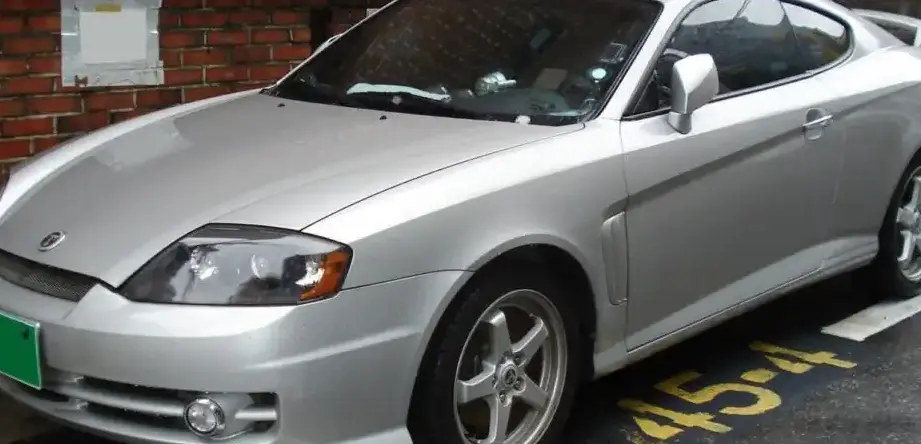
The Hyundai Tuscani, known as the Hyundai Coupe in some markets, represented a significant step for the South Korean automaker into the realm of sporty, affordable coupes. Produced from 1997 to 2001 (as the Tuscani I), this model aimed to capture a younger demographic with its sleek styling, influenced by the Mitsubishi Eclipse and Toyota Celica. The 1.8 16V variant, producing 132 horsepower, served as a mid-range offering within the Tuscani lineup, positioned between the base 1.6L engine and the more potent 2.0L options. It was primarily marketed towards buyers seeking a balance of performance and fuel efficiency, offering a more engaging driving experience than the entry-level models without the higher price tag of the larger-displacement engines.
Technical Specifications
| Brand | Hyundai |
| Model | Tuscani |
| Generation | Tuscani I |
| Type (Engine) | 1.8 16V (132 Hp) |
| Start of production | 1997 |
| End of production | 2001 |
| Powertrain Architecture | Internal Combustion engine |
| Body type | Coupe |
| Seats | 5 |
| Doors | 3 |
| Fuel consumption (urban) | 10.7 l/100 km (22 US mpg) |
| Fuel consumption (extra urban) | 7.8 l/100 km (30.2 US mpg) |
| Fuel Type | Petrol (Gasoline) |
| Maximum speed | 190 km/h (118.06 mph) |
| Weight-to-power ratio | 9.4 kg/Hp |
| Weight-to-torque ratio | 7.5 kg/Nm |
| Power | 132 Hp @ 6000 rpm |
| Power per litre | 73.5 Hp/l |
| Torque | 166 Nm @ 5000 rpm (122.44 lb.-ft. @ 5000 rpm) |
| Engine layout | Front, Longitudinal |
| Engine Model/Code | Beta / G4GM |
| Engine displacement | 1796 cm3 (109.6 cu. in.) |
| Number of cylinders | 4 |
| Engine configuration | Inline |
| Cylinder Bore | 82 mm (3.23 in.) |
| Piston Stroke | 85 mm (3.35 in.) |
| Compression ratio | 10:1 |
| Number of valves per cylinder | 4 |
| Fuel injection system | Multi-port manifold injection |
| Engine aspiration | Naturally aspirated engine |
| Valvetrain | DOHC |
| Engine oil capacity | 4 l (4.23 US qt | 3.52 UK qt) |
| Coolant capacity | 6 l (6.34 US qt | 5.28 UK qt) |
| Kerb Weight | 1240 kg (2733.73 lbs.) |
| Max. weight | 1600 kg (3527.4 lbs.) |
| Max load | 360 kg (793.66 lbs.) |
| Trunk (boot) space – maximum | 360 l (12.71 cu. ft.) |
| Fuel tank capacity | 55 l (14.53 US gal | 12.1 UK gal) |
| Length | 4340 mm (170.87 in.) |
| Width | 1730 mm (68.11 in.) |
| Height | 1310 mm (51.57 in.) |
| Wheelbase | 2480 mm (97.64 in.) |
| Front track | 1470 mm (57.87 in.) |
| Rear (Back) track | 1450 mm (57.09 in.) |
| Drivetrain Architecture | Front wheel drive |
| Number of gears and type of gearbox | 5 gears, manual transmission |
| Front suspension | Spring Strut |
| Rear suspension | Coil spring |
| Front brakes | Ventilated discs |
| Rear brakes | Disc |
| Steering type | Steering rack and pinion |
| Power steering | Hydraulic Steering |
| Tires size | 195/60 R14 |
Powertrain & Engine Architecture
The heart of the Tuscani 1.8 16V is Hyundai’s Beta engine, specifically the G4GM code. This 1.8-liter inline-four engine utilizes a double overhead camshaft (DOHC) valvetrain operating 16 valves (four per cylinder). The engine employs multi-port fuel injection, a common setup for the era, delivering fuel directly into the intake ports. The 10:1 compression ratio was a standard figure for naturally aspirated engines of this period, balancing performance and fuel efficiency. The engine’s longitudinal mounting within the front-wheel-drive chassis contributed to a more balanced weight distribution. The five-speed manual transmission was the standard offering, providing drivers with direct control over the engine’s power. While an automatic transmission was available, it was often criticized for diminishing the car’s sporty character and impacting fuel economy.
Driving Characteristics
The 1.8L engine, producing 132 hp, provided adequate, though not exhilarating, performance. Acceleration to 60 mph was typically in the 9-10 second range. The engine’s torque peak of 166 Nm (122.44 lb-ft) at 5000 rpm meant that drivers needed to rev the engine to access its power. The five-speed manual transmission allowed for precise gear selection, maximizing the engine’s potential. Compared to the 1.6L version, the 1.8 offered a noticeable improvement in both acceleration and highway cruising ability. However, it lacked the punch of the 2.0L models. The front-wheel-drive configuration, while common for cars in this class, could exhibit torque steer under hard acceleration. The suspension, tuned for a balance of comfort and handling, provided a reasonably compliant ride, but wasn’t particularly sporty.
Equipment & Trim Levels
The Tuscani 1.8 16V typically came equipped with features considered standard for a coupe in the late 1990s. These included power windows, power steering, and a basic audio system. Interior upholstery was generally cloth, with options for upgraded materials available. The dashboard layout was functional, though not particularly luxurious. Optional extras included air conditioning, alloy wheels, and a sunroof. Higher trim levels offered features like leather upholstery and upgraded audio systems. The Tuscani aimed for a youthful aesthetic, with a relatively modern interior design for its time.
Chassis & Braking
The Tuscani I utilized a front-wheel-drive chassis with a MacPherson strut suspension in the front and a coil spring setup in the rear. The front brakes were ventilated discs, providing adequate stopping power, while the rear brakes were solid discs. The steering was a rack-and-pinion system with hydraulic power assistance. The suspension was tuned for a balance between ride comfort and handling, leaning more towards the comfort side. Stabilizer bars were included to reduce body roll during cornering, but the overall handling characteristics were not as sharp as some of its competitors.
Market Reception & Comparison
The Tuscani 1.8 16V was generally well-received as an affordable and stylish coupe. Critics praised its design and value for money, but noted that its performance was not class-leading. Compared to the 1.6L version, the 1.8 offered a significant improvement in performance, making it the more desirable choice for drivers seeking a more engaging experience. However, the 2.0L models provided a substantial power boost, appealing to those prioritizing performance. Fuel economy was reasonable for a coupe of its size and era, averaging around 22-30 mpg depending on driving conditions. Reliability was generally good, though some owners reported minor issues with the electrical system.
Legacy
The Hyundai Tuscani I, particularly the 1.8 16V variant, holds a nostalgic appeal for many enthusiasts. While not a groundbreaking vehicle, it represented a turning point for Hyundai, demonstrating the company’s ability to produce stylish and relatively well-engineered cars. The Beta engine proved to be a durable and reliable powerplant, and many examples are still on the road today. In the used car market, the Tuscani 1.8 16V is often sought after as an affordable and distinctive coupe, offering a unique alternative to more common models. Its relative simplicity and readily available parts contribute to its continued viability as a classic car.