
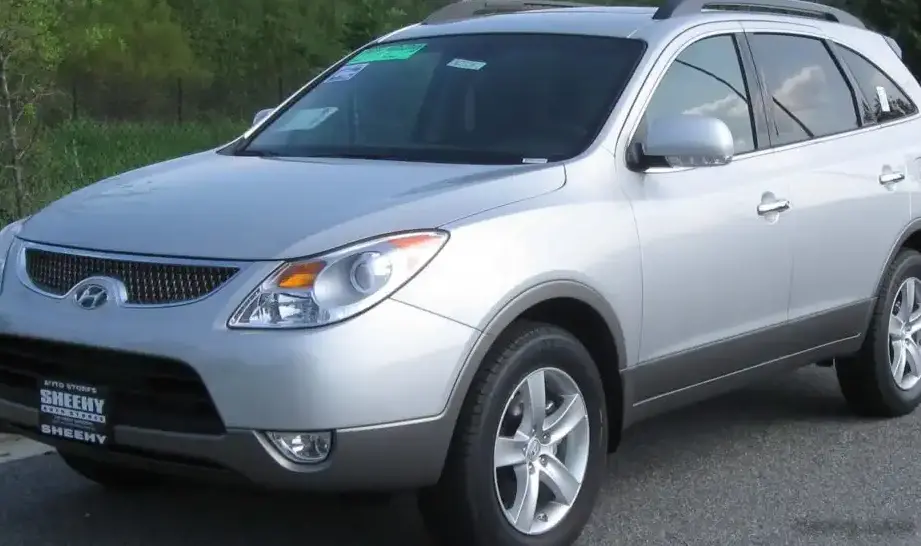
The Hyundai Veracruz 3.0 CRDi 4WD Automatic, produced between 2006 and 2009, represented Hyundai’s entry into the mid-size crossover SUV segment with a focus on providing a premium experience at a competitive price point. Positioned as the flagship trim level within the Veracruz range, the 3.0 CRDi offered a significant step up in performance and features compared to the base 2.7-liter gasoline engine option. It was primarily marketed towards families and individuals seeking a spacious, well-equipped SUV with all-weather capability, particularly in markets where diesel engines were popular. The Veracruz itself was Hyundai’s first attempt at a dedicated SUV platform, moving away from truck-based designs.
Technical Specifications
| Brand | Hyundai |
| Model | Veracruz |
| Generation | Veracruz |
| Type (Engine) | 3.0 CRDi (240 Hp) 4WD Automatic |
| Start of production | 2006 |
| End of production | 2009 |
| Powertrain Architecture | Internal Combustion engine |
| Body type | SUV |
| Seats | 5 |
| Doors | 5 |
| Fuel Type | Diesel |
| Weight-to-power ratio | 8.8 kg/Hp, 113.6 Hp/tonne |
| Weight-to-torque ratio | 4.7 kg/Nm, 213.5 Nm/tonne |
| Power | 240 Hp @ 3800 rpm |
| Power per litre | 81.1 Hp/l |
| Torque | 451 Nm @ 1750-3500 rpm (332.64 lb.-ft. @ 1750-3500 rpm) |
| Engine layout | Front, Transverse |
| Engine Model/Code | S / D6EA |
| Engine displacement | 2959 cm3 (180.57 cu. in.) |
| Number of cylinders | 6 |
| Engine configuration | V-engine |
| Cylinder Bore | 84 mm (3.31 in.) |
| Piston Stroke | 89 mm (3.5 in.) |
| Compression ratio | 17.3:1 |
| Number of valves per cylinder | 4 |
| Fuel injection system | Diesel Commonrail |
| Engine aspiration | Turbocharger, Intercooler |
| Engine oil capacity | 7.2 l (7.61 US qt | 6.34 UK qt) |
| Coolant | 9.8 l (10.36 US qt | 8.62 UK qt) |
| Kerb Weight | 2112 kg (4656.16 lbs.) |
| Fuel tank capacity | 78 l (20.61 US gal | 17.16 UK gal) |
| Length | 4840 mm (190.55 in.) |
| Width | 1970 mm (77.56 in.) |
| Height | 1805 mm (71.06 in.) |
| Wheelbase | 2805 mm (110.43 in.) |
| Front track | 1670 mm (65.75 in.) |
| Rear (Back) track | 1670 mm (65.75 in.) |
| Ride height (ground clearance) | 205 mm (8.07 in.) |
| Drag coefficient (Cd) | 0.38 |
| Minimum turning circle (turning diameter) | 11.4 m (37.4 ft.) |
| Drive wheel | All wheel drive (4×4) |
| Number of gears and type of gearbox | 6 gears, automatic transmission |
| Front brakes | Ventilated discs |
| Rear brakes | Disc |
| Assisting systems | ABS (Anti-lock braking system) |
| Tires size | 245/60 R18 H |
| Wheel rims size | 18 |
Powertrain & Engine Architecture
The heart of the Veracruz 3.0 CRDi is the D6EA engine, a 2.959-liter V6 diesel. This engine utilizes a second-generation common-rail direct injection system, delivering fuel at extremely high pressures for optimized combustion. The D6EA features a variable geometry turbocharger (VGT) and an intercooler, enhancing both power and torque across a broad RPM range. The engine’s 17.3:1 compression ratio is typical for a diesel engine, contributing to its efficiency. The engine is transversely mounted in the front of the vehicle. The six-speed automatic transmission, sourced from Hyundai’s own development, was specifically tuned to handle the high torque output of the diesel engine. It features a torque converter and electronically controlled shifting for smooth operation.
Driving Characteristics
The 240 horsepower and 451 Nm (332.64 lb-ft) of torque provided by the 3.0 CRDi engine delivered brisk acceleration for a vehicle of its size. While not a sports SUV, the Veracruz offered ample power for highway merging, overtaking, and towing. The automatic transmission, while smooth, wasn’t particularly quick to downshift, resulting in a slightly less responsive feel compared to the available manual transmission options in other markets. The all-wheel-drive system provided enhanced traction in inclement weather, making it a capable all-season vehicle. The gear ratios were optimized for fuel efficiency and comfortable cruising, rather than outright performance. Compared to the 2.7-liter gasoline engine, the CRDi offered a substantial increase in torque, resulting in a more relaxed driving experience, especially when fully loaded or towing.
Equipment & Trim Levels
The 3.0 CRDi trim typically included a generous array of standard features. Interior appointments included leather upholstery, power-adjustable front seats (often with heating and cooling), and a premium audio system. Standard convenience features included automatic climate control, cruise control, and power windows and locks. Safety features such as ABS, traction control, and multiple airbags were also standard. Optional extras included a sunroof, navigation system, and upgraded sound system. The interior design was generally considered upscale for its time, with a focus on comfort and practicality.
Chassis & Braking
The Veracruz utilized a MacPherson strut front suspension and a multi-link rear suspension, providing a comfortable ride quality. The suspension was tuned to prioritize comfort over sporty handling. The all-wheel-drive system employed a viscous coupling to distribute torque between the front and rear axles as needed. Braking duties were handled by ventilated discs at the front and solid discs at the rear. ABS (Anti-lock Braking System) was standard, enhancing braking performance and stability. Stabilizer bars were fitted to both the front and rear axles to reduce body roll during cornering.
Market Reception & Comparison
The Hyundai Veracruz 3.0 CRDi was generally well-received by automotive critics. It was praised for its spacious interior, comfortable ride, and generous equipment levels. The diesel engine was lauded for its fuel efficiency and strong torque output. However, some critics noted that the automatic transmission could be slow to respond and that the handling wasn’t as sharp as some of its competitors. Compared to other trims, the 3.0 CRDi offered significantly better performance and fuel economy than the 2.7-liter gasoline engine, but at a higher price point. It competed with vehicles like the Honda Pilot, Toyota Highlander, and Ford Explorer.
Legacy
The Hyundai Veracruz, while discontinued in 2009, laid the groundwork for Hyundai’s future success in the SUV market. The 3.0 CRDi powertrain, while not without its quirks, proved to be relatively reliable, with many examples still on the road today. Common maintenance items include regular servicing of the fuel injection system and turbocharger. The Veracruz’s focus on value and features helped establish Hyundai as a serious contender in the mid-size SUV segment. On the used car market, the 3.0 CRDi models tend to command a premium due to their performance and fuel efficiency, but finding well-maintained examples can be challenging.
