
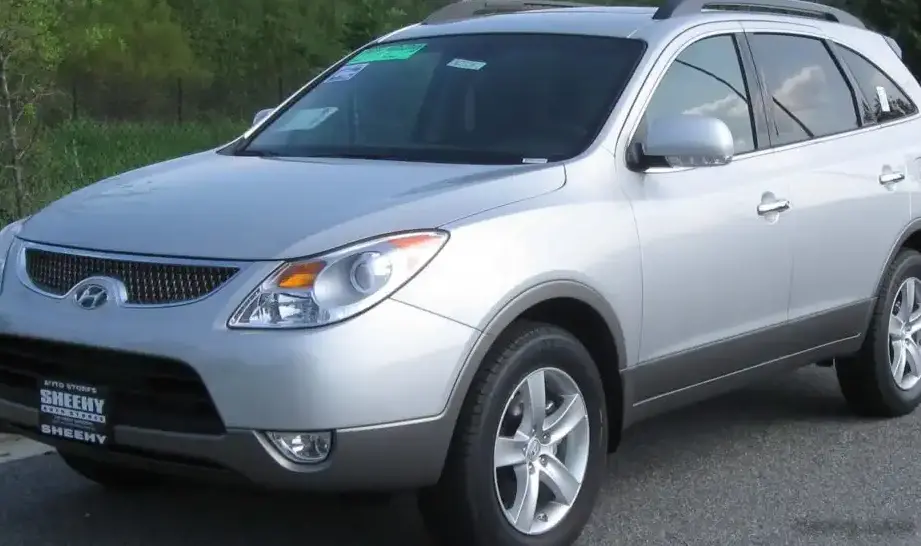
The Hyundai Veracruz 3.0 CRDi Automatic, produced between 2006 and 2009, represented Hyundai’s entry into the mid-size crossover SUV segment with a focus on diesel efficiency and a more refined driving experience. This variant, powered by the 3.0-liter CRDi engine paired with a six-speed automatic transmission, was positioned as a premium offering within the Veracruz lineup, appealing to buyers seeking a balance of power, fuel economy, and comfort. It was primarily marketed in Europe and other regions where diesel engines were favored, offering a compelling alternative to gasoline-powered competitors.
Technical Specifications
| Brand | Hyundai |
| Model | Veracruz |
| Generation | Veracruz |
| Type (Engine) | 3.0 CRDi (240 Hp) Automatic |
| Start of production | 2006 |
| End of production | 2009 |
| Powertrain Architecture | Internal Combustion engine |
| Body type | SUV |
| Seats | 5 |
| Doors | 5 |
| Fuel Type | Diesel |
| Weight-to-power ratio | 8.5 kg/Hp, 118.2 Hp/tonne |
| Weight-to-torque ratio | 4.5 kg/Nm, 222.2 Nm/tonne |
| Power | 240 Hp @ 3800 rpm |
| Power per litre | 81.1 Hp/l |
| Torque | 451 Nm @ 1750-3500 rpm (332.64 lb.-ft. @ 1750-3500 rpm) |
| Engine layout | Front, Transverse |
| Engine Model/Code | S / D6EA |
| Engine displacement | 2959 cm3 (180.57 cu. in.) |
| Number of cylinders | 6 |
| Engine configuration | V-engine |
| Cylinder Bore | 84 mm (3.31 in.) |
| Piston Stroke | 89 mm (3.5 in.) |
| Compression ratio | 17.3:1 |
| Number of valves per cylinder | 4 |
| Fuel injection system | Diesel Commonrail |
| Engine aspiration | Turbocharger, Intercooler |
| Engine oil capacity | 7.2 l (7.61 US qt | 6.34 UK qt) |
| Coolant | 9.8 l (10.36 US qt | 8.62 UK qt) |
| Kerb Weight | 2030 kg (4475.38 lbs.) |
| Fuel tank capacity | 78 l (20.61 US gal | 17.16 UK gal) |
| Length | 4840 mm (190.55 in.) |
| Width | 1970 mm (77.56 in.) |
| Height | 1805 mm (71.06 in.) |
| Wheelbase | 2805 mm (110.43 in.) |
| Front track | 1670 mm (65.75 in.) |
| Rear (Back) track | 1670 mm (65.75 in.) |
| Ride height (ground clearance) | 205 mm (8.07 in.) |
| Drag coefficient (Cd) | 0.38 |
| Minimum turning circle (turning diameter) | 11.4 m (37.4 ft.) |
| Drivetrain Architecture | The Internal combustion engine (ICE) drives the front wheels of the vehicle. |
| Drive wheel | Front wheel drive |
| Number of gears and type of gearbox | 6 gears, automatic transmission |
| Front brakes | Ventilated discs |
| Rear brakes | Disc |
| Assisting systems | ABS (Anti-lock braking system) |
| Tires size | 245/60 R18 H |
| Wheel rims size | 18 |
Powertrain & Engine Architecture
The heart of the Veracruz 3.0 CRDi is the D6EA engine, a 2.959-liter V6 diesel. This engine utilizes a second-generation common-rail direct injection system, delivering fuel at extremely high pressures for optimized combustion. The turbocharger, coupled with an intercooler, significantly boosts power output and torque. The engine features four valves per cylinder and a robust cast iron block, contributing to its durability. The six-speed automatic transmission, sourced from Hyundai’s own development, was designed to handle the engine’s substantial torque output. It features a torque converter for smooth launches and gear changes, and offers a manual shift mode for greater driver control. The transmission’s gear ratios were tuned to balance acceleration with fuel efficiency, prioritizing comfortable cruising at highway speeds.
Driving Characteristics
The 240 horsepower and 451 Nm (332.64 lb-ft) of torque provided by the 3.0 CRDi engine and automatic transmission combination delivered a respectable level of performance for a mid-size SUV. While not as quick as some of its gasoline-powered rivals, the Veracruz offered strong acceleration from a standstill and ample power for overtaking maneuvers. The automatic transmission, while smooth, could sometimes feel hesitant during downshifts, particularly when demanding quick acceleration. Compared to the manual transmission versions, the automatic offered a more relaxed driving experience, especially in urban traffic. The weight of the vehicle, around 2030 kg (4475.38 lbs), was noticeable, but the engine’s torque helped to mitigate this, providing good pulling power even when fully loaded.
Equipment & Trim Levels
The 3.0 CRDi Automatic trim typically included a generous array of standard features. These commonly included leather upholstery, automatic climate control, a premium audio system, power-adjustable front seats, and alloy wheels. Safety features such as ABS, electronic stability control, and multiple airbags were also standard. Optional extras often included a sunroof, navigation system, and rear parking sensors. The interior design was generally considered to be well-appointed for its class, with a focus on comfort and practicality. The dashboard layout was straightforward and user-friendly, with logically placed controls.
Chassis & Braking
The Veracruz featured a MacPherson strut front suspension and a multi-link rear suspension, providing a comfortable and controlled ride. The suspension was tuned to prioritize ride quality over sporty handling, making it well-suited for long-distance cruising. The front brakes were ventilated discs, while the rear brakes were solid discs, providing adequate stopping power for the vehicle’s weight. The ABS system helped to prevent wheel lockup during hard braking, enhancing safety. Stabilizer bars were fitted to both the front and rear axles to reduce body roll during cornering.
Market Reception & Comparison
The Hyundai Veracruz 3.0 CRDi Automatic was generally well-received by automotive critics, who praised its spacious interior, comfortable ride, and fuel-efficient diesel engine. However, some critics noted that the automatic transmission could be slow to respond at times, and that the handling was not as sharp as some of its competitors. Compared to the gasoline-powered Veracruz variants, the 3.0 CRDi offered significantly better fuel economy, making it an attractive option for drivers who covered long distances. It also provided more torque, resulting in stronger acceleration and towing capacity. Compared to other diesel SUVs in its class, such as the BMW X5 and the Mercedes-Benz ML, the Veracruz offered a more affordable price point, making it a compelling value proposition.
Legacy
The Hyundai Veracruz, while discontinued in 2009, remains a relatively reliable vehicle in the used car market. The 3.0 CRDi engine, when properly maintained, is known for its durability and longevity. Common issues include turbocharger wear and potential problems with the diesel particulate filter (DPF), particularly on vehicles that have spent a lot of time in urban driving conditions. The automatic transmission is generally reliable, but regular fluid changes are essential to prevent premature wear. Today, the Veracruz 3.0 CRDi Automatic represents a solid choice for buyers seeking a spacious, comfortable, and fuel-efficient SUV at an affordable price. Its blend of practicality, refinement, and diesel power continues to appeal to a niche market of buyers who appreciate its unique qualities.
