
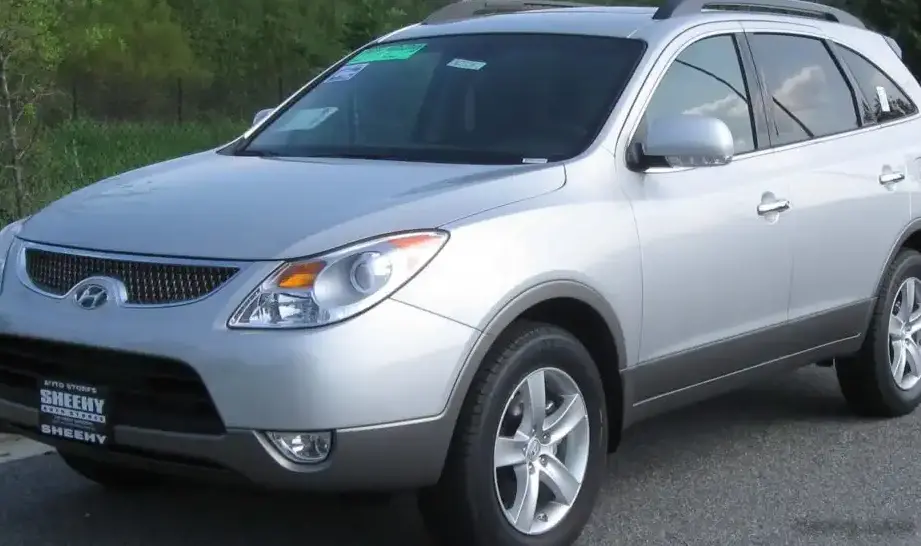
The Hyundai Veracruz 3.0 CRDi 4WD Automatic, produced between 2009 and 2011, represented a significant offering in Hyundai’s lineup as a mid-size crossover SUV. Positioned as a more premium alternative to the Santa Fe, the Veracruz aimed to compete with established players like the Honda Pilot and Toyota Highlander. This particular variant, equipped with the 3.0-liter CRDi diesel engine and a six-speed automatic transmission, was primarily targeted towards buyers seeking a blend of fuel efficiency, towing capacity, and all-weather capability. It was largely sold in markets outside of North America, where diesel engines held greater popularity in the SUV segment.
Technical Specifications
| Brand | Hyundai |
| Model | Veracruz |
| Generation | Veracruz |
| Type (Engine) | 3.0 CRDi (245 Hp) 4WD Automatic |
| Start of production | 2009 |
| End of production | 2011 |
| Powertrain Architecture | Internal Combustion engine |
| Body type | SUV |
| Seats | 5 |
| Doors | 5 |
| Fuel Type | Diesel |
| Weight-to-power ratio | 8.6 kg/Hp, 116 Hp/tonne |
| Weight-to-torque ratio | 4.7 kg/Nm, 213.5 Nm/tonne |
| Power | 245 Hp @ 3800 rpm |
| Power per litre | 82.8 Hp/l |
| Torque | 451 Nm @ 1750-3500 rpm, 332.64 lb.-ft. @ 1750-3500 rpm |
| Engine layout | Front, Transverse |
| Engine Model/Code | S / D6EA |
| Engine displacement | 2959 cm3, 180.57 cu. in. |
| Number of cylinders | 6 |
| Engine configuration | V-engine |
| Cylinder Bore | 84 mm, 3.31 in. |
| Piston Stroke | 89 mm, 3.5 in. |
| Compression ratio | 17.3:1 |
| Number of valves per cylinder | 4 |
| Fuel injection system | Diesel Commonrail |
| Engine aspiration | Turbocharger, Intercooler |
| Engine oil capacity | 7.2 l, 7.61 US qt | 6.34 UK qt |
| Coolant | 9.8 l, 10.36 US qt | 8.62 UK qt |
| Kerb Weight | 2112 kg, 4656.16 lbs |
| Fuel tank capacity | 78 l, 20.61 US gal | 17.16 UK gal |
| Length | 4840 mm, 190.55 in |
| Width | 1970 mm, 77.56 in |
| Height | 1805 mm, 71.06 in |
| Wheelbase | 2805 mm, 110.43 in |
| Front track | 1670 mm, 65.75 in |
| Rear (Back) track | 1670 mm, 65.75 in |
| Ride height (ground clearance) | 205 mm, 8.07 in |
| Drag coefficient (Cd) | 0.38 |
| Minimum turning circle (turning diameter) | 11.4 m, 37.4 ft |
| Drive wheel | All wheel drive (4×4) |
| Number of gears and type of gearbox | 6 gears, automatic transmission |
| Front brakes | Ventilated discs |
| Rear brakes | Disc |
| Assisting systems | ABS (Anti-lock braking system) |
| Tires size | 245/60 R18 H |
| Wheel rims size | 18 |
Powertrain & Engine Architecture
The heart of the Veracruz 3.0 CRDi was the D6EA engine, a 2.959-liter V6 diesel. This engine utilized a common-rail direct injection system, delivering fuel at extremely high pressure for improved combustion efficiency and reduced emissions. A variable geometry turbocharger (VGT) and intercooler further enhanced performance, providing a broad torque curve. The engine featured four valves per cylinder and a robust cast iron block, contributing to its durability. The six-speed automatic transmission, sourced from Hyundai’s own development, was chosen for its smooth operation and ability to handle the engine’s substantial torque output. The transmission featured adaptive shift logic, adjusting shift points based on driving conditions and driver input.
Driving Characteristics
The 245 horsepower and 451 Nm (332 lb-ft) of torque delivered by the 3.0 CRDi engine provided the Veracruz with ample power for everyday driving and towing. While not a sports SUV, the combination of the diesel engine and automatic transmission offered brisk acceleration and effortless cruising. The automatic transmission, while smooth, wasn’t particularly quick to downshift, which could be noticeable when overtaking or climbing hills. Compared to potential manual transmission versions (not widely available in many markets), the automatic offered convenience at the expense of some driver engagement and potentially slightly lower fuel economy. The all-wheel-drive system provided enhanced traction in slippery conditions, making it a capable vehicle for year-round use.
Equipment & Trim Levels
The Veracruz 3.0 CRDi 4WD Automatic typically came well-equipped, reflecting its positioning as a more upscale offering. Standard features often included leather upholstery, automatic climate control, a premium audio system, power-adjustable front seats, and alloy wheels. Safety features such as ABS, electronic stability control, and multiple airbags were also standard. Optional extras could include a sunroof, navigation system, and rear parking sensors. The interior design was generally conservative and functional, prioritizing comfort and practicality over outright luxury.
Chassis & Braking
The Veracruz utilized a conventional SUV chassis layout with independent suspension at the front and a multi-link suspension at the rear. This setup provided a comfortable ride quality, absorbing bumps and imperfections in the road surface effectively. The all-wheel-drive system employed a viscous coupling to distribute torque between the front and rear axles as needed. Braking duties were handled by ventilated discs at the front and solid discs at the rear. The ABS system helped to maintain steering control during hard braking maneuvers. Stabilizer bars were fitted to both the front and rear axles to reduce body roll during cornering.
Market Reception & Comparison
The Hyundai Veracruz 3.0 CRDi 4WD Automatic was generally well-received by automotive critics, who praised its spacious interior, comfortable ride, and strong diesel engine. However, some reviewers noted that the interior design lacked the sophistication of some of its competitors. Fuel economy was a strong point, with the diesel engine offering significantly better mileage than comparable gasoline-powered SUVs. Compared to the gasoline-powered Veracruz variants, the 3.0 CRDi offered superior torque and fuel efficiency, but at a higher initial cost. Reliability was generally good, although diesel engines can be more complex to maintain than gasoline engines.
Legacy
The Hyundai Veracruz, while discontinued after a relatively short production run, laid the groundwork for Hyundai’s future SUV offerings. The 3.0 CRDi engine proved to be a durable and reliable powerplant, and many examples remain on the road today. In the used car market, the Veracruz 3.0 CRDi 4WD Automatic represents a compelling value proposition for buyers seeking a spacious, capable, and fuel-efficient SUV. However, potential buyers should be aware of the higher maintenance costs associated with diesel engines and ensure that the vehicle has been properly maintained throughout its life. The Veracruz’s success helped establish Hyundai as a serious contender in the mid-size SUV segment, paving the way for models like the Santa Fe and Palisade.
