
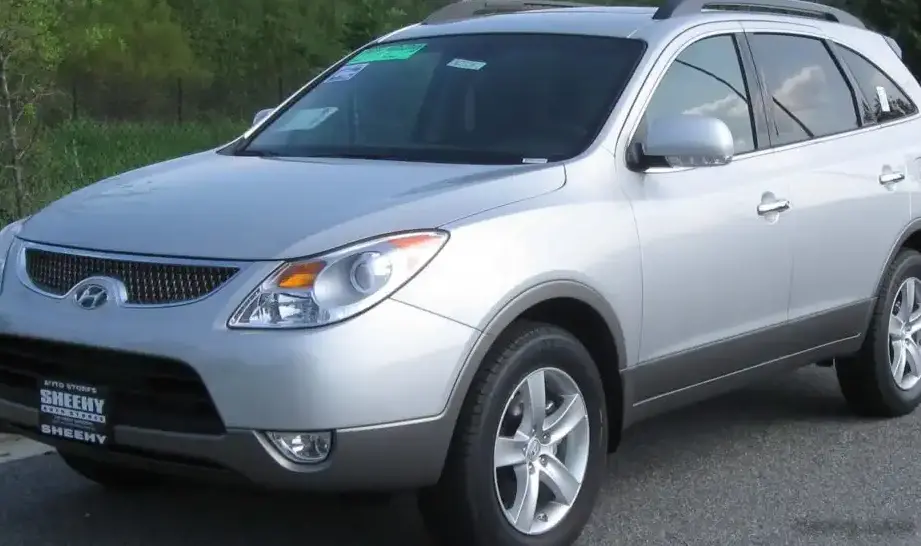
The Hyundai Veracruz 3.0 CRDi Automatic, produced between 2009 and 2011, represented a significant offering in Hyundai’s lineup as a mid-size crossover SUV. Positioned as a more premium alternative to the Santa Fe, the Veracruz aimed to compete with established players like the Honda Pilot and Toyota Highlander. This particular variant, equipped with the 3.0-liter CRDi diesel engine and a six-speed automatic transmission, was primarily targeted towards buyers seeking a blend of fuel efficiency, towing capacity, and comfortable highway cruising. It was not widely sold in the US market, being more prevalent in Europe and other regions where diesel engines were more popular.
Technical Specifications
| Brand | Hyundai |
| Model | Veracruz |
| Generation | Veracruz |
| Type (Engine) | 3.0 CRDi (245 Hp) Automatic |
| Start of production | 2009 |
| End of production | 2011 |
| Powertrain Architecture | Internal Combustion engine |
| Body type | SUV |
| Seats | 5 |
| Doors | 5 |
| Fuel Type | Diesel |
| Weight-to-power ratio | 8.3 kg/Hp, 120.7 Hp/tonne |
| Weight-to-torque ratio | 4.5 kg/Nm, 222.2 Nm/tonne |
| Power | 245 Hp @ 3800 rpm |
| Power per litre | 82.8 Hp/l |
| Torque | 451 Nm @ 1750-3500 rpm (332.64 lb.-ft. @ 1750-3500 rpm) |
| Engine layout | Front, Transverse |
| Engine Model/Code | S / D6EA |
| Engine displacement | 2959 cm3 (180.57 cu. in.) |
| Number of cylinders | 6 |
| Engine configuration | V-engine |
| Cylinder Bore | 84 mm (3.31 in.) |
| Piston Stroke | 89 mm (3.5 in.) |
| Compression ratio | 17.3:1 |
| Number of valves per cylinder | 4 |
| Fuel injection system | Diesel Commonrail |
| Engine aspiration | Turbocharger, Intercooler |
| Engine oil capacity | 7.2 l (7.61 US qt | 6.34 UK qt) |
| Coolant | 9.8 l (10.36 US qt | 8.62 UK qt) |
| Kerb Weight | 2030 kg (4475.38 lbs.) |
| Fuel tank capacity | 78 l (20.61 US gal | 17.16 UK gal) |
| Length | 4840 mm (190.55 in.) |
| Width | 1970 mm (77.56 in.) |
| Height | 1805 mm (71.06 in.) |
| Wheelbase | 2805 mm (110.43 in.) |
| Front track | 1670 mm (65.75 in.) |
| Rear (Back) track | 1670 mm (65.75 in.) |
| Ride height (ground clearance) | 205 mm (8.07 in.) |
| Drag coefficient (Cd) | 0.38 |
| Minimum turning circle (turning diameter) | 11.4 m (37.4 ft.) |
| Drivetrain Architecture | The Internal combustion engine (ICE) drives the front wheels of the vehicle. |
| Drive wheel | Front wheel drive |
| Number of gears and type of gearbox | 6 gears, automatic transmission |
| Front brakes | Ventilated discs |
| Rear brakes | Disc |
| Assisting systems | ABS (Anti-lock braking system) |
| Tires size | 245/60 R18 H |
| Wheel rims size | 18 |
Powertrain & Engine Architecture
The heart of the Veracruz 3.0 CRDi is the D6EA engine, a 2.959-liter V6 diesel. This engine utilizes a common-rail direct injection system, delivering fuel at extremely high pressure for optimized combustion. A variable geometry turbocharger (VGT) and intercooler work in tandem to boost power and torque while minimizing turbo lag. The engine’s 17.3:1 compression ratio is typical for diesel engines, contributing to its efficiency. The six-speed automatic transmission, while not known for being particularly sporty, was chosen for its smooth operation and suitability for long-distance driving. It featured adaptive shift logic, attempting to learn the driver’s style and adjust gear changes accordingly. This transmission was a common unit found in other Hyundai and Kia vehicles of the era, prioritizing refinement over aggressive performance.
Driving Characteristics
The 245 horsepower and 332 lb-ft of torque provided by the 3.0 CRDi engine delivered respectable performance for a mid-size SUV. Acceleration was adequate, though not particularly brisk, with a 0-60 mph time estimated around 8.5-9.5 seconds. The automatic transmission, while smooth, could sometimes feel hesitant during quick overtaking maneuvers. The gear ratios were tuned for fuel economy and relaxed cruising rather than outright performance. Compared to the gasoline-powered Veracruz variants, the diesel offered significantly more torque, making it better suited for towing and carrying heavy loads. However, the diesel’s power delivery was less peaky and more linear than the gasoline engines. The automatic transmission, while generally reliable, didn’t offer manual shift modes or particularly quick response times, making it less engaging for drivers seeking a more sporty experience.
Equipment & Trim Levels
The Veracruz 3.0 CRDi Automatic typically came well-equipped, reflecting its positioning as a more premium offering. Standard features often included leather upholstery, automatic climate control, a premium audio system, power-adjustable front seats, and alloy wheels. Optional extras could include a sunroof, navigation system, and rear parking sensors. The interior design was generally considered comfortable and spacious, with a focus on practicality and ease of use. The dashboard layout was straightforward, with logically placed controls. Higher trim levels often added features like heated seats, upgraded audio systems, and woodgrain interior trim, further enhancing the sense of luxury.
Chassis & Braking
The Veracruz featured a conventional front-wheel-drive layout with independent suspension at all four corners. The front suspension utilized MacPherson struts, while the rear employed a multi-link setup. This configuration provided a comfortable ride, though handling was not particularly sporty. Disc brakes were fitted to all four wheels, with ABS (Anti-lock Braking System) as standard. The braking performance was adequate for everyday driving, but the system lacked the stopping power of some competitors. The suspension tuning prioritized ride comfort over sharp handling, making it a good choice for long highway journeys but less engaging on winding roads.
Market Reception & Comparison
The Hyundai Veracruz 3.0 CRDi Automatic received generally positive reviews from automotive critics. It was praised for its spacious interior, comfortable ride, and fuel efficiency. However, some critics noted that the automatic transmission could be slow to respond and that the handling was not as engaging as some rivals. Compared to the gasoline-powered Veracruz models, the diesel offered superior fuel economy and torque, but it also came with a higher price tag. The diesel’s reliability was generally considered good, though diesel engines typically require more diligent maintenance than gasoline engines. In markets where diesel fuel was readily available and affordable, the 3.0 CRDi variant was a popular choice for buyers seeking a practical and efficient SUV.
Legacy
The Hyundai Veracruz, while discontinued in 2011, laid the groundwork for Hyundai’s future SUV offerings. The Santa Fe, which replaced the Veracruz in many markets, benefited from the lessons learned during the Veracruz’s development. The 3.0 CRDi engine proved to be a reliable and durable unit, and many examples are still on the road today. In the used car market, the Veracruz 3.0 CRDi Automatic remains a relatively affordable and practical option for buyers seeking a spacious and fuel-efficient SUV. However, potential buyers should be aware of the higher maintenance costs associated with diesel engines and ensure that the vehicle has been properly maintained. The Veracruz represented a significant step forward for Hyundai in terms of build quality, refinement, and overall sophistication, helping to establish the brand as a serious contender in the global SUV market.
