
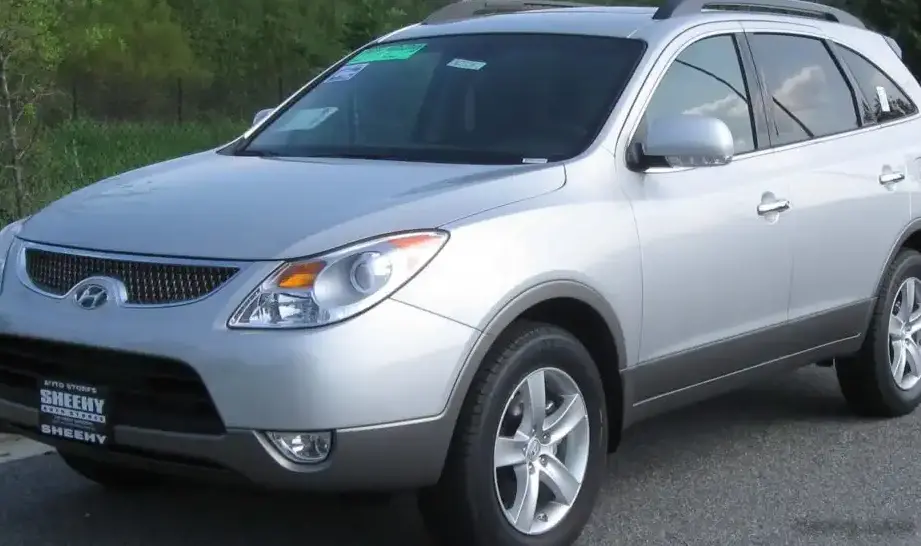
The Hyundai Veracruz 3.0 CRDi Automatic, produced between 2011 and 2013, represented a significant offering in Hyundai’s lineup as a mid-size crossover SUV. Positioned as a more premium alternative to the Santa Fe, the Veracruz aimed to compete with established players like the Honda Pilot and Toyota Highlander. This particular variant, equipped with the 3.0-liter CRDi diesel engine and a six-speed automatic transmission, was primarily targeted towards European and other international markets where diesel engines were favored for their fuel efficiency and torque. In the United States, the Veracruz was only offered with a gasoline engine. The Veracruz was later replaced by the Hyundai Santa Fe XL.
Technical Specifications
| Brand | Hyundai |
| Model | Veracruz |
| Generation | Veracruz |
| Type (Engine) | 3.0 CRDi (255 Hp) Automatic |
| Start of production | 2011 |
| End of production | 2013 |
| Powertrain Architecture | Internal Combustion engine |
| Body type | SUV |
| Seats | 5 |
| Doors | 5 |
| Fuel Type | Diesel |
| Weight-to-power ratio | 8 kg/Hp, 125.3 Hp/tonne |
| Weight-to-torque ratio | 4.5 kg/Nm, 221.6 Nm/tonne |
| Power | 255 Hp @ 3800 rpm |
| Power per litre | 86.2 Hp/l |
| Torque | 451 Nm @ 1750-3500 rpm (332.64 lb.-ft. @ 1750-3500 rpm) |
| Engine layout | Front, Transverse |
| Engine Model/Code | S II / D6EB |
| Engine displacement | 2959 cm3 (180.57 cu. in.) |
| Number of cylinders | 6 |
| Engine configuration | V-engine |
| Cylinder Bore | 84 mm (3.31 in.) |
| Piston Stroke | 89 mm (3.5 in.) |
| Number of valves per cylinder | 4 |
| Fuel injection system | Diesel Commonrail |
| Engine aspiration | Turbocharger, Intercooler |
| Engine oil capacity | 7.2 l (7.61 US qt | 6.34 UK qt) |
| Coolant | 9.8 l (10.36 US qt | 8.62 UK qt) |
| Kerb Weight | 2035 kg (4486.41 lbs.) |
| Fuel tank capacity | 78 l (20.61 US gal | 17.16 UK gal) |
| Length | 4840 mm (190.55 in.) |
| Width | 1970 mm (77.56 in.) |
| Height | 1795 mm (70.67 in.) |
| Wheelbase | 2805 mm (110.43 in.) |
| Front track | 1670 mm (65.75 in.) |
| Rear (Back) track | 1670 mm (65.75 in.) |
| Drag coefficient (Cd) | 0.38 |
| Minimum turning circle (turning diameter) | 11.4 m (37.4 ft.) |
| Drivetrain Architecture | The Internal combustion engine (ICE) drives the front wheels of the vehicle. |
| Drive wheel | Front wheel drive |
| Number of gears and type of gearbox | 6 gears, automatic transmission |
| Front brakes | Ventilated discs |
| Rear brakes | Disc |
| Assisting systems | ABS (Anti-lock braking system) |
| Tires size | 245/60 R18 H |
| Wheel rims size | 18 |
Powertrain & Engine Architecture
The heart of the Veracruz 3.0 CRDi is the Hyundai S II / D6EB engine, a 2.959-liter V6 diesel. This engine utilizes a second-generation common rail direct injection (CRDi) system, delivering fuel directly into the cylinders at extremely high pressure for optimized combustion. The D6EB engine features a single turbocharger with an intercooler, boosting power and torque output. The engine is configured with four valves per cylinder and utilizes a double overhead camshaft (DOHC) valvetrain. The six-speed automatic transmission, sourced from Hyundai’s own development, was chosen for its smooth shifting characteristics and ability to handle the engine’s substantial torque. This transmission featured adaptive shift logic, adjusting shift points based on driving conditions and driver input.
Driving Characteristics
The 255 horsepower and 332 lb-ft of torque produced by the 3.0 CRDi engine provided the Veracruz with respectable performance for its size. While not a sports SUV, the engine delivered strong acceleration, particularly in the mid-range, making overtaking maneuvers effortless. The automatic transmission, while smooth, wasn’t particularly quick to downshift, which could sometimes result in a slight delay in response. Compared to the gasoline-powered Veracruz models, the diesel offered significantly more torque, resulting in better towing capacity and improved fuel economy. The front-wheel-drive configuration contributed to a comfortable ride, but it did limit the vehicle’s off-road capabilities compared to all-wheel-drive alternatives.
Equipment & Trim Levels
The Veracruz 3.0 CRDi Automatic typically came well-equipped, reflecting its positioning as a more premium offering. Standard features often included leather upholstery, automatic climate control, a premium audio system, power-adjustable front seats, and alloy wheels. Higher trim levels added features such as a sunroof, navigation system, and parking sensors. Interior design focused on comfort and practicality, with a spacious cabin and ample storage compartments. The dashboard layout was straightforward and user-friendly, with logically placed controls.
Chassis & Braking
The Veracruz utilized a conventional front-wheel-drive chassis with independent suspension at the front (typically MacPherson struts) and a multi-link suspension at the rear. This setup provided a comfortable ride quality, absorbing bumps and imperfections in the road effectively. The braking system consisted of ventilated discs at the front and solid discs at the rear, coupled with an Anti-lock Braking System (ABS) for enhanced safety. The steering was hydraulically assisted, providing a reasonable level of feedback and precision.
Market Reception & Comparison
The Hyundai Veracruz 3.0 CRDi Automatic was generally well-received by automotive critics, particularly for its spacious interior, comfortable ride, and fuel-efficient diesel engine. However, some reviewers noted that the interior materials weren’t quite as refined as those found in some of its competitors. Compared to the gasoline-powered Veracruz, the diesel version offered superior fuel economy and torque, making it a more practical choice for long-distance driving and towing. Against rivals like the Honda Pilot and Toyota Highlander, the Veracruz offered a compelling value proposition, often undercutting them in price while providing a similar level of features and comfort.
Legacy
The Hyundai Veracruz 3.0 CRDi Automatic has proven to be a relatively reliable vehicle in the used car market. The D6EB diesel engine, while complex, is generally robust when properly maintained. Common issues include turbocharger wear and potential problems with the diesel particulate filter (DPF), particularly on vehicles that have primarily been used for short trips. The six-speed automatic transmission has also proven to be durable, with few reported issues. Today, the Veracruz 3.0 CRDi remains a popular choice for buyers seeking a spacious, comfortable, and fuel-efficient SUV, offering a good balance of practicality and value.
