
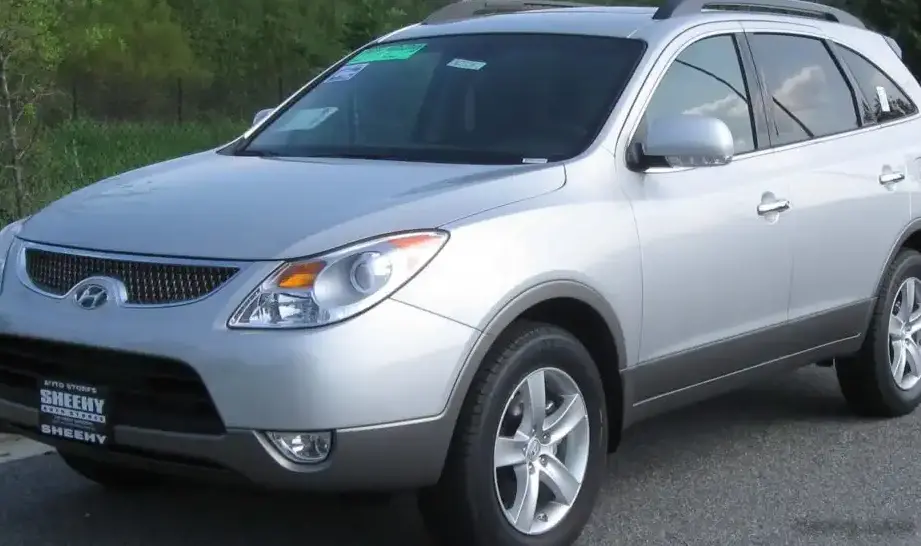
The Hyundai Veracruz 3.8, produced from 2006 to 2011, represented Hyundai’s entry into the mid-size crossover SUV segment. Positioned as a more premium offering within the Hyundai lineup, the Veracruz aimed to compete with established players like the Honda Pilot and Toyota Highlander. The 3.8-liter variant, equipped with a six-speed automatic transmission, served as the top-tier engine option, offering a balance of power and refinement. It was a key model for Hyundai as they sought to elevate their brand image and demonstrate their capability in producing competitive SUVs for the North American market.
Technical Specifications
| Brand | Hyundai |
| Model | Veracruz |
| Generation | Veracruz |
| Type (Engine) | 3.8 (264 Hp) Automatic |
| Start of production | 2006 |
| End of production | 2011 |
| Powertrain Architecture | Internal Combustion engine |
| Body type | SUV |
| Seats | 5 |
| Doors | 5 |
| Fuel Type | Petrol (Gasoline) |
| Weight-to-power ratio | 7.5 kg/Hp, 134 Hp/tonne |
| Weight-to-torque ratio | 5.7 kg/Nm, 176.6 Nm/tonne |
| Power | 264 Hp @ 6000 rpm |
| Power per litre | 69.9 Hp/l |
| Torque | 348 Nm @ 4500 rpm, 256.67 lb.-ft. @ 4500 rpm |
| Engine layout | Front, Transverse |
| Engine Model/Code | Lambda / G6DA |
| Engine displacement | 3778 cm3, 230.55 cu. in. |
| Number of cylinders | 6 |
| Engine configuration | V-engine |
| Cylinder Bore | 96 mm, 3.78 in. |
| Piston Stroke | 87 mm, 3.43 in. |
| Compression ratio | 10.4:1 |
| Number of valves per cylinder | 4 |
| Fuel injection system | Multi-port manifold injection |
| Engine aspiration | Naturally aspirated engine |
| Valvetrain | DOHC |
| Engine oil capacity | 5.2 l, 5.49 US qt | 4.58 UK qt |
| Coolant | 10.5 l, 11.1 US qt | 9.24 UK qt |
| Kerb Weight | 1970 kg, 4343.11 lbs |
| Fuel tank capacity | 78 l, 20.61 US gal | 17.16 UK gal |
| Length | 4840 mm, 190.55 in |
| Width | 1970 mm, 77.56 in |
| Height | 1805 mm, 71.06 in |
| Wheelbase | 2805 mm, 110.43 in |
| Front track | 1670 mm, 65.75 in |
| Rear (Back) track | 1670 mm, 65.75 in |
| Ride height (ground clearance) | 205 mm, 8.07 in |
| Drag coefficient (Cd) | 0.38 |
| Minimum turning circle (turning diameter) | 11.4 m, 37.4 ft |
| Drivetrain Architecture | The Internal combustion engine (ICE) drives the front wheels of the vehicle. |
| Drive wheel | Front wheel drive |
| Number of gears and type of gearbox | 6 gears, automatic transmission |
| Front brakes | Ventilated discs |
| Rear brakes | Disc |
| Assisting systems | ABS (Anti-lock braking system) |
| Tires size | 245/60 R18 H |
| Wheel rims size | 18 |
Powertrain & Engine Architecture
The heart of the Veracruz 3.8 is the Hyundai Lambda engine, specifically the G6DA variant. This 3.8-liter, naturally aspirated V6 engine utilizes a 60-degree V-angle configuration. It features a dual overhead camshaft (DOHC) valvetrain with four valves per cylinder, contributing to its respectable power output. The engine employs multi-port fuel injection, delivering fuel directly into the intake ports. The Lambda engine was designed with durability and refinement in mind, featuring an aluminum block and cylinder heads. Paired with the engine is a six-speed automatic transmission, designed to provide smooth shifts and efficient power delivery. This transmission was a significant upgrade from the four-speed automatics found in earlier Hyundai models, offering closer gear ratios and improved responsiveness. The transmission’s control logic was tuned to balance fuel economy and performance, adapting to driving conditions and driver input.
Driving Characteristics
The Veracruz 3.8, with its 264 horsepower and 256 lb-ft of torque, offered a noticeable step up in performance compared to the base 3.0-liter V6 option. Acceleration was brisk, allowing for confident merging and overtaking maneuvers. While not a sports SUV, the 3.8 provided ample power for everyday driving and even when fully loaded with passengers and cargo. The six-speed automatic transmission played a crucial role in maximizing the engine’s potential, providing smooth and timely shifts. Compared to the manual transmission options available on other Hyundai models, the automatic prioritized comfort and ease of use. The gear ratios were optimized for highway cruising, keeping engine speeds relatively low at typical highway speeds. However, some reviewers noted that the transmission could occasionally feel hesitant during quick downshifts.
Equipment & Trim Levels
The Veracruz 3.8 typically came well-equipped, reflecting its position as the premium trim level. Standard features included leather upholstery, heated front seats, a power-adjustable driver’s seat, automatic climate control, and a premium audio system. Optional extras included a navigation system, a sunroof, and rear-seat entertainment system. The interior design was generally considered upscale for its time, with a focus on comfort and practicality. The dashboard layout was straightforward and easy to use, with logically placed controls. Hyundai offered various packages that bundled popular options together, allowing buyers to customize their Veracruz to their specific needs and preferences.
Chassis & Braking
The Veracruz utilized a traditional body-on-frame construction, providing a robust and durable platform. The suspension system consisted of independent front suspension with coil springs and a multi-link rear suspension. This setup aimed to provide a comfortable ride while maintaining reasonable handling characteristics. The Veracruz 3.8 featured ventilated front disc brakes and solid rear disc brakes, providing adequate stopping power for its weight class. Anti-lock braking system (ABS) was standard, enhancing safety and control during emergency braking situations. The steering was hydraulically assisted, offering a balanced feel between responsiveness and ease of use. Stabilizer bars were included both front and rear to reduce body roll during cornering.
Market Reception & Comparison
The Hyundai Veracruz 3.8 generally received positive reviews from automotive critics. It was praised for its spacious interior, comfortable ride, and generous standard features. The 3.8-liter engine was considered a strong performer, providing ample power for most driving situations. However, some critics noted that the Veracruz’s handling was not as sporty as some of its competitors. Fuel economy was also a point of concern, with the 3.8-liter engine consuming more fuel than the base 3.0-liter option. Compared to the 3.0-liter Veracruz, the 3.8 offered a significant performance boost but came at a higher price point and with slightly reduced fuel efficiency. Against competitors like the Honda Pilot and Toyota Highlander, the Veracruz offered a compelling value proposition, often undercutting their prices while providing similar levels of features and comfort.
Legacy
The Hyundai Veracruz, and particularly the 3.8-liter variant, played a significant role in establishing Hyundai as a credible player in the mid-size SUV segment. The Lambda engine proved to be a reliable and durable powerplant, with many examples still on the road today. While not without its flaws, the Veracruz offered a compelling combination of value, comfort, and performance. In the used car market, the Veracruz 3.8 remains a popular choice for buyers seeking a spacious and affordable SUV. Maintenance costs are generally reasonable, and parts availability is good. However, potential buyers should be aware of potential issues with the timing chain tensioners and the automatic transmission, which may require attention as the vehicle ages. Overall, the Veracruz 3.8 represents a solid and dependable SUV that continues to offer good value for money.
