Technical Specifications
| Brand | Hyundai |
| Model | Verna |
| Generation | Verna V |
| Type (Engine) | 1.6 Gamma (123 Hp) Automatic |
| Start of production | August, 2017 |
| End of production | March, 2020 |
| Powertrain Architecture | Internal Combustion engine |
| Body type | Sedan |
| Seats | 5 |
| Doors | 4 |
| Fuel Type | Petrol (Gasoline) |
| Power | 123 Hp @ 6400 rpm |
| Power per litre | 77.3 Hp/l |
| Torque | 151 Nm @ 4850 rpm |
| Torque (lb-ft) | 111.37 lb.-ft. @ 4850 rpm |
| Engine layout | Front, Transverse |
| Engine Model/Code | Gamma II / G4FG |
| Engine displacement | 1591 cm3 |
| Engine displacement (cu. in.) | 97.09 cu. in. |
| Number of cylinders | 4 |
| Engine configuration | Inline |
| Number of valves per cylinder | 4 |
| Fuel injection system | Multi-port manifold injection |
| Engine aspiration | Naturally aspirated engine |
| Valvetrain | DOHC, Dual VTVT |
| Engine oil capacity | 3.6 l |
| Engine oil capacity (US qt) | 3.8 US qt |
| Engine oil capacity (UK qt) | 3.17 UK qt |
| Coolant | 5.3 l |
| Coolant (US qt) | 5.6 US qt |
| Coolant (UK qt) | 4.66 UK qt |
| Fuel tank capacity | 45 l |
| Fuel tank capacity (US gal) | 11.89 US gal |
| Fuel tank capacity (UK gal) | 9.9 UK gal |
| Length | 4440 mm |
| Length (in.) | 174.8 in. |
| Width | 1729 mm |
| Width (in.) | 68.07 in. |
| Height | 1475 mm |
| Height (in.) | 58.07 in. |
| Wheelbase | 2600 mm |
| Wheelbase (in.) | 102.36 in. |
| Drivetrain Architecture | The Internal combustion engine (ICE) drives the front wheels of the vehicle. |
| Drive wheel | Front wheel drive |
| Number of gears | 6 |
| Gearbox type | automatic transmission |
| Front suspension | Coil spring, Independent type McPherson |
| Rear suspension | Torsion |
| Front brakes | Disc |
| Rear brakes | Drum |
| Assisting systems | ABS (Anti-lock braking system) |
| Steering type | Steering rack and pinion |
| Power steering | Electric Steering |
| Tires size | 185/65 R15; 195/55 R16 |
| Wheel rims size | 15; 16 |
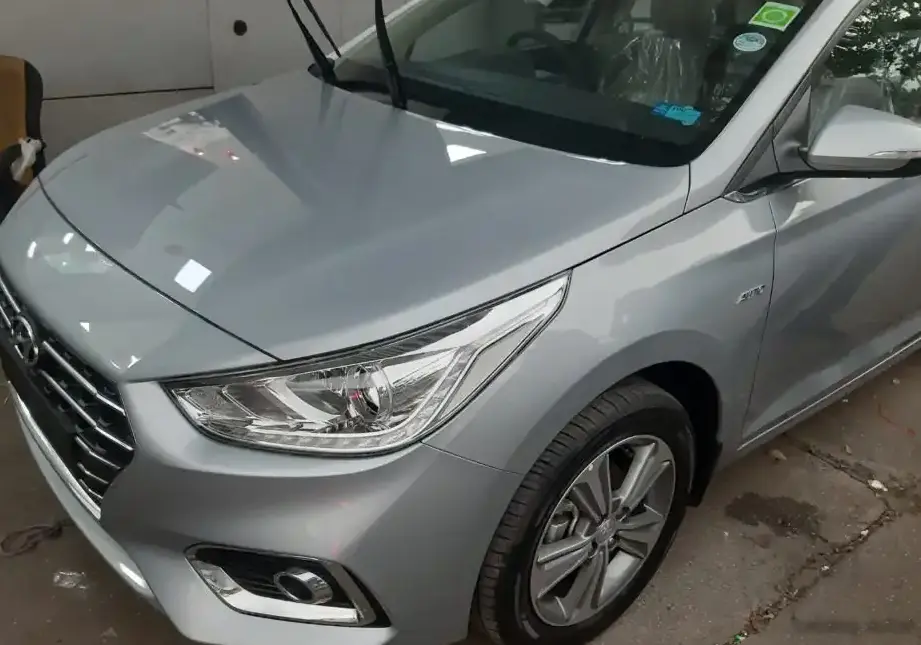
The Hyundai Verna V 1.6 Gamma (123 Hp) Automatic, produced from August 2017 to March 2020, was a key model in Hyundai’s compact sedan lineup, primarily aimed at the burgeoning automotive markets in Asia and other developing regions. This variant occupied a mid-range position within the broader Verna V series, offering a compelling blend of affordability, fuel efficiency, and a comfortable driving experience. As part of the second generation (Verna V), built on the RB platform, it directly competed with established rivals such as the Honda City, Toyota Vios, and Maruti Suzuki Ciaz. The combination of the 1.6 Gamma engine and a six-speed automatic transmission was specifically engineered to appeal to buyers prioritizing convenience and a refined daily commute.
Powertrain & Engine Architecture
At the core of the Verna V 1.6 Gamma Automatic lies the Hyundai Gamma II engine, designated with the code G4FG. This 1.6-liter inline-four cylinder engine employs a multi-point fuel injection system and a dual overhead camshaft (DOHC) valvetrain, enhanced by Hyundai’s proprietary Dual Variable Timing Valve Technology (Dual VTVT). Dual VTVT intelligently adjusts valve timing on both the intake and exhaust valves, optimizing engine efficiency and responsiveness throughout the engine’s operating range. The engine generates 123 horsepower at 6,400 rpm and 151 Nm (111.37 lb-ft) of torque at 4,850 rpm. The Gamma II engine is generally recognized for its smooth operation and respectable fuel economy. The engine is coupled with a six-speed automatic transmission. While lacking the performance focus of a dual-clutch transmission, this unit delivers smooth and predictable gear changes, contributing to the vehicle’s overall comfortable driving character. The transmission’s gear ratios are calibrated for fuel efficiency and everyday usability, rather than maximizing acceleration.
Driving Characteristics
The 1.6 Gamma engine paired with the six-speed automatic transmission provides adequate performance for typical city and highway driving scenarios. Acceleration isn’t particularly rapid, with 0-60 mph times estimated to be in the 11-12 second range. However, the engine delivers sufficient power for overtaking and maintaining comfortable cruising speeds. The automatic transmission generally shifts smoothly, although it can occasionally exhibit some hesitation during more aggressive acceleration attempts. Compared to the manual transmission version of the same engine, the automatic version sacrifices a degree of responsiveness. Higher trim levels, equipped with larger displacement engines (such as the 1.6L Turbo), offered significantly more power and a more engaging driving experience. The automatic transmission’s programming prioritizes fuel economy, resulting in a slightly less dynamic feel compared to the manual transmission option.
Equipment & Trim Levels
The Verna V 1.6 Gamma Automatic typically included standard features such as air conditioning, power windows, power steering, central locking, and an audio system with USB connectivity. Higher sub-trim levels within the Verna V range added features like alloy wheels, a touchscreen infotainment system, rear parking sensors, and a rearview camera. Interior upholstery was generally cloth, with higher trims offering leather seat options. Safety features included dual front airbags and an Anti-lock Braking System (ABS). Optional extras frequently included a sunroof, automatic climate control, and an upgraded audio system.
Chassis & Braking
The Verna V utilizes a front-wheel-drive layout, featuring a McPherson strut suspension in the front and a torsion beam suspension in the rear. This suspension configuration provides a comfortable ride quality, effectively absorbing bumps and road imperfections. The front brakes are disc brakes, while the rear brakes are drum brakes – a cost-saving measure commonly found in this vehicle segment. The steering system is electrically assisted, offering a light and easy steering feel. The car’s chassis is tuned for comfort rather than sporty handling, prioritizing ride quality over sharp cornering performance.
Market Reception & Comparison
The Hyundai Verna V 1.6 Gamma Automatic was generally well-received in its target markets. Reviewers consistently praised its comfortable ride, spacious interior, and overall value proposition. However, some critics noted the engine’s lack of substantial power and the occasional sluggishness of the automatic transmission. Compared to other trims within the Verna V lineup, the 1.6 Gamma Automatic offered a more accessible price point, appealing to budget-conscious buyers. Fuel economy was a significant strength, typically achieving around 30-35 miles per gallon in mixed driving conditions. The higher-specification trims with larger engines were often criticized for their increased price tags, making the 1.6 Gamma Automatic a popular choice for those seeking a balance between features and affordability.
Legacy
The Hyundai Verna V 1.6 Gamma Automatic has proven to be a relatively reliable vehicle in the used car market. The Gamma II engine is generally considered durable, and the six-speed automatic transmission has a solid reputation for dependability. Routine maintenance requirements include regular oil changes, air filter replacements, and spark plug replacements. While some owners have reported minor issues with the infotainment system or certain electrical components, these are typically not major concerns. Today, the Verna V 1.6 Gamma Automatic continues to be a popular choice for buyers seeking an affordable and dependable compact sedan, offering a good combination of features, fuel efficiency, and practicality.