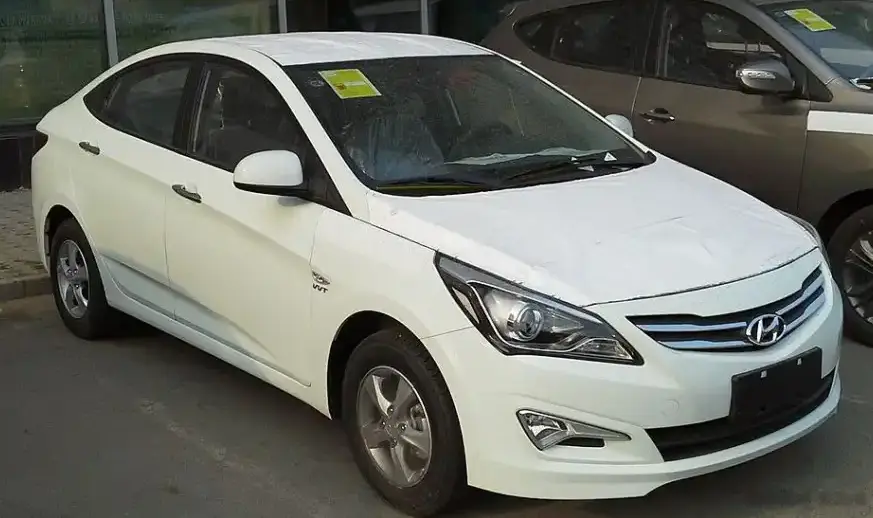
The Hyundai Verna VI 1.5 MPi (115 Hp) IVT represents a significant iteration in Hyundai’s long-running Verna (also known as Accent in some markets) compact sedan line. Introduced in February 2023, this variant is positioned as a fuel-efficient and accessible option within the sixth generation (Verna VI) of the model, primarily targeted towards value-conscious buyers. The Verna VI, built on an updated platform, aims to offer a more refined driving experience and modern features compared to its predecessors, particularly in markets where it serves as a key competitor in the B-segment sedan class. This specific 1.5 MPi IVT trim is a core offering, designed to balance affordability with acceptable performance and comfort.
Technical Specifications
| Brand | Hyundai |
| Model | Verna |
| Generation | Verna VI |
| Type (Engine) | 1.5 MPi (115 Hp) IVT |
| Start of production | February, 2023 |
| Powertrain Architecture | Internal Combustion engine |
| Body type | Sedan |
| Seats | 5 |
| Doors | 4 |
| Fuel consumption (combined) | 5.1 l/100 km (46.1 US mpg, 55.4 UK mpg, 19.6 km/l) |
| Fuel Type | Petrol (Gasoline) |
| Power | 115 Hp @ 6300 rpm |
| Power per litre | 76.8 Hp/l |
| Torque | 144 Nm @ 4500 rpm (106.21 lb.-ft. @ 4500 rpm) |
| Engine layout | Front, Transverse |
| Engine Model/Code | Smartstream / G4FL |
| Engine displacement | 1497 cm3 (91.35 cu. in.) |
| Number of cylinders | 4 |
| Engine configuration | Inline |
| Number of valves per cylinder | 4 |
| Fuel injection system | Multi-port manifold injection |
| Engine aspiration | Naturally aspirated engine |
| Engine oil capacity | 3.8 l (4.02 US qt | 3.34 UK qt) |
| Coolant | 5.6 l (5.92 US qt | 4.93 UK qt) |
| Fuel tank capacity | 45 l (11.89 US gal | 9.9 UK gal) |
| Length | 4535 mm (178.54 in.) |
| Width | 1765 mm (69.49 in.) |
| Height | 1475 mm (58.07 in.) |
| Wheelbase | 2670 mm (105.12 in.) |
| Drivetrain Architecture | The Internal combustion engine (ICE) drives the front wheels of the vehicle. |
| Drive wheel | Front wheel drive |
| Number of gears and type of gearbox | automatic transmission IVT |
| Front suspension | Coil spring, Independent type McPherson |
| Rear suspension | Torsion |
| Front brakes | Disc |
| Rear brakes | Drum |
| Assisting systems | ABS (Anti-lock braking system) |
| Steering type | Steering rack and pinion |
| Power steering | Electric Steering |
| Tires size | 205/55 R16 |
| Wheel rims size | 16 |
Powertrain & Engine Architecture
The heart of the Verna VI 1.5 MPi IVT is Hyundai’s Smartstream G4FL engine, a 1.5-liter naturally aspirated inline-four cylinder gasoline engine. This engine utilizes a multi-port fuel injection (MPI) system, a proven technology that delivers reliable fuel delivery and combustion. The engine produces 115 horsepower at 6,300 rpm and 144 Nm (106.21 lb-ft) of torque at 4,500 rpm. The engine is designed with a focus on efficiency and drivability, rather than outright performance. The ‘Smartstream’ designation indicates Hyundai’s efforts to optimize the engine for fuel economy and reduced emissions. The engine features a timing chain, reducing maintenance compared to timing belts. The engine is paired with Hyundai’s Intelligent Variable Transmission (IVT), which is a continuously variable transmission (CVT) marketed under a different name. The IVT is designed to provide smooth, seamless acceleration and improved fuel efficiency by continuously adjusting the gear ratio to keep the engine operating in its optimal range.
Driving Characteristics
The 1.5 MPi IVT powertrain delivers a comfortable and predictable driving experience. Acceleration is adequate for everyday driving situations, but it’s not particularly sporty. The IVT effectively masks the engine’s limitations, providing a linear power delivery without the noticeable shift shocks of a traditional automatic transmission. However, under hard acceleration, the IVT can exhibit a “rubber band” effect, where engine rpm rises quickly without a corresponding increase in vehicle speed. Compared to potential turbocharged variants or even a manual transmission version (if offered in some markets), this combination prioritizes fuel economy and ease of use over performance. The IVT’s programming is tuned for efficiency, which means it tends to keep engine rpm relatively low during cruising, contributing to quieter operation and better fuel consumption. The steering is light and easy, making it well-suited for urban driving.
Equipment & Trim Levels
The Verna VI 1.5 MPi IVT typically comes standard with a respectable array of features. These generally include air conditioning, power windows and locks, a basic audio system with Bluetooth connectivity, and standard safety equipment like ABS, airbags, and stability control. Higher trim levels add features such as alloy wheels, a touchscreen infotainment system with Apple CarPlay and Android Auto compatibility, a rearview camera, and potentially features like keyless entry and push-button start. Interior upholstery is typically cloth, with higher trims offering leatherette or genuine leather options. The dashboard layout is modern and functional, with a focus on ease of use. Optional extras often include a sunroof, upgraded audio systems, and advanced driver-assistance systems (ADAS) like lane departure warning and automatic emergency braking, depending on the market.
Chassis & Braking
The Verna VI utilizes a front-wheel-drive layout with a McPherson strut independent suspension in the front and a torsion beam rear suspension. This suspension setup is a common configuration for compact sedans, offering a good balance of ride comfort and handling. The front brakes are disc brakes, providing adequate stopping power, while the rear brakes are typically drum brakes in this trim level to keep costs down. The electric power steering provides light and responsive steering feel. The chassis is designed to provide a comfortable ride, absorbing bumps and imperfections in the road surface effectively. Stabilizer bars are included to reduce body roll during cornering, but the overall handling is geared towards comfort rather than sporty dynamics.
Market Reception & Comparison
The Hyundai Verna VI 1.5 MPi IVT has generally been well-received as a practical and affordable compact sedan. Critics have praised its fuel efficiency, comfortable ride, and modern features. However, some have noted its lack of outright performance compared to competitors with turbocharged engines. In terms of fuel economy, it typically achieves around 5.1 l/100 km (46.1 US mpg), which is competitive within its class. Compared to higher-trim Verna models with more powerful engines, the 1.5 MPi IVT offers a more economical option, but at the expense of performance. It competes directly with other B-segment sedans like the Toyota Yaris Sedan, Nissan Versa, and Volkswagen Virtus, offering a compelling value proposition in many markets.
Legacy
The Hyundai Verna VI 1.5 MPi IVT powertrain is expected to be relatively reliable, building on Hyundai’s reputation for producing durable engines and transmissions. The Smartstream engine is designed for longevity, and the IVT, while a CVT, has proven to be generally dependable in other Hyundai and Kia models. As the Verna VI ages, the 1.5 MPi IVT variant is likely to remain a popular choice in the used car market due to its fuel efficiency and affordability. Regular maintenance, including oil changes and IVT fluid checks, will be crucial to ensuring its long-term reliability. The combination of a naturally aspirated engine and a CVT transmission makes it a relatively simple and straightforward powertrain to maintain, potentially reducing long-term ownership costs.