
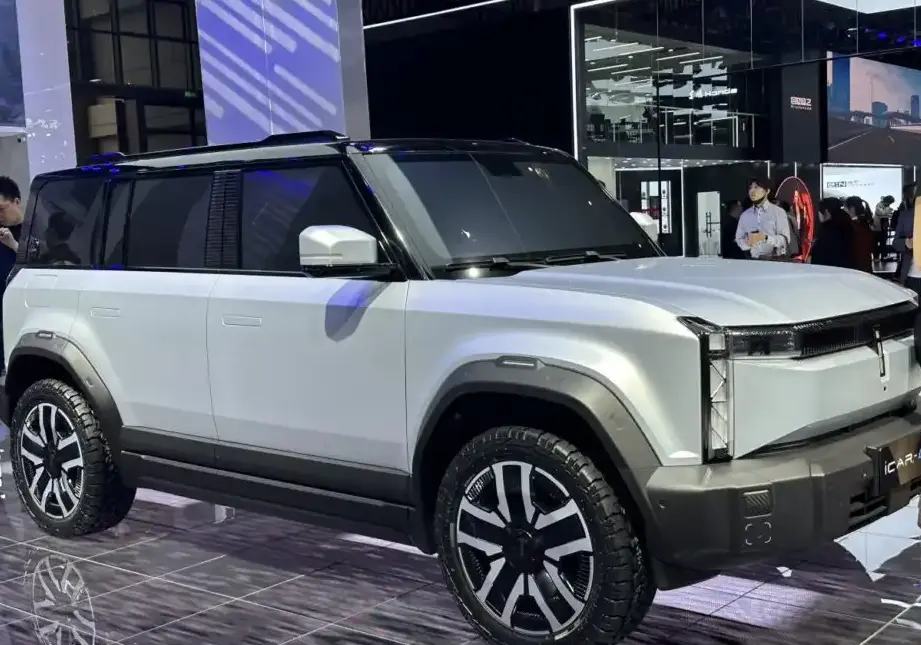
The iCAR 03, launched in February 2024, represents a significant entry into the burgeoning electric SUV market. This all-electric vehicle, positioned as a mid-range offering within the iCAR lineup, features a dual-motor, all-wheel-drive (4WD) configuration powered by a 69.77 kWh battery pack. The 03 is a five-door, five-seat SUV designed to balance range, performance, and practicality for the modern consumer. It utilizes a dedicated BEV (Battery Electric Vehicle) platform, showcasing iCAR’s commitment to electrification.
Technical Specifications
| Brand | iCAR |
| Model | 03 |
| Generation | 03 |
| Type (Engine) | 69.77 kWh (279 Hp) 4WD |
| Start of production | February, 2024 |
| Powertrain Architecture | BEV (Electric Vehicle) |
| Body type | SUV |
| Seats | 5 |
| Doors | 5 |
| Fuel Type | Electricity |
| Acceleration 0 – 100 km/h | 6.5 sec |
| Acceleration 0 – 62 mph | 6.5 sec |
| Acceleration 0 – 60 mph | 6.2 sec |
| Maximum speed | 150 km/h (93.21 mph) |
| Weight-to-power ratio | 6.8 kg/Hp, 147.5 Hp/tonne |
| Weight-to-torque ratio | 4.9 kg/Nm, 203.5 Nm/tonne |
| Gross battery capacity | 69.77 kWh |
| Battery technology | Lithium iron phosphate (LiFePO4) |
| Battery location | Below the floor |
| All-electric range (CLTC) | 501 km (311.31 mi) |
| Average Energy consumption (CLTC) | 16.5 kWh/100 km (26.55 kWh/100 mi) |
| Average Energy consumption (MPGe) | 127 MPGe |
| Average Energy consumption (km/kWh) | 6.1 km/kWh |
| Average Energy consumption (mi/kWh) | 3.8 mi/kWh |
| Electric motor power (Front) | 95 Hp |
| Electric motor Torque (Front) | 165 Nm (121.7 lb.-ft.) |
| Electric motor model/code (Front) | 112AA3 |
| Electric motor location (Front) | Front axle, Transverse |
| Electric motor type (Front) | Synchronous |
| Electric motor power (Rear) | 184 Hp |
| Electric motor Torque (Rear) | 220 Nm (162.26 lb.-ft.) |
| Electric motor model/code (Rear) | 112AA5 |
| Electric motor location (Rear) | Rear axle, Transverse |
| Electric motor type (Rear) | Synchronous |
| System power | 279 Hp |
| System torque | 385 Nm (283.96 lb.-ft.) |
| Kerb Weight | 1892 kg (4171.15 lbs.) |
| Max. weight | 2286 kg (5039.77 lbs.) |
| Max load | 394 kg (868.62 lbs.) |
| Length | 4406 mm (173.46 in.) |
| Width | 1910 mm (75.2 in.) |
| Height | 1715 mm (67.52 in.) |
| Wheelbase | 2715 mm (106.89 in.) |
| Front track | 1626 mm (64.02 in.) |
| Rear track | 1645 mm (64.76 in.) |
| Front overhang | 791 mm (31.14 in.) |
| Rear overhang | 900 mm (35.43 in.) |
| Ride height (ground clearance) | 200 mm (7.87 in.) |
| Minimum turning circle | 11.4 m (37.4 ft.) |
| Approach angle | 28° |
| Departure angle | 32° |
| Climb angle | 28.8° |
| Drivetrain Architecture | One electric motor drives the front wheels, one electric motor drives the rear wheels. |
| Drive wheel | All wheel drive (4×4) |
| Number of gears | 1 |
| Type of gearbox | automatic transmission |
| Front suspension | Independent, type McPherson with coil spring and anti-roll bar |
| Rear suspension | Independent multi-link spring suspension with stabilizer |
| Front brakes | Ventilated discs |
| Rear brakes | Disc |
| Assisting systems | ABS (Anti-lock braking system) |
| Steering type | Steering rack and pinion |
| Power steering | Electric Steering |
| Tires size | 235/60 R18; 225/55 R19 |
| Wheel rims size | 18; 19 |
Powertrain & Engine Architecture
The iCAR 03 utilizes a dual-motor, all-wheel-drive (AWD) powertrain. The front axle is driven by a synchronous electric motor producing 95 horsepower and 165 Nm (121.7 lb.-ft.) of torque, identified by the model code 112AA3. The rear axle features a more powerful synchronous motor, generating 184 horsepower and 220 Nm (162.26 lb.-ft.) of torque (model code 112AA5). Combined, these motors deliver a system output of 279 horsepower and 385 Nm (283.96 lb.-ft.) of torque. The battery pack, employing Lithium Iron Phosphate (LiFePO4) technology, has a gross capacity of 69.77 kWh and is positioned under the vehicle floor to optimize space and lower the center of gravity. The single-speed automatic transmission is inherent to electric vehicle design, providing seamless power delivery. The LiFePO4 chemistry is chosen for its enhanced thermal stability and longer cycle life compared to traditional Nickel Manganese Cobalt (NMC) batteries, though it typically offers slightly lower energy density.
Driving Characteristics
The iCAR 03’s dual-motor AWD system provides brisk acceleration, achieving 0-60 mph in approximately 6.2 seconds. The instant torque delivery characteristic of electric motors results in responsive acceleration in all driving situations. The single-speed transmission ensures smooth, linear power delivery without the gear changes found in internal combustion engine vehicles. While the 0-60 mph time is respectable, it’s not focused on outright performance like some higher-end EVs. Instead, the iCAR 03 prioritizes a balanced driving experience, offering sufficient power for everyday driving and highway merging. The AWD system enhances traction and stability, particularly in inclement weather conditions. The relatively low center of gravity, thanks to the underfloor battery pack, contributes to confident handling.
Equipment & Trim Levels
Specific trim levels and standard equipment for the iCAR 03 vary by market. However, generally, the base model includes features such as a touchscreen infotainment system, digital instrument cluster, automatic climate control, and a suite of advanced driver-assistance systems (ADAS) including automatic emergency braking, lane departure warning, and adaptive cruise control. Interior upholstery typically consists of cloth or synthetic leather, with higher trims offering genuine leather options. Optional extras may include a panoramic sunroof, premium audio system, and upgraded wheels. The interior design emphasizes a minimalist aesthetic with a focus on user-friendly technology.
Chassis & Braking
The iCAR 03 utilizes an independent suspension system at all four wheels. The front suspension employs a McPherson strut design with coil springs and an anti-roll bar, while the rear features a multi-link setup with a stabilizer bar. This configuration aims to provide a comfortable ride and responsive handling. The braking system consists of ventilated discs at the front and solid discs at the rear, coupled with an Anti-lock Braking System (ABS) for enhanced safety. The electric regenerative braking system also contributes to slowing the vehicle and recovering energy back to the battery.
Market Reception & Comparison
The iCAR 03 has been generally well-received as a competitive offering in the electric SUV segment. Critics have praised its spacious interior, comfortable ride, and respectable range. Compared to other EVs in its price range, the iCAR 03 offers a compelling combination of features and performance. Its CLTC range of 501 km (311.31 mi) is competitive, though real-world range may vary depending on driving conditions and habits. The use of LiFePO4 battery chemistry is seen as a positive by some, due to its safety and longevity, while others note its slightly lower energy density compared to NMC batteries.
Legacy
As a relatively new vehicle, the long-term reliability of the iCAR 03 remains to be fully established. However, the use of proven electric powertrain components and the robust LiFePO4 battery technology suggest a promising outlook. The iCAR 03 represents a significant step for the brand in establishing itself as a player in the rapidly growing electric vehicle market. Its success will likely depend on continued innovation in battery technology, charging infrastructure development, and competitive pricing. On the used car market, early models are expected to hold their value reasonably well, particularly as demand for electric vehicles continues to increase.
