
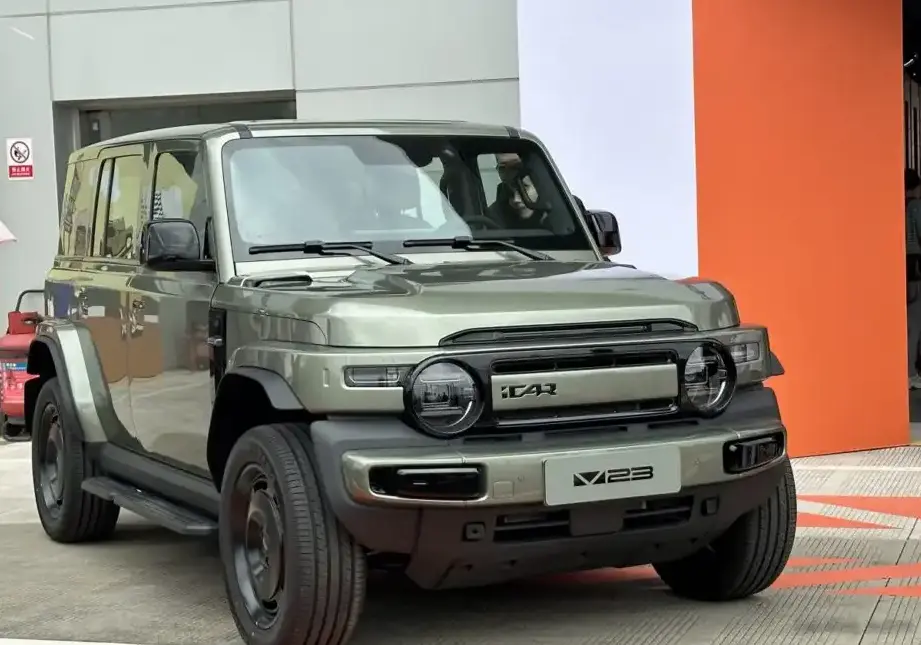
The iCAR V23 81.76 kWh (136 Hp) is a battery electric vehicle (BEV) SUV introduced in March 2025 by iCAR. Positioned as a mainstream electric offering, the V23 represents iCAR’s entry into the growing compact SUV segment. It is built upon a dedicated electric vehicle platform, prioritizing range and practicality for everyday use. This specific variant, with its 81.76 kWh battery pack and single electric motor producing 136 horsepower, serves as the base model within the V23 lineup, offering a balance between affordability and usability. The V23 is primarily targeted towards the Asian market, though expansion to other regions is anticipated.
Technical Specifications
| BrandiCAR | ModelV23 |
| GenerationV23 | Type (Engine)81.76 kWh (136 Hp) |
| Start of productionMarch, 2025 | Powertrain ArchitectureBEV (Electric Vehicle) |
| Body typeSUV | Seats5 |
| Doors5 | Fuel TypeElectricity |
| Maximum speed140 km/h (86.99 mph) | Weight-to-power ratio12.6 kg/Hp, 79.1 Hp/tonne |
| Weight-to-torque ratio9.6 kg/Nm, 104.7 Nm/tonne | Gross battery capacity81.76 kWh |
| Battery technologyLithium nickel manganese cobalt oxides (Li-NMC) | Battery locationBelow the floor |
| All-electric range (CLTC)550 km (341.75 mi) | Average Energy consumption (CLTC)16.6 kWh/100 km (26.72 kWh/100 mi) |
| Average Energy consumption (MPGe)126 MPGe | Average Energy consumption (km/kWh)6 km/kWh |
| Average Energy consumption (mi/kWh)3.7 mi/kWh | Electric motor1 |
| Electric motor power136 Hp | Electric motor Torque180 Nm (132.76 lb.-ft.) |
| Electric motor model/code112AB9 | Electric motor locationRear axle, Transverse |
| Electric motor typeSynchronous | System power136 Hp |
| System torque180 Nm (132.76 lb.-ft.) | Kerb Weight1720 kg (3791.95 lbs.) |
| Max. weight2095 kg (4618.68 lbs.) | Max load375 kg (826.73 lbs.) |
| Trunk (boot) space – minimum234 l (8.26 cu. ft.) | Trunk (boot) space – maximum744 l (26.27 cu. ft.) |
| Length4220 mm (166.14 in.) | Width1915 mm (75.39 in.) |
| Height1845 mm (72.64 in.) | Wheelbase2735 mm (107.68 in.) |
| Front track1613 mm (63.5 in.) | Rear (Back) track1641 mm (64.61 in.) |
| Ride height (ground clearance)200 mm (7.87 in.) | Approach angle42° |
| Departure angle40° | Wading depth600 mm (23.62 in.) |
| Drivetrain ArchitectureOne electric motor drives the rear wheels. | Drive wheelRear wheel drive |
| Number of gears and type of gearbox1 gears, automatic transmission | Front suspensionIndependent, type McPherson with coil spring and anti-roll bar |
| Rear suspensionIndependent multi-link spring suspension with stabilizer | Front brakesVentilated discs |
| Rear brakesDisc | Assisting systemsABS (Anti-lock braking system) |
| Steering typeSteering rack and pinion | Power steeringElectric Steering |
| Tires size255/55 R19 | Wheel rims size19 |
Powertrain & Engine Architecture
The iCAR V23 utilizes a front-motor, rear-wheel-drive configuration. The single electric motor, designated model 112AB9, is a synchronous motor delivering 136 horsepower and 180 Nm (132.76 lb.-ft.) of torque. The motor is transversely mounted on the rear axle. Power is delivered through a single-speed automatic transmission, typical of most BEVs. The 81.76 kWh battery pack employs Lithium Nickel Manganese Cobalt Oxide (Li-NMC) chemistry, chosen for its energy density and balance of performance and cost. The battery is positioned under the vehicle floor, contributing to a lower center of gravity and maximizing interior space. The vehicle supports fast charging capabilities, though specific charging times vary depending on the charging infrastructure used.
Driving Characteristics
The V23 81.76 kWh offers adequate performance for urban and highway driving. While not a performance-oriented vehicle, the instant torque delivery characteristic of electric motors provides brisk acceleration from a standstill. The single-speed transmission ensures smooth and seamless power delivery. Compared to potential higher-output variants of the V23 (if offered), this base model prioritizes efficiency over outright speed. The rear-wheel-drive configuration provides a balanced driving experience, though it may exhibit some understeer at the limits of adhesion. The single gear ratio is optimized for efficiency and everyday usability, rather than maximizing top speed. The vehicle’s regenerative braking system allows for one-pedal driving in certain conditions, further enhancing efficiency and convenience.
Equipment & Trim Levels
The base V23 81.76 kWh trim comes standard with features such as automatic climate control, a touchscreen infotainment system with smartphone integration, and a suite of advanced driver-assistance systems (ADAS) including automatic emergency braking and lane-keeping assist. Interior upholstery is typically cloth, with options for leatherette available as an upgrade. Dashboard configuration is modern and minimalist, emphasizing the vehicle’s technological focus. Standard features also include power windows and locks, keyless entry, and a rearview camera. Optional extras include a panoramic sunroof, upgraded sound system, parking assist features, and heated front seats. The infotainment system supports over-the-air software updates, ensuring the vehicle remains current with the latest features and improvements.
Chassis & Braking
The V23 utilizes an independent suspension system at all four wheels. The front suspension employs a McPherson strut design with coil springs and an anti-roll bar, while the rear features a multi-link setup with a stabilizer bar. This configuration aims to provide a comfortable ride and stable handling. Braking duties are handled by ventilated discs at the front and solid discs at the rear, coupled with an Anti-lock Braking System (ABS). The vehicle’s relatively low weight, thanks to the battery pack’s placement, contributes to efficient braking performance. The electronic stability control (ESC) system further enhances safety by helping to prevent skidding and loss of control. The steering system is an electric power-assisted rack and pinion setup, providing precise and responsive steering feel.
Market Reception & Comparison
Initial reviews of the iCAR V23 have been generally positive, with critics praising its spacious interior, comfortable ride, and competitive range. The 136 horsepower powertrain is considered adequate for most drivers, though some reviewers have noted that it lacks the punch of more powerful electric SUVs. Compared to other trims within the V23 lineup (should they exist), this base model offers the most affordable entry point into the iCAR electric SUV range. Its fuel economy, expressed as 126 MPGe, is competitive with other electric vehicles in its class, such as the Hyundai Kona Electric or the Nissan LEAF. Reliability data is still emerging, given the vehicle’s recent launch, but iCAR has emphasized the durability of its battery technology and powertrain components. Early reports suggest that the battery pack is well-protected and designed for long-term use.
Legacy
The iCAR V23 81.76 kWh (136 Hp) represents a significant step for iCAR in establishing itself as a player in the electric vehicle market. Its success will depend on its ability to deliver on its promises of range, reliability, and affordability. The V23’s long-term reliability will depend on the robustness of its battery management system and the durability of its electric motor. In the used car market, this variant is expected to appeal to buyers seeking an affordable and practical electric SUV with a reasonable range. The V23’s success will likely influence iCAR’s future electric vehicle offerings and its overall brand image, potentially paving the way for more advanced and higher-performance electric models. The vehicle’s relatively simple powertrain, compared to more complex multi-motor setups, may contribute to lower maintenance costs and increased longevity.
