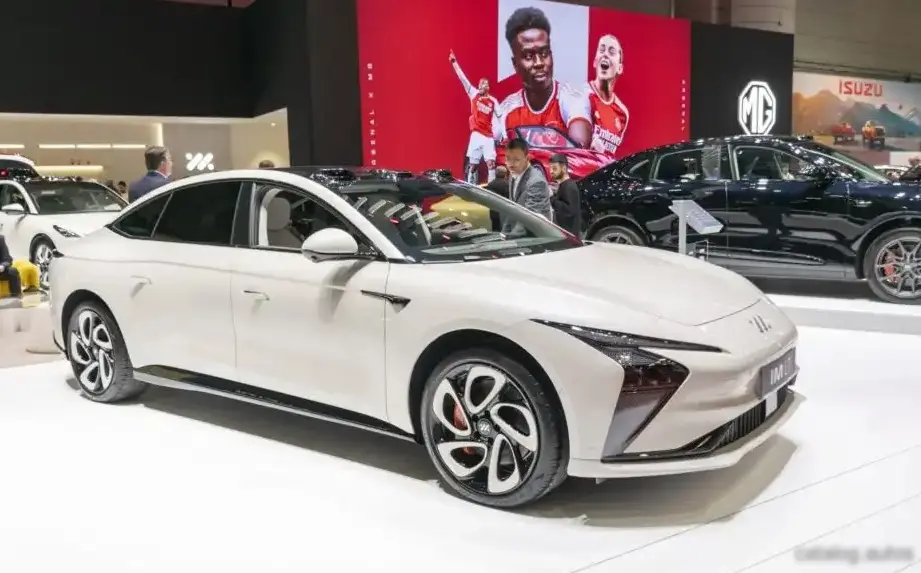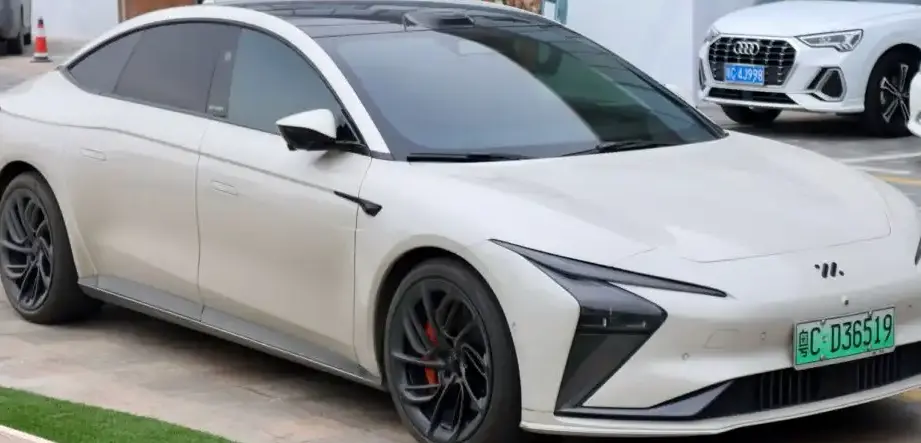
The IM L7 90 kWh, a high-performance all-electric sedan, was produced from 2022 to February 2024. Representing a significant entry into the burgeoning electric vehicle market, the L7 aimed to combine luxury, performance, and advanced technology. Positioned as a flagship model for the IM (Innovative Mobility) brand, it competed with established EV manufacturers like Tesla and emerging Chinese automakers. The L7 is built upon a dedicated electric vehicle platform, prioritizing battery integration and efficient aerodynamics. This particular variant, featuring a 90 kWh battery pack and dual-motor all-wheel drive, represents the top-tier performance offering within the L7 lineup.
Technical Specifications
| Brand | IM |
| Model | L7 |
| Generation | L7 |
| Type (Engine) | 90 kWh (578 Hp) Dual Motor AWD |
| Start of production | 2022 |
| End of production | February, 2024 |
| Powertrain Architecture | BEV (Electric Vehicle) |
| Body type | Sedan |
| Seats | 5 |
| Doors | 4 |
| Fuel Type | Electricity |
| Acceleration 0 – 100 km/h | 3.87 sec |
| Acceleration 0 – 62 mph | 3.87 sec |
| Acceleration 0 – 60 mph | 3.7 sec |
| Maximum speed | 200 km/h (124.27 mph) |
| 100 km/h – 0 | 32.69 m |
| Weight-to-power ratio | 4 kg/Hp, 252.4 Hp/tonne |
| Weight-to-torque ratio | 3.2 kg/Nm, 316.6 Nm/tonne |
| Gross battery capacity | 90 kWh |
| Battery voltage | 400 V |
| Battery technology | Lithium nickel manganese cobalt oxides (Li-NMC) |
| Battery location | Below the floor |
| All-electric range (WLTP) | 500 km (310.69 mi) |
| All-electric range (CLTC) | 615 km (382.14 mi) |
| Average Energy consumption (CLTC) | 15.4 kWh/100 km (24.78 kWh/100 mi) |
| MPGe | 136 |
| km/kWh | 6.5 |
| mi/kWh | 4 |
| Electric motor 1 power | 340 Hp |
| Electric motor 1 Torque | 475 Nm (350.34 lb.-ft.) |
| Electric motor 1 model/code | TZ230XY1301 |
| Electric motor 1 location | Rear axle, Transverse |
| Electric motor 1 type | Synchronous |
| Electric motor 2 power | 238 Hp |
| Electric motor 2 Torque | 250 Nm (184.39 lb.-ft.) |
| Electric motor 2 model/code | TZ180XS0951 |
| Electric motor 2 location | Front axle, Transverse |
| Electric motor 2 type | Synchronous |
| System power | 578 Hp |
| System torque | 725 Nm (534.73 lb.-ft.) |
| Kerb Weight | 2290 kg (5048.59 lbs.) |
| Max. weight | 2735 kg (6029.64 lbs.) |
| Max load | 445 kg (981.06 lbs.) |
| Trunk (boot) space – minimum | 435 l (15.36 cu. ft.) |
| Length | 5098 mm (200.71 in.) |
| Width | 1960 mm (77.17 in.) |
| Height | 1485 mm (58.46 in.) |
| Wheelbase | 3100 mm (122.05 in.) |
| Front track | 1664 mm (65.51 in.) |
| Rear (Back) track | 1660 mm (65.35 in.) |
| Ride height (ground clearance) | 170 mm (6.69 in.) |
| Drag coefficient (Cd) | 0.21 |
| Minimum turning circle | 10.8 m (35.43 ft.) |
| Approach angle | 15° |
| Departure angle | 17° |
| Drivetrain Architecture | One electric motor drives the front wheels, one electric motor drives the rear wheels. |
| Drive wheel | All wheel drive (4×4) |
| Number of gears | 1 |
| Type of gearbox | automatic transmission |
| Front suspension | Coil spring, Double wishbone, Transverse stabilizer |
| Rear suspension | Independent multi-link spring suspension with stabilizer |
| Front brakes | Ventilated discs |
| Rear brakes | Ventilated discs |
| Assisting systems | ABS (Anti-lock braking system), 4-wheel steering (4WS, active rear steering) |
| Steering type | Steering rack and pinion |
| Power steering | Electric Steering |
| Front wheel tires | 245/40 R20 |
| Rear wheel tires | 275/35 R20 |
| Wheel rims size | 20 |
Powertrain & Engine Architecture
The IM L7 90 kWh utilizes a dual-motor, all-wheel drive (AWD) powertrain. Each axle is powered by a synchronous electric motor. The front motor (TZ180XS0951) produces 238 horsepower and 250 Nm (184.39 lb-ft) of torque, while the rear motor (TZ230XY1301) generates 340 horsepower and 475 Nm (350.34 lb-ft) of torque. Combined, the system delivers a total output of 578 horsepower and 725 Nm (534.73 lb-ft) of torque. The 90 kWh battery pack, employing Lithium Nickel Manganese Cobalt Oxide (Li-NMC) chemistry, is positioned under the floor to optimize weight distribution and lower the center of gravity. The battery operates at 400V. The single-speed automatic transmission is inherent to electric vehicle design, providing seamless power delivery. Regenerative braking contributes to increased efficiency and range.
Driving Characteristics
The L7 90 kWh delivers brisk acceleration, achieving 0-60 mph in approximately 3.7 seconds. The dual-motor AWD system provides excellent traction and stability, particularly in adverse weather conditions. The instant torque characteristic of electric motors results in responsive acceleration at any speed. While lacking the multi-gear complexity of internal combustion engines, the single-speed transmission is optimized for both acceleration and cruising efficiency. The low center of gravity, thanks to the underfloor battery pack, contributes to confident handling and reduced body roll. The 4-wheel steering system further enhances agility and maneuverability, especially in urban environments.
Equipment & Trim Levels
The L7 90 kWh was generally well-equipped, featuring a large touchscreen infotainment system, advanced driver-assistance systems (ADAS), and a premium interior. Standard features included leather upholstery, heated and ventilated front seats, a panoramic sunroof, and a high-end audio system. Optional extras included advanced autonomous driving capabilities, upgraded interior trim materials, and a rear-seat entertainment system. The overall interior design emphasized a minimalist aesthetic with a focus on technology integration.
Chassis & Braking
The L7 utilizes a coil spring, double wishbone suspension setup at the front, coupled with an independent multi-link spring suspension at the rear. Both ends incorporate a transverse stabilizer bar to minimize body roll. Ventilated disc brakes are employed on all four wheels, providing ample stopping power. The inclusion of ABS (Anti-lock Braking System) and the 4-wheel steering system contribute to enhanced safety and control. The relatively low curb weight of 2290 kg (5048.59 lbs) aids in braking performance and overall agility.
Market Reception & Comparison
The IM L7 received generally positive reviews, with critics praising its performance, technology, and luxurious interior. Its range of 500 km (310.69 mi) WLTP was competitive within the EV segment. Compared to rivals like the Tesla Model S, the L7 offered a comparable level of performance and technology at a potentially lower price point. However, the L7’s brand recognition was lower than that of established EV manufacturers. The energy consumption of 15.4 kWh/100 km (24.78 kWh/100 mi) was considered reasonable for a vehicle of its size and performance.
Legacy
Although production was relatively short-lived, the IM L7 90 kWh represents an important step in the development of the Chinese EV market. The powertrain, while sophisticated, is typical of modern EV designs and is expected to offer long-term reliability, provided the battery management system functions effectively. As a used vehicle, the L7’s value will likely be influenced by battery health and the availability of charging infrastructure. The L7’s focus on technology and performance helped to establish IM as a contender in the competitive EV landscape, paving the way for future models.