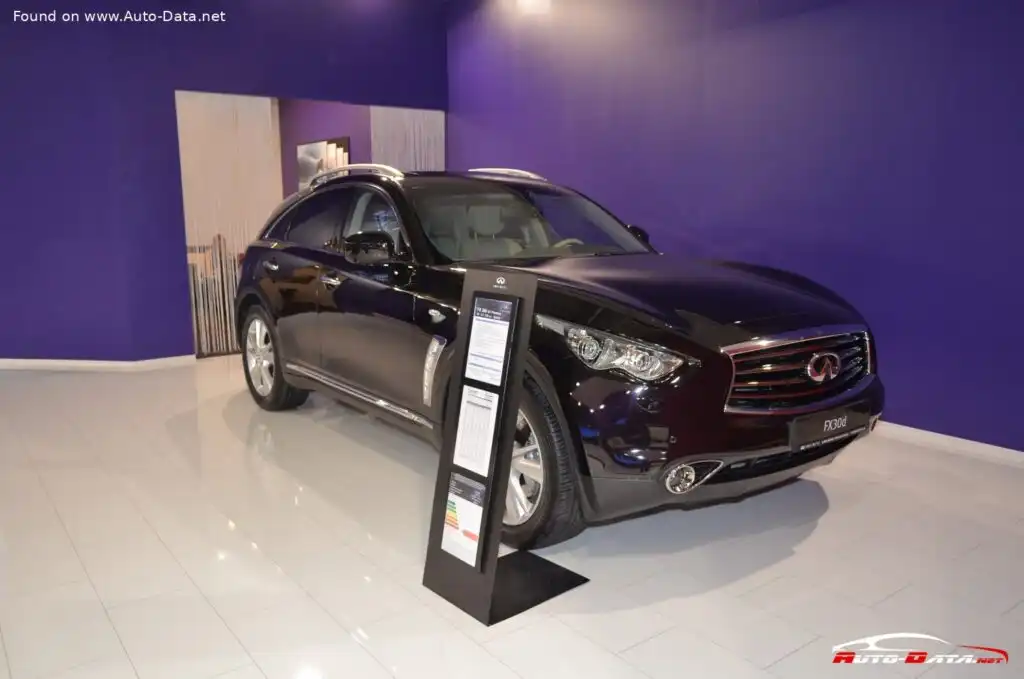
The Infiniti FX II 30d, produced between 2010 and 2012, represented a diesel-powered offering within the second generation of Infiniti’s FX series crossover vehicles. Positioned as a mid-range trim, it aimed to provide a balance of performance and fuel efficiency for the European and select international markets. The FX II, built on the D platform shared with the Nissan 370Z and other Nissan/Infiniti models, sought to blend sporty handling with the practicality of a crossover SUV. This particular 30d variant distinguished itself with a 3.0-liter V6 turbodiesel engine paired with a seven-speed automatic transmission and Infiniti’s ATTESA E-TS all-wheel-drive system.
Technical Specifications
| Brand | Infiniti |
| Model | FX |
| Generation | FX II |
| Type (Engine) | 30d (238 Hp) ATTESA E-TS AWD Automatic |
| Start of production | 2010 |
| End of production | 2012 |
| Powertrain Architecture | Internal Combustion engine |
| Body type | Crossover |
| Seats | 5 |
| Doors | 5 |
| Fuel consumption (economy) – urban (NEDC) | 11.2 l/100 km (21 US mpg, 25.2 UK mpg, 8.9 km/l) |
| Fuel consumption (economy) – extra urban (NEDC) | 7.8 l/100 km (30.2 US mpg, 36.2 UK mpg, 12.8 km/l) |
| Fuel consumption (economy) – combined (NEDC) | 9 l/100 km (26.1 US mpg, 31.4 UK mpg, 11.1 km/l) |
| CO2 emissions (NEDC) | 238 g/km |
| Fuel Type | Diesel |
| Acceleration 0 – 100 km/h | 8.3 sec |
| Acceleration 0 – 62 mph | 8.3 sec |
| Acceleration 0 – 60 mph | 7.9 sec |
| Maximum speed | 212 km/h (131.73 mph) |
| Emission standard | Euro 5 |
| Weight-to-power ratio | 9 kg/Hp, 110.7 Hp/tonne |
| Weight-to-torque ratio | 3.9 kg/Nm, 255.8 Nm/tonne |
| Power | 238 Hp @ 3750 rpm |
| Power per litre | 79.5 Hp/l |
| Torque | 550 Nm @ 1750 rpm (405.66 lb.-ft. @ 1750 rpm) |
| Engine layout | Front, Longitudinal |
| Engine Model/Code | V9X |
| Engine displacement | 2993 cm3 (182.64 cu. in.) |
| Number of cylinders | 6 |
| Engine configuration | V-engine |
| Cylinder Bore | 84 mm (3.31 in.) |
| Piston Stroke | 90 mm (3.54 in.) |
| Number of valves per cylinder | 4 |
| Fuel injection system | Diesel Commonrail |
| Engine aspiration | Turbocharger, Intercooler |
| Valvetrain | DOHC |
| Engine oil capacity | 5.3 l (5.6 US qt | 4.66 UK qt) |
| Coolant | 13 l (13.74 US qt | 11.44 UK qt) |
| Kerb Weight | 2150 kg (4739.94 lbs.) |
| Max. weight | 2520 kg (5555.65 lbs.) |
| Max load | 370 kg (815.71 lbs.) |
| Trunk (boot) space – minimum | 410 l (14.48 cu. ft.) |
| Trunk (boot) space – maximum | 1305 l (46.09 cu. ft.) |
| Fuel tank capacity | 90 l (23.78 US gal | 19.8 UK gal) |
| Length | 4865 mm (191.54 in.) |
| Width | 1925 mm (75.79 in.) |
| Width including mirrors | 2134 mm (84.02 in.) |
| Height | 1680 mm (66.14 in.) |
| Wheelbase | 2885 mm (113.58 in.) |
| Minimum turning circle | 11.2 m (36.75 ft.) |
| Drivetrain Architecture | All wheel drive (4×4) |
| Number of gears and type of gearbox | 7 gears, automatic transmission |
| Front suspension | Double wishbone, Transverse stabilizer |
| Rear suspension | Independent multi-link spring suspension with stabilizer |
| Front brakes | Ventilated discs, 355 mm |
| Rear brakes | Ventilated discs, 350 mm |
| Assisting systems | ABS (Anti-lock braking system) |
| Steering type | Steering rack and pinion |
| Power steering | Hydraulic Steering |
| Tires size | 265/50 R20 |
| Wheel rims size | 8J x 20 |
INTRODUCTION
The Infiniti FX II 30d, launched in 2010, was a key component in Infiniti’s strategy to expand its presence in the European market with a diesel-powered luxury crossover. It slotted into the FX lineup alongside the 370 GT (gasoline) model, offering a more fuel-efficient alternative without sacrificing the brand’s emphasis on performance and style. The FX II, internally designated as the A33 platform, aimed to deliver a unique driving experience blending the agility of a sports car with the versatility of an SUV. The 30d variant specifically targeted buyers seeking lower running costs and increased torque for towing or navigating challenging road conditions.
Powertrain & Engine Architecture
At the heart of the FX II 30d lies the V9X engine, a 3.0-liter V6 turbodiesel. This engine, a product of Nissan/Infiniti’s diesel development program, utilizes a common rail direct injection system to deliver fuel directly into the cylinders at extremely high pressure. This enhances combustion efficiency and reduces emissions. The engine boasts a DOHC (Double Overhead Camshaft) valvetrain, optimizing airflow for improved power output. A variable geometry turbocharger with an intercooler further enhances performance by forcing more air into the engine. The V9X produces 238 horsepower at 3750 rpm and a substantial 550 Nm (405.66 lb-ft) of torque at 1750 rpm. This torque output is a significant advantage over the gasoline-powered 370 GT. The engine is longitudinally mounted, contributing to a balanced weight distribution. Paired with the V9X is a seven-speed automatic transmission, providing smooth and responsive gear changes. This transmission was chosen for its ability to handle the engine’s torque and provide a comfortable driving experience.
Driving Characteristics
The FX II 30d’s driving experience is characterized by its strong low-end torque and relatively relaxed cruising demeanor. The seven-speed automatic transmission is well-tuned, offering quick shifts and keeping the engine within its optimal power band. While not as overtly sporty as the 370 GT, the 30d delivers respectable acceleration, achieving 0-60 mph in approximately 7.9 seconds. The ATTESA E-TS all-wheel-drive system plays a crucial role in handling, providing excellent traction in various conditions. The system normally operates in rear-wheel drive, enhancing driving engagement, but seamlessly shifts power to the front wheels when needed to maintain stability. Compared to the 370 GT, the 30d feels heavier due to the diesel engine and associated components, but the added torque makes it more capable for towing and provides effortless overtaking power. The gear ratios are optimized for fuel efficiency and relaxed highway cruising.
Equipment & Trim Levels
The FX II 30d typically came well-equipped, reflecting its positioning as a luxury crossover. Standard features included leather upholstery, power-adjustable front seats, a premium audio system, automatic climate control, and a navigation system. Exterior features included alloy wheels, xenon headlights, and a power liftgate. Optional extras included a panoramic sunroof, adaptive cruise control, and a rear-seat entertainment system. Interior trim levels varied, with options for different wood or metallic accents. The overall interior design emphasized a blend of luxury and sportiness, with a driver-focused cockpit and high-quality materials.
Chassis & Braking
The FX II 30d features a robust chassis designed to handle the vehicle’s weight and provide a comfortable ride. The front suspension utilizes a double wishbone setup with a transverse stabilizer bar, while the rear suspension employs an independent multi-link spring suspension, also with a stabilizer bar. This configuration provides a good balance between handling and ride comfort. Braking duties are handled by ventilated discs on all four wheels, measuring 355mm at the front and 350mm at the rear. An Anti-lock Braking System (ABS) is standard, enhancing safety and control during hard braking. The steering is a rack-and-pinion system with hydraulic power assistance, providing precise and responsive steering feel.
Market Reception & Comparison
The Infiniti FX II 30d was generally well-received by automotive critics, who praised its strong diesel engine, comfortable ride, and luxurious interior. However, some reviewers noted that the fuel economy, while better than the gasoline-powered 370 GT, wasn’t class-leading. Compared to competitors like the BMW X5 and Audi Q7, the FX II 30d offered a more distinctive styling and a slightly more affordable price point. The 30d’s torque advantage over the 370 GT made it a more practical choice for buyers who frequently tow or drive in challenging conditions. Reliability reports suggest that the V9X diesel engine is generally robust, but like all diesel engines, it requires regular maintenance and careful fuel quality control.
Legacy
The Infiniti FX II 30d remains a relatively uncommon vehicle on the used car market, particularly in North America where Infiniti’s diesel offerings were limited. The V9X engine, while generally reliable, can be expensive to repair if major issues arise. However, well-maintained examples offer a unique combination of luxury, performance, and fuel efficiency. The FX II 30d represents a significant chapter in Infiniti’s attempt to establish itself as a serious player in the European luxury crossover segment, showcasing the brand’s willingness to embrace diesel technology to meet the demands of the market.