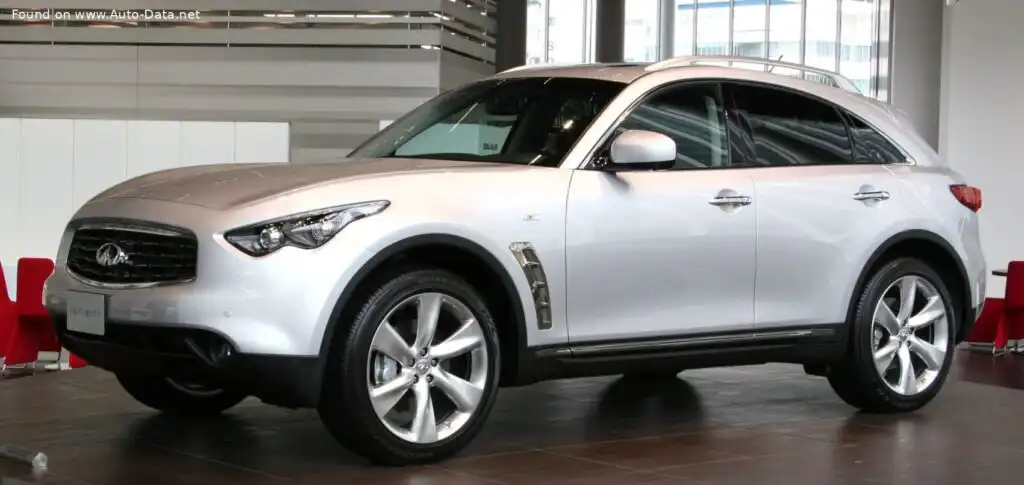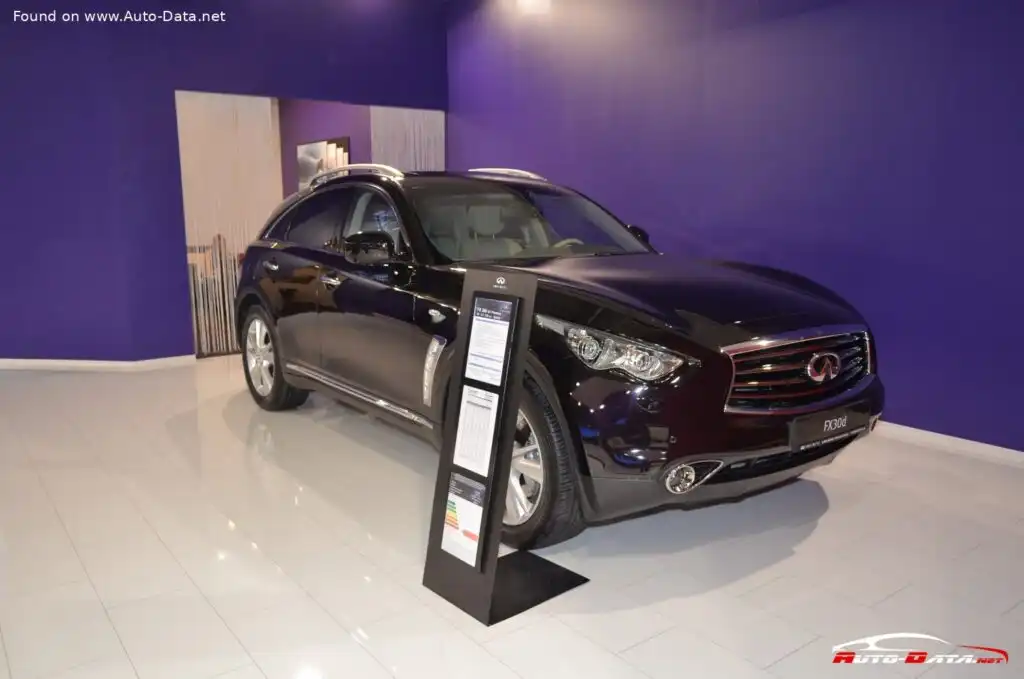
The Infiniti FX50, specifically the second-generation facelift model produced from 2011 to 2013, represents a significant offering in the luxury crossover segment. Positioned as the performance-oriented variant of the FX lineup, it featured a naturally aspirated 5.0-liter V8 engine paired exclusively with a seven-speed automatic transmission and Infiniti’s ATTESA E-TS all-wheel-drive system. This combination aimed to deliver a blend of luxury, performance, and all-weather capability, appealing to buyers seeking a more engaging driving experience than typically found in the class. The FX50 sat at the top of the FX range, offering a substantial power upgrade over the V6 models and a more sophisticated drivetrain than the base configurations.
Technical Specifications
| Brand | Infiniti |
| Model | FX |
| Generation | FX II (facelift 2011) |
| Type (Engine) | 50 V8 (390 Hp) ATTESA E-TS AWD Automatic |
| Start of production | 2011 |
| End of production | 2013 |
| Powertrain Architecture | Internal Combustion engine |
| Body type | Crossover |
| Seats | 5 |
| Doors | 5 |
| Fuel consumption (economy) – urban (NEDC) | 18.9 l/100 km (12.4 US mpg, 14.9 UK mpg, 5.3 km/l) |
| Fuel consumption (economy) – extra urban (NEDC) | 9.8 l/100 km (24 US mpg, 28.8 UK mpg, 10.2 km/l) |
| Fuel consumption (economy) – combined (NEDC) | 13.1 l/100 km (18 US mpg, 21.6 UK mpg, 7.6 km/l) |
| CO2 emissions (NEDC) | 307 g/km |
| Fuel Type | Petrol (Gasoline) |
| Acceleration 0 – 100 km/h | 5.8 sec |
| Acceleration 0 – 62 mph | 5.8 sec |
| Acceleration 0 – 60 mph | 5.5 sec |
| Maximum speed | 250 km/h (155.34 mph) – Electronically limited |
| Emission standard | Euro 5 |
| Weight-to-power ratio | 5.3 kg/Hp, 188.7 Hp/tonne |
| Weight-to-torque ratio | 4.1 kg/Nm, 241.9 Nm/tonne |
| Power | 390 Hp @ 6500 rpm |
| Power per litre | 77.6 Hp/l |
| Torque | 500 Nm @ 4400 rpm (368.78 lb.-ft. @ 4400 rpm) |
| Maximum engine speed | 6800 rpm |
| Engine layout | Front, Longitudinal |
| Engine Model/Code | VK50VE |
| Engine displacement | 5026 cm3 (306.71 cu. in.) |
| Number of cylinders | 8 |
| Engine configuration | V-engine |
| Cylinder Bore | 95.5 mm (3.76 in.) |
| Piston Stroke | 87.7 mm (3.45 in.) |
| Compression ratio | 10.6:1 |
| Number of valves per cylinder | 4 |
| Fuel injection system | Multi-port manifold injection |
| Engine aspiration | Naturally aspirated engine |
| Valvetrain | DOHC, VVEL |
| Engine oil capacity | 6.7 l (7.08 US qt | 5.9 UK qt) |
| Coolant | 11 l (11.62 US qt | 9.68 UK qt) |
| Kerb Weight | 2067 kg (4556.95 lbs.) |
| Max. weight | 2615 kg (5765.09 lbs.) |
| Max load | 548 kg (1208.13 lbs.) |
| Trunk (boot) space – minimum | 702 l (24.79 cu. ft.) |
| Trunk (boot) space – maximum | 1756 l (62.01 cu. ft.) |
| Fuel tank capacity | 90 l (23.78 US gal | 19.8 UK gal) |
| Max. roof load | 45 kg (99.21 lbs.) |
| Permitted trailer load with brakes (12%) | 1588 kg (3500.94 lbs.) |
| Permitted trailer load without brakes | 454 kg (1000.9 lbs.) |
| Permitted towbar download | 159 kg (350.53 lbs.) |
| Length | 4860 mm (191.34 in.) |
| Width | 1925 mm (75.79 in.) |
| Height | 1680 mm (66.14 in.) |
| Wheelbase | 2885 mm (113.58 in.) |
| Front track | 1635 mm (64.37 in.) |
| Rear (Back) track | 1640 mm (64.57 in.) |
| Ride height (ground clearance) | 187 mm (7.36 in.) |
| Drag coefficient (Cd) | 0.36 |
| Minimum turning circle (turning diameter) | 11.2 m (36.75 ft.) |
| Approach angle | 28.8° |
| Departure angle | 20.9° |
| Drivetrain Architecture | The Internal combustion engine (ICE) drives the rear wheels permanently, and the front wheels are driven through an electrically or mechanically operated clutch if necessary. |
| Drive wheel | All wheel drive (4×4) |
| Number of gears and type of gearbox | 7 gears, automatic transmission |
| Front suspension | Double wishbone, Transverse stabilizer |
| Rear suspension | Independent multi-link spring suspension with stabilizer |
| Front brakes | Ventilated discs, 355×33 mm |
| Rear brakes | Ventilated discs, 350×20 mm |
| Assisting systems | ABS (Anti-lock braking system) |
| Steering type | Steering rack and pinion |
| Power steering | Hydraulic Steering |
| Tires size | 265/45 R21 |
| Wheel rims size | 9.5J x 21 |
Powertrain & Engine Architecture
The heart of the FX50 is the VK50VE 5.0-liter V8 engine. This engine is a naturally aspirated powerplant featuring multi-port fuel injection and a double overhead camshaft (DOHC) valvetrain with Variable Valve Event and Lift (VVEL) technology. VVEL continuously adjusts the timing and lift of both intake and exhaust valves, optimizing engine performance and efficiency across a wide range of operating conditions. The engine produces 390 horsepower at 6500 rpm and 500 Nm (368 lb-ft) of torque at 4400 rpm. The seven-speed automatic transmission, sourced from Aisin, provides smooth and relatively quick shifts. It’s designed to handle the engine’s substantial torque output and contribute to both performance and fuel efficiency. The ATTESA E-TS all-wheel-drive system is a key component, proactively distributing torque between the front and rear axles based on factors like throttle position, steering angle, and wheel speed, enhancing stability and traction.
Driving Characteristics
The FX50 delivers a noticeably more spirited driving experience compared to the V6-powered models. Acceleration is brisk, with 0-60 mph times consistently in the mid-5-second range. The seven-speed automatic transmission generally provides smooth shifts, although it can occasionally feel hesitant during quick downshifts. The ATTESA E-TS system provides excellent grip in various conditions, inspiring confidence during cornering. However, the FX50’s weight (over 4,500 lbs) is noticeable, and it doesn’t feel as agile as some lighter crossovers. The ride quality is generally comfortable, but the firm suspension tuning can transmit some road imperfections to the cabin.
Equipment & Trim Levels
The FX50 typically came well-equipped with standard features including leather upholstery, heated and ventilated front seats, a power-adjustable steering wheel, a premium audio system, and a navigation system. Common options included a rear-seat entertainment system, adaptive cruise control, and a panoramic sunroof. Interior trim options generally consisted of wood or aluminum accents. The FX50 was often offered with unique exterior styling cues, such as specific wheel designs and chrome accents, to differentiate it from the lower trims.
Chassis & Braking
The FX50 utilizes a double wishbone suspension setup at the front and an independent multi-link suspension at the rear, both incorporating a transverse stabilizer bar to reduce body roll. The braking system consists of ventilated discs on all four wheels, with larger front rotors (355mm) compared to the V6 models. Anti-lock brakes (ABS) are standard. The suspension tuning is geared towards a balance of comfort and handling, prioritizing stability over outright sportiness.
Market Reception & Comparison
Critics generally praised the FX50 for its powerful engine, luxurious interior, and capable all-wheel-drive system. However, its fuel economy was often cited as a drawback, with combined fuel consumption figures around 18 mpg. Compared to the FX35 (V6 model), the FX50 offered a significant performance advantage but came at a higher price point. Against competitors like the BMW X5 and Porsche Cayenne, the FX50 offered a compelling value proposition, providing similar levels of luxury and performance at a lower cost.
Legacy
The Infiniti FX50 (2011-2013) has established a reputation as a reliable and relatively durable luxury crossover. The VK50VE engine, while known for its power, is generally considered robust when properly maintained. Common maintenance items include regular oil changes and inspections of the cooling system. The seven-speed automatic transmission has also proven to be fairly reliable. On the used car market, the FX50 remains a popular choice for buyers seeking a performance-oriented luxury crossover at a reasonable price. However, potential buyers should be aware of the higher fuel costs and the potential for age-related maintenance issues.