
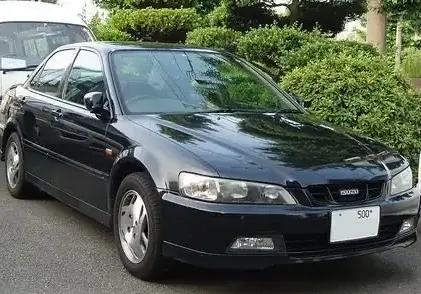
The Isuzu Aska IV (GS-5) 2.0 i 16V Automatic, produced between 1998 and 2002, represented a significant offering in Isuzu’s lineup during that period. Positioned as a mid-range trim within the fourth generation Aska (GS-5), this variant aimed to balance performance with convenience, targeting buyers who preferred the ease of an automatic transmission. The Aska, while not widely known in North America, was a popular choice in Asian markets, particularly in Japan and parts of Southeast Asia, competing with established sedans like the Toyota Corolla and Honda Civic. It was a rebadged version of the Honda Accord, a result of the close partnership between Isuzu and Honda at the time.
Technical Specifications
| Brand | Isuzu |
| Model | Aska |
| Generation | Aska IV (GS-5) |
| Type | 2.0 i 16V (150 Hp) Automatic |
| Start of production | 1998 |
| End of production | 2002 |
| Powertrain Architecture | Internal Combustion engine |
| Body type | Sedan |
| Seats | 5 |
| Doors | 4 |
| Fuel Type | Petrol (Gasoline) |
| Power | 150 Hp @ 6000 rpm |
| Power per litre | 75.1 Hp/l |
| Torque | 186 Nm @ 5000 rpm / 137.19 lb.-ft. @ 5000 rpm |
| Engine layout | Front, Transverse |
| Engine Model/Code | 6HEITC |
| Engine displacement | 1997 cm3 / 121.86 cu. in. |
| Number of cylinders | 4 |
| Engine configuration | Inline |
| Cylinder Bore | 85 mm / 3.35 in. |
| Piston Stroke | 88 mm / 3.46 in. |
| Compression ratio | 9:1 |
| Number of valves per cylinder | 4 |
| Fuel injection system | Multi-port manifold injection |
| Engine aspiration | Naturally aspirated engine |
| Valvetrain | OHC |
| Max. weight | 1545 kg / 3406.14 lbs |
| Trunk (boot) space – minimum | 446 l / 15.75 cu. ft |
| Fuel tank capacity | 60 l / 15.85 US gal | 13.2 UK gal |
| Length | 4635 mm / 182.48 in. |
| Width | 1695 mm / 66.73 in. |
| Height | 1270 mm / 50 in. |
| Wheelbase | 2665 mm / 104.92 in. |
| Front track | 1480 mm / 58.27 in. |
| Rear (Back) track | 1480 mm / 58.27 in. |
| Drivetrain Architecture | The Internal combustion engine (ICE) drives the front wheels of the vehicle. |
| Drive wheel | Front wheel drive |
| Number of gears and type of gearbox | 4 gears, automatic transmission |
| Front suspension | Coil spring |
| Rear suspension | Coil spring |
| Front brakes | Ventilated discs |
| Rear brakes | Disc |
| Assisting systems | ABS (Anti-lock braking system) |
| Steering type | Steering rack and pinion |
| Power steering | Hydraulic Steering |
| Tires size | 195/60 R15 |
| Wheel rims size | 15 |
Powertrain & Engine Architecture
The heart of the Aska 2.0 i 16V Automatic is the 6HEITC engine, a 1.997-liter inline-four cylinder powerplant. This engine utilizes a single overhead camshaft (OHC) valvetrain with four valves per cylinder, contributing to its relatively high output for its displacement. The engine employs multi-port fuel injection, a common technology in the late 1990s, ensuring efficient fuel delivery and optimized combustion. The 9:1 compression ratio was a standard figure for naturally aspirated engines of the era, balancing performance and fuel economy. Paired with this engine is a four-speed automatic transmission, designed for smooth and convenient operation. This transmission, while not offering the responsiveness of a manual gearbox, provided a comfortable driving experience, particularly in urban environments.
Driving Characteristics
The 150 horsepower and 186 Nm (137.19 lb-ft) of torque delivered by the 2.0-liter engine, when channeled through the four-speed automatic, resulted in adequate, but not exhilarating, performance. Acceleration was respectable for everyday driving, but it lacked the punch of the higher-output variants or those equipped with a manual transmission. The automatic transmission’s gear ratios were tuned for fuel efficiency and smooth transitions, rather than aggressive acceleration. Compared to a manual version, the automatic offered less driver control and a slightly diminished sense of connection to the engine. However, it provided a more relaxed driving experience, especially in stop-and-go traffic. The front-wheel-drive configuration contributed to predictable handling, but also limited the car’s potential for spirited driving.
Equipment & Trim Levels
The 2.0 i 16V Automatic trim typically included features such as power windows, power door locks, and air conditioning as standard equipment. Interior upholstery was generally cloth, with options for upgraded materials available. The dashboard layout was functional and straightforward, prioritizing ease of use. Optional extras could include a CD player, alloy wheels, and a sunroof. The Aska aimed for a comfortable and well-equipped interior, though it didn’t necessarily compete with luxury brands in terms of materials or features.
Chassis & Braking
The Aska IV (GS-5) utilized a coil spring suspension system at both the front and rear, providing a comfortable ride quality. The front suspension featured independent coil springs, while the rear employed a semi-independent setup. Braking duties were handled by ventilated discs at the front and solid discs at the rear, providing adequate stopping power for the vehicle’s weight. An Anti-lock Braking System (ABS) was included as a standard safety feature, enhancing braking performance and stability, particularly on slippery surfaces. The steering system was a rack and pinion setup with hydraulic power assistance, offering precise and responsive steering feel.
Market Reception & Comparison
The Isuzu Aska 2.0 i 16V Automatic received generally positive reviews for its comfortable ride, reliable engine, and practical interior. Critics noted that the automatic transmission slightly dulled the engine’s performance compared to the manual version. Fuel economy was considered average for its class. Compared to other trims in the Aska lineup, the 2.0-liter automatic offered a good balance between performance and convenience, appealing to a broader range of buyers. The higher-output variants provided more exhilarating performance, while the lower-displacement models prioritized fuel efficiency. The Aska’s main competitors, such as the Toyota Corolla and Honda Civic, offered similar levels of refinement and reliability.
Legacy
The Isuzu Aska IV (GS-5) 2.0 i 16V Automatic, while not a high-performance icon, has proven to be a relatively reliable vehicle over the long term. The 6HEITC engine is known for its durability, and the four-speed automatic transmission, while not the most advanced, has generally held up well. In the used car market, these Askas are often sought after for their affordability and practicality. Maintenance costs are generally reasonable, and parts availability, while potentially becoming more challenging over time, is still adequate. The Aska represents a solid, if somewhat understated, offering from Isuzu during a period of close collaboration with Honda, and remains a viable option for buyers seeking a dependable and economical used sedan.
